
A Practical Guide to Expansion Tank Requirements for Water Heaters in Colorado
## Do Colorado Homes Require an Expansion Tank on a Water Heater?
Understanding expansion tank requirements for water heaters in Colorado is something every homeowner replacing or installing a water heater needs to get right. The short answer: if your home has a closed plumbing system — created by a backflow preventer, pressure reducing valve (PRV), or check valve — Colorado code requires a thermal expansion tank or equivalent device on any tank-style water heater.
Here is a quick summary of when an expansion tank is required in Colorado:
- Closed plumbing system present? Yes — expansion tank required by code - Backflow preventer on water main? Yes — creates a closed system, expansion tank required - PRV (pressure reducing valve) installed? Yes — expansion tank required - Check valve on water supply line? Yes — expansion tank required - Open plumbing system (no backflow devices)? Expansion tank not mandated by code, but still recommended - Tankless water heater? Generally exempt from expansion tank requirements - Denver jurisdiction? Yes — expansion tanks required on all tank-style water heaters - Boulder jurisdiction? Yes — expansion tanks required by local law for closed systems
When water heats up inside a tank, it expands. In an open system, that extra water pressure pushes harmlessly back toward the municipal supply line. But when a backflow device blocks that path, the pressure has nowhere to go — and that's where serious damage can happen. A 50-gallon water heater, for example, expands to roughly 52 gallons when heated to 120°F. Without an expansion tank to absorb that extra volume, pressure spikes can strain your pipes, wear out your relief valve, and shorten the life of your water heater significantly.
Colorado adopted the 2021 International Residential Code (IRC) with amendments effective April 12, 2024. Under IRC Sections P2903.4, P2903.4.1, and P2903.4.2, thermal expansion control is mandatory whenever a backflow preventer, check valve, or PRV creates a closed system. Many Colorado cities — including Denver — have gone further by requiring expansion tanks on all tank-style water heater installations regardless of system type.
What is a Closed Plumbing System and How Does It Affect Your Home?
To understand why we install expansion tanks, we first need to look at how water behaves inside your pipes. Historically, most municipal water systems in Colorado were "open." If the water inside your home's water heater expanded, it simply flowed backward out of your house and back into the municipal water supply.
However, modern plumbing standards prioritize protecting public drinking water. To prevent contaminated water from your home from siphoning back into the city's clean water supply, water utilities require backflow preventers, pressure reducing valves (PRVs), or check valves.
Once any of these safety devices are installed on your main water line, your home’s plumbing becomes a closed plumbing system. The water can enter your home, but it cannot escape back into the city main. When you begin to research How to Choose the Right Water Heater, understanding whether you have an open or closed system is the crucial first step.
Identifying a Closed System in Colorado Homes
How do you know if your home has a closed system? You can usually find out with a quick visual inspection near your main water shutoff valve, which is typically located in your basement, crawlspace, or utility closet where the water line enters the house.
Look for the following devices:
1. Pressure Reducing Valve (PRV): This is a brass, bell-shaped valve with a screw on top. It regulates the high pressure coming from the municipal water supply down to a safe level for your home's pipes. 2. Backflow Prevention Device or Dual Check Valve: This is typically a brass fitting located right after your water meter. It contains internal check valves that only allow water to flow in one direction.
If you spot either of these devices, you have a closed plumbing system. Without a thermal expansion tank, your home is highly vulnerable to the structural stresses caused by daily heating cycles. If you suspect your system is closed but don't see an expansion tank, you may already be experiencing some of the warning signs detailed in our Water Heater Problems Thornton Guide.
The Physics of Thermal Expansion
Water is virtually incompressible. When you heat cold water, the molecules move faster and spread out, causing the overall volume to increase.
To visualize this, consider a standard 50-gallon water heater. When cold municipal water enters the tank and is heated to a standard domestic temperature of 120°F, it expands in volume to approximately 52 gallons.
In a closed system, those extra 2 gallons of water volume have nowhere to go. Because the water cannot expand outward, it creates a massive, rapid pressure spike. This pressure puts immense stress on the glass lining of your tank, your copper pipes, and your faucets. Over time, these repeated pressure spikes act like bending a metal paperclip back and forth — eventually, the metal fatigues and snaps. In your water heater’s case, this leads to premature tank rupture. If you are comparing system types, read our Tankless vs Tank Water Heater Comparison to see how different designs handle this thermal energy.
Understanding the expansion tank requirements for water heaters colorado
Plumbing codes exist to protect your home, your family, and the community. The Colorado State Plumbing Board establishes the baseline rules for the state, but local municipalities often adopt their own specific modifications. Because of this, staying compliant with expansion tank requirements for water heaters in Colorado requires looking at both statewide codes and local city amendments.
Before starting any installation, check local permitting rules. You can learn more about this in our guide: Do I Need a Permit for Water Heater Replacement in Colorado.
2021 IRC and Colorado State Amendments
Colorado has adopted the 2021 International Residential Code (IRC) along with specific state plumbing amendments. Under these guidelines, the rules for thermal expansion control are explicitly laid out:
- Section P2903.4 (Thermal Expansion Control): This section dictates that an approved device for controlling pressure must be installed whenever a plumbing system is closed. - Section P2903.4.1 (Pressure-Reducing Valves): If a PRV is installed on the water supply system, a thermal expansion tank or equivalent device is required. - Section P2903.4.2 (Backflow Preventers and Check Valves): If a backflow preventer or check valve is present, thermal expansion control must be provided.
The state amendments that went into effect on April 12, 2024, reinforced these standards. If a professional plumber or building inspector finds a closed system upstream of a storage water heater, they cannot sign off on the installation without a properly sized expansion tank. For homeowners in neighboring communities, keeping up with these standards is standard practice, as detailed in our Water Heater Replacement Longmont Guide.
Local Jurisdictional Variations Across Colorado
While the state code sets the minimum baseline, Colorado cities have the authority to enforce stricter rules:
- Denver: Under the Denver Residential Code, a thermal expansion tank is required on all tank-style water heaters, regardless of whether a backflow preventer is present. Denver inspectors enforce this strictly during water heater replacements. - Boulder: Boulder municipal code mandates expansion tanks by law for all closed plumbing systems and highly encourages them for open systems to prevent premature appliance failures. - Durango: The city's Cross Connection Control Program strictly enforces backflow prevention, meaning nearly every home in Durango has a closed system and must have an expansion tank installed by code. - Westminster & Thornton: Both local jurisdictions follow the IRC closely. If our technicians find a PRV or check valve during a replacement, we must install an expansion tank to pass the municipal inspection. If you live in this area, you can find local assistance through our Water Heater Services Westminster page.
The Risks of Ignoring Colorado Expansion Tank Rules
Omitting an expansion tank to save a few dollars during installation is a recipe for expensive problems down the road. When a closed plumbing system is subjected to constant thermal expansion cycles without protection, several components are put at risk. If you are wondering How Long Does a Water Heater Last, the answer is significantly shorter if it is subjected to constant pressure spikes.
Dangerous Pressure Spikes and T&P Valve Limitations
Every storage water heater is equipped with a Temperature and Pressure (T&P) relief valve. This is a critical safety device designed to open if the tank pressure reaches 150 psi or if the water temperature reaches 210°F.
However, the T&P valve is an emergency safety backup, not an operating control for daily thermal expansion.
Without an expansion tank, your water heater can lose up to half a gallon of heated water through the T&P valve during every single heating cycle. This leads to:
- Chronic dripping: The T&P valve will constantly drip or weep water down its discharge pipe. - Mineral buildup: Constant dripping causes calcium and hard water minerals to build up inside the valve, which can eventually seize it shut. - Safety hazards: If the T&P valve is seized shut and pressure continues to spike, the tank could rupture violently. In gas water heaters, severe pressure fluctuations can even cause the center flue to collapse, creating a highly dangerous carbon monoxide leak inside your home.
If you are noticing water pooling around your tank or a dripping relief valve, it is time to schedule a professional inspection. You can learn more about our local installation standards on our Water Heater Installation Thornton page.
Water Heater Warranty Implications
Did you know that failing to install an expansion tank can completely void your water heater’s manufacturer warranty?
Major manufacturers design their tanks to withstand standard operating pressures, but not the extreme, repetitive pressure spikes of a closed system. Nearly every major water heater brand includes a clause in their warranty stating that the warranty is void if the unit is installed in a closed system without a properly functioning thermal expansion tank.
If your tank leaks or fails prematurely, the manufacturer will ask for proof of proper installation. If an inspector or technician notes that no expansion tank was present in a closed system, you will be on the hook for the entire cost of a replacement. To ensure your investment is protected, check out our Tankless Water Heaters Lifespan Guide 2026.
Sizing and Installing Your Thermal Expansion Tank
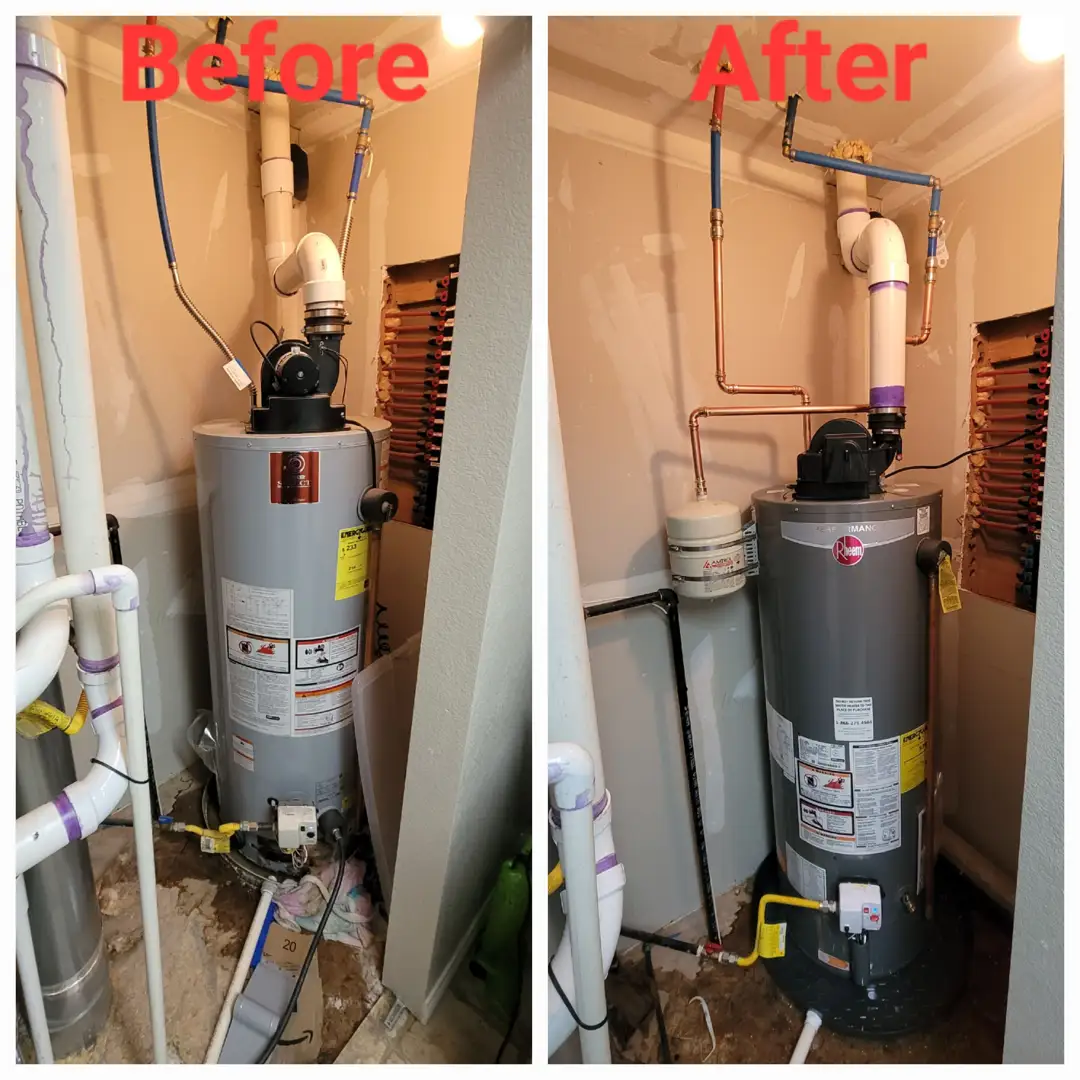
An expansion tank is a small metal tank split in half by a rubber diaphragm. One side connects directly to your plumbing system and fills with water; the other side contains pressurized air. When water expands, it pushes against the rubber diaphragm, compressing the air (which is highly compressible) and safely absorbing the excess pressure.
To function properly, the tank must be installed on the cold water inlet line before it enters the water heater. It must also be properly sized and pressurized to match your home's incoming municipal water pressure. If you need a replacement in the Westminster area, our team can help ensure your system is perfectly balanced; learn more at Water Heater Replacement Westminster.
How to Determine the Right Tank Size
Choosing the right expansion tank depends on two factors: the gallon capacity of your water heater and your home's static water pressure. If the expansion tank is too small, it won't be able to handle the volume of expanded water.
Use this general sizing chart as a guide:
| Water Heater Capacity (Gallons) | Supply Water Pressure (PSI) | Required Expansion Tank Size (Gallons) | | --- | --- | --- | | 40 Gallons | 40 to 60 PSI | 2.0 Gallons | | 40 Gallons | 60 to 80 PSI | 2.0 Gallons | | 50 Gallons | 40 to 60 PSI | 2.0 Gallons | | 50 Gallons | 60 to 80 PSI | 4.5 Gallons | | 80 Gallons | 40 to 60 PSI | 4.5 Gallons | | 80 Gallons | 60 to 80 PSI | 4.5 Gallons (or larger) |
Before installation, a plumber will use a pressure gauge to measure your home's incoming water pressure. They will then use a standard bicycle pump to pump air into the expansion tank's air valve until the tank's pre-charge pressure matches your home's water pressure exactly.
Are Expansion Tanks Required for Tankless Water Heaters in Colorado?
If you are upgrading to a tankless (on-demand) water heater, you might be wondering if you still need an expansion tank.
In almost all cases, tankless water heaters do not require a thermal expansion tank.
Because tankless water heaters do not store a large volume of hot water, there is very little water sitting inside the unit to expand. The heating process is flow-activated; water only heats up as it flows through the heat exchanger to an open faucet. Because the faucet is open, the system is naturally open while heating occurs, meaning pressure cannot build up.
However, if you have a tankless system that utilizes a small storage tank (or a "recirculation loop" that keeps hot water constantly moving through your pipes), a closed system can still experience minor thermal expansion. In these specialized setups, a small expansion tank may still be recommended.
Frequently Asked Questions about expansion tank requirements for water heaters colorado
Do I need an expansion tank if my water heater is in the basement?
Yes. The physical location of your water heater within your home (such as a basement, utility closet, or garage) does not change the physics of thermal expansion. If your home has a closed system due to a PRV or backflow preventer, an expansion tank is required by Colorado plumbing code regardless of where the water heater is installed.
How do I know if my expansion tank has failed?
Thermal expansion tanks typically last between 5 to 10 years. You can check yours with two simple tests:
1. The Tapping Test: Gently tap the top and bottom halves of the tank with a metal wrench or screwdriver. The top half (connected to the water line) should sound dull and full. The bottom half (which should contain compressed air) should sound hollow. If both sides sound completely solid or dull, the tank is likely full of water and the internal diaphragm has ruptured. 2. The Schrader Valve Test: Remove the plastic cap on the air valve at the bottom of the tank and gently press the center pin. If water squirts out instead of air, the diaphragm has failed, and the tank must be replaced immediately.
Can I install a water heater expansion tank myself in Colorado?
While some homeowners attempt DIY plumbing, we highly discourage installing an expansion tank yourself. To comply with Colorado municipal codes, any water heater replacement or modification requires a mechanical permit and a professional inspection. Additionally, securing the tank properly, soldering water lines, and matching the pre-charge pressure to your home’s static water pressure require specialized tools and training. A faulty DIY installation can lead to severe water damage or a denied insurance claim.
Conclusion
Staying compliant with expansion tank requirements for water heaters in Colorado is about more than just passing a municipal code inspection — it is about protecting your home, your family, and your wallet. Whether you live in Thornton, Northglenn, or Denver, a properly installed thermal expansion tank ensures your water heater runs safely and lasts as long as possible.
At Quality Heating and Air, we treat every home like our own. Our licensed, experienced plumbers understand local Colorado building codes inside and out. We will inspect your system, measure your water pressure, and ensure your new water heater is installed safely, efficiently, and fully up to code.
Are you ready to upgrade your water heater or verify that your current system is safe? Schedule a Water Heater Service with Quality Heating and Air today!

Testimonials
Neighbors trust Quality Heating & Air for honest work and fair pricing.
Service Areas