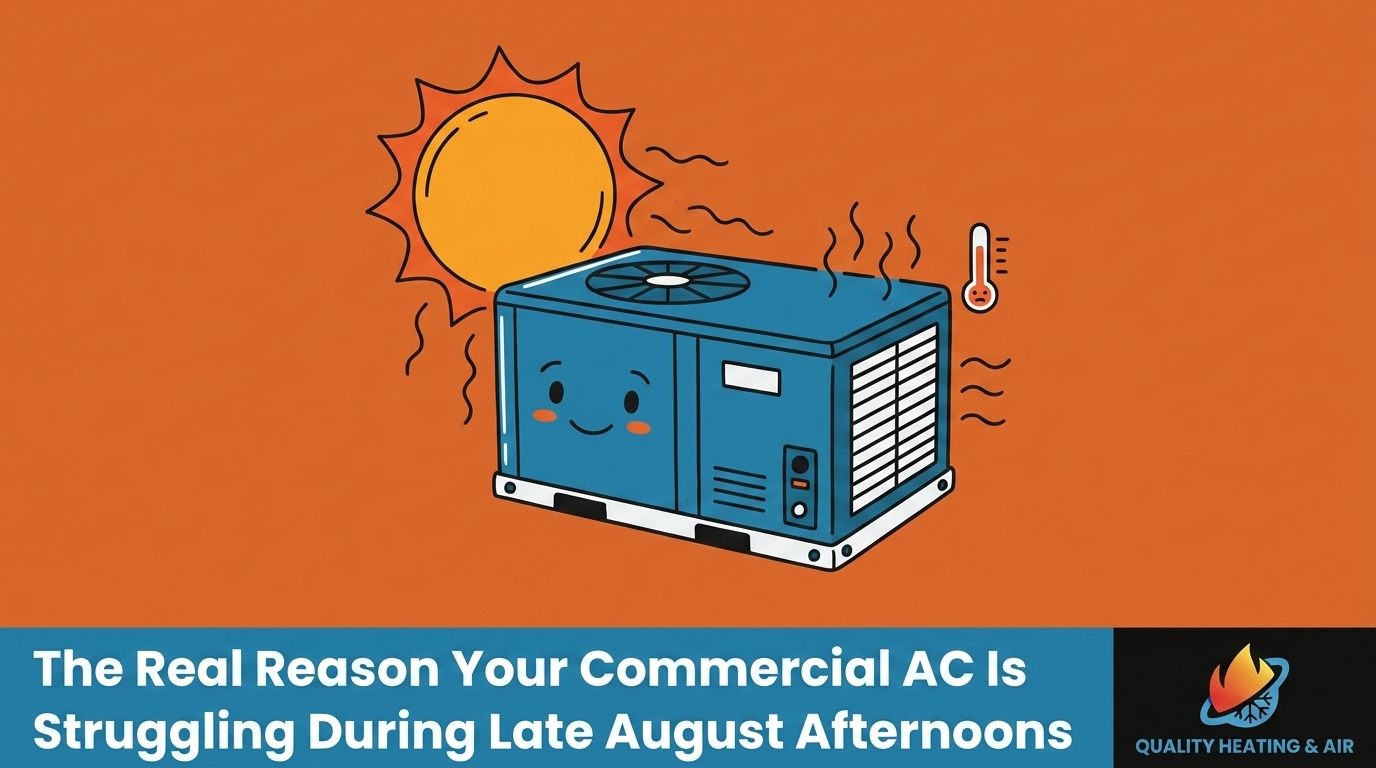
The Real Reason Your Commercial AC Is Struggling During Late August Afternoons
The Mid-Afternoon Breaking Point for Commercial Cooling Systems
Your facility feels like an oven by 3:00 PM, and you are desperately searching for the real reason your commercial AC is struggling during late August afternoons. The thermostats are set correctly, the blowers are running continuously, yet the indoor temperature steadily creeps upward as the sun hits its peak. For facility managers and business owners, this mid-afternoon cooling failure is one of the most frustrating operational hurdles of the late summer season.
It is easy to assume that a sudden mechanical breakdown has occurred when the building suddenly stops cooling. However, a late-season cooling failure is rarely a spontaneous event. Instead, it is the compounding result of months of neglected maintenance catching up with your equipment exactly when cooling is needed most. Addressing this requires a professional approach to commercial air conditioning rather than applying temporary band-aids that only mask the symptoms.
When commercial systems begin losing ground against the afternoon heat, the root cause almost always points back to a gradual decline in heat rejection capacity. Securing a comprehensive HVAC maintenance plan is the most effective way to intercept these cumulative issues before they escalate into a total system lockout on a late August afternoon.
The Cumulative Toll of Summer on Rooftop Units
To understand why your system fails at the end of the season, you have to look at what Commercial Rooftop Units (RTUs) endure from May through August. Throughout the spring and summer, the outdoor environment throws a continuous barrage of airborne debris at your HVAC equipment. Cottonwood seeds, pollen, vehicle exhaust particulate, and everyday dust are constantly pulled into the system by the powerful condenser fans.
Over three to four months, this environmental debris accumulates heavily on the condenser coils. These coils are responsible for releasing the heat absorbed from inside your building into the outside air. When they become coated in a thick layer of grime, that dirt acts as a powerful insulator, trapping heat inside the system. Instead of transferring thermal energy efficiently, the Commercial Rooftop Units (RTUs) are forced to hold onto it.
The Data on Capacity Loss: According to Department of Energy (DOE) guidelines, commercial HVAC systems can lose up to 30% of their total cooling capacity strictly due to dirty condenser coils. Because this capacity loss happens gradually—a fraction of a percent every day—it is incredibly easy to ignore during the milder days of June and July. It is only when peak temperatures hit on a late August afternoon that the system lacks the reserve capacity required to keep up with the thermal load of the building.
Understanding the Mechanics of Compressor Thermal Overload
When a commercial system loses its ability to reject heat, the internal mechanics are put under immense strain. This strain typically culminates in a 3 PM thermal overload, a specific mechanical sequence that causes the system to shut down during the hottest part of the day to prevent catastrophic failure.
A thermal overload switch is a critical safety mechanism built directly into the compressor. Its sole job is to monitor the internal temperature of the compressor motor windings. If those temperatures exceed safe operating limits, the switch breaks the electrical circuit, instantly shutting down the compressor. While this leaves your building without active cooling, it is actually saving your business from having to replace a completely destroyed compressor.
The Sequence of a High-Pressure Lockout
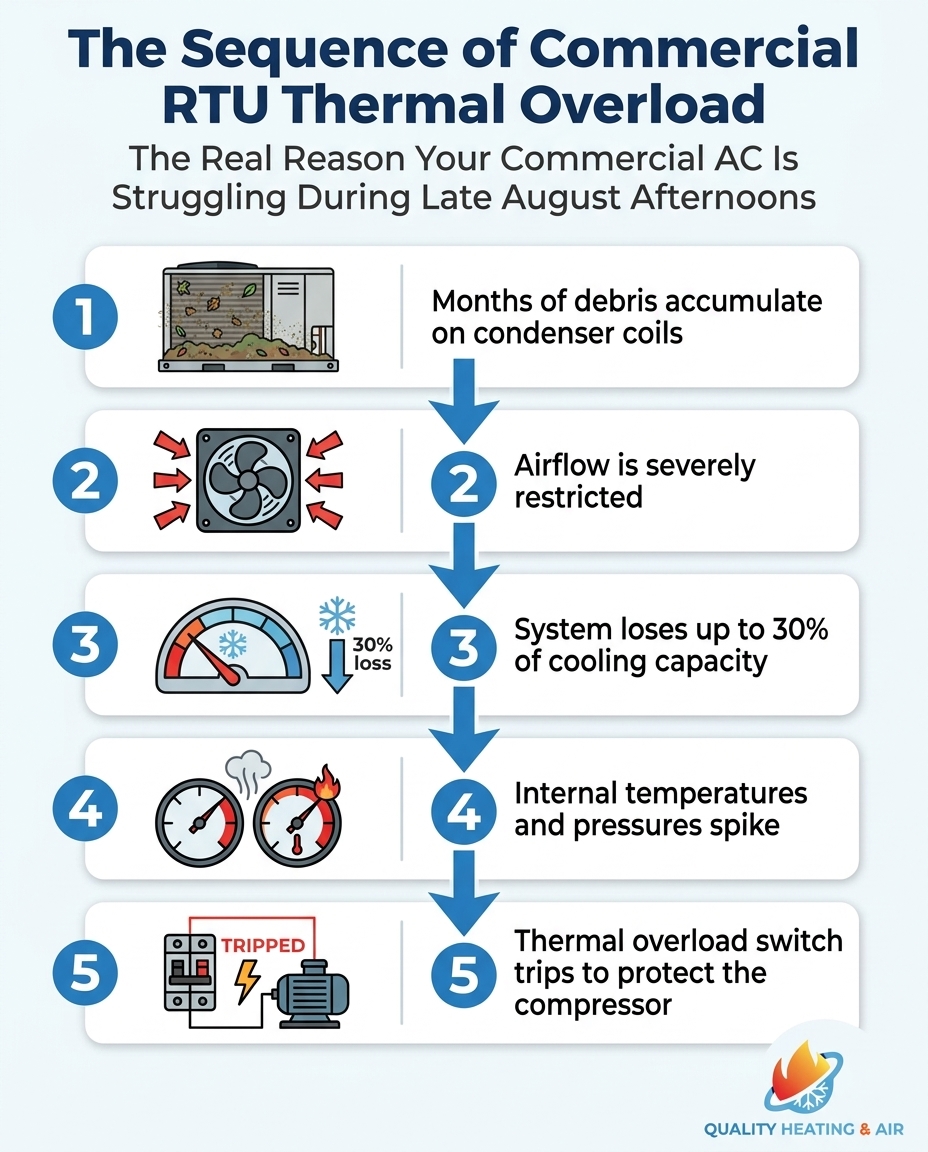
The journey to a 3 PM thermal overload follows a predictable, escalating sequence of mechanical distress:
1. Restricted Airflow: The accumulation of summer debris severely restricts the condenser fan's ability to pull ambient air across the aluminum fins of the condenser coils.
2. Trapped Thermal Energy: Because there is not enough airflow passing over the coils, the high-pressure, high-temperature refrigerant inside cannot release its absorbed heat to the outside air.
3. Spiking Internal Pressures: Unable to shed heat, the refrigerant returns to the compressor much warmer than intended. This causes internal system pressures and compressor motor temperatures to spike rapidly as the equipment works harder to pump the superheated fluid.
4. The Safety Shutdown: As the outdoor ambient temperature peaks around mid-afternoon, the compressor crosses its critical temperature threshold. The thermal overload switch trips, shutting down the compressor. Meanwhile, the indoor blower often continues running, circulating unconditioned, warm air throughout the facility.
Facility managers should be reassured that when this safety switch trips, the Commercial Rooftop Units (RTUs) are doing exactly what they were engineered to do: protect themselves. However, resetting the breaker or waiting for the unit to cool down overnight will not fix the underlying problem. Professional intervention is required to resolve the restricted airflow and restore proper heat rejection.
How High Altitude and Dry Heat Compound the Strain
The mechanical challenges of heat rejection are significantly amplified by regional climate factors. In Northglenn, the elevation sits at over 5,300 feet above sea level. At this altitude, the air is notably thinner, meaning there is less air density compared to sea-level environments. Because the air is less dense, condenser fans must move a significantly higher volume of air to achieve the exact same amount of standard heat transfer.
When you combine this requirement for higher airflow with the intense, dry heat of a Colorado summer, the strain on Commercial Rooftop Units (RTUs) multiplies. Dry conditions lead to elevated levels of environmental dust and loose soil becoming airborne. This dust gets sucked into the RTUs, clogging filters and coating coils at an accelerated rate compared to more humid, vegetation-heavy climates.
This regional reality means that pristine coils are a non-negotiable operational requirement, not an optional luxury. If your system is already fighting thinner air to reject heat, any additional barrier—like a layer of baked-on dust—will push the compressor to its breaking point much faster. Maintaining excellent indoor air quality and ensuring outdoor coils are entirely unobstructed are both critical components of surviving the high-altitude summer.
Surface Washing vs. Professional Deep Coil Cleaning
When facing a 3 PM thermal overload on a late August afternoon, many facility managers assume that changing the indoor air filters will solve the problem. While clean filters are essential for indoor airflow, they do absolutely nothing to resolve condenser-side heat rejection issues on the roof. To restore full cooling capacity, the outdoor coils must be cleaned—but the method of cleaning matters immensely.
Quick, superficial surface washing with a standard hose is often insufficient for commercial equipment. This approach frequently pushes dirt deeper into the center of the thick commercial coils, creating a solid wall of compacted mud that restricts airflow even more severely. Professional deep-cleaning is required to effectively dissolve and remove compacted debris without bending or damaging the delicate aluminum fins.
The Risks of Superficial Maintenance
Choosing the wrong maintenance approach can actively harm your Commercial Rooftop Units (RTUs). Consider the differences between basic surface washing and a professional deep clean:
• Superficial Surface Wash — Methodology: Low-pressure water sprayed only on the outer visible layer of the coil. — Impact on Equipment: Pushes dirt deeper into the core; leaves the root cause unresolved; risks rapid return of 3 PM thermal overload.
• Improper Chemical Use — Methodology: Applying highly acidic, non-diluted cleaners without proper rinsing. — Impact on Equipment: Strips the protective coating; corrodes delicate aluminum fins; permanently reduces the lifespan of the RTU.
• Professional Deep Clean — Methodology: Application of specialized, safe foaming agents followed by calibrated, high-volume rinsing from the inside out. — Impact on Equipment: Safely lifts and expels embedded debris; restores original heat rejection capacity; protects compressor health.
Quality Heating & Air is committed to thorough, deep-cleaning maintenance rather than quick surface fixes, ensuring commercial systems survive the toughest parts of the Colorado summer. This commitment extends to keeping clients informed. For example, during a spring consultation regarding an AC and furnace replacement, a technician provided a highly knowledgeable and friendly consultation, explaining all available options clearly. This transparent communication gave the customer complete confidence in the proposed system—the exact same educational approach taken when explaining why a deep coil cleaning is vastly superior to a basic surface wash.
The Hidden Business Costs of Ignoring Late-Summer Strain
Allowing Commercial Rooftop Units (RTUs) to limp through the end of the season with recurring 3 PM thermal overload events carries significant operational and financial risks. The most immediate impact is felt inside the building. Uncomfortable indoor temperatures directly degrade employee productivity and negatively impact the customer experience. When a retail space or office environment feels stagnant and hot, business operations suffer measurable losses.
Beyond human comfort, there is a severe risk to the equipment itself. If thermal overload switches are repeatedly tripped, or worse, if an unqualified handyman attempts to bypass the safety switch to force the unit to run, the compressor will suffer permanent damage. Replacing a commercial compressor is a major capital expense that dwarfs the cost of routine preventative maintenance.
Furthermore, running a compromised system drives up utility costs exponentially. When a commercial system operates at a 30% capacity deficit due to dirty coils, it must run significantly longer to achieve the target temperature. This constant, strained operation draws massive amounts of electricity, leading to late-summer utility bills that can shock a facility's operating budget.
Proactive professional intervention reverses these hidden costs. In a recent service scenario where an AC was not performing optimally, a technician performed thorough maintenance, explained every step of the process, and answered all of the customer's questions. The outcome was definitive: the AC was restored to work better than ever. Scheduling proper AC maintenance and service ensures your equipment operates efficiently, protecting both your bottom line and your physical assets.
Frequently Asked Questions About Commercial Cooling Under Pressure
Why does my commercial AC struggle in the afternoon?
Your commercial AC struggles in the afternoon because the outdoor ambient temperatures reach their peak, placing maximum demand on the system's ability to reject heat. If the condenser coils are dirty or airflow is restricted, the unit cannot shed the heat it absorbed from the building. This causes the system to run continuously without effectively lowering the indoor temperature.
What causes an RTU compressor to overheat?
An RTU compressor overheats primarily due to restricted airflow across the outdoor condenser coils, often caused by an accumulation of summer dust and debris. When the refrigerant cannot release its heat, it returns to the compressor too warm, causing internal motor temperatures to spike. Low refrigerant levels or a failing condenser fan motor can also trigger this dangerous overheating cycle.
Why is my RTU freezing up in the summer?
An RTU freezes up in the summer when there is a severe lack of indoor airflow or a refrigerant issue, preventing the evaporator coil from absorbing heat. Common culprits include completely clogged indoor air filters, slipping blower belts, or a malfunctioning expansion valve. When the coil cannot absorb heat, the condensation on its surface drops below freezing and turns to solid ice.
How do you fix an AC that struggles in the extreme heat?
Fixing an AC that struggles in extreme heat requires addressing the system's heat rejection capabilities through professional maintenance. A certified technician must perform a deep chemical cleaning of the outdoor condenser coils to remove insulating grime. Additionally, they will verify proper refrigerant charge and ensure all fan motors are operating at their rated specifications.
Can dirty condenser coils really cause a commercial system to shut down?
Yes, dirty condenser coils are one of the leading causes of complete system shutdowns in commercial HVAC equipment. The dirt acts as an insulator, driving internal compressor temperatures so high that the thermal overload safety switch trips. This forces the system offline to protect the compressor from permanent, catastrophic electrical failure.
How does high altitude affect commercial HVAC performance?
High altitude affects commercial HVAC performance by reducing the density of the air moving through the system. Because thinner air holds less mass per cubic foot, condenser fans must work harder and move more air to achieve the necessary heat transfer. This makes keeping the coils spotlessly clean even more critical, as the system is already operating at a natural disadvantage.
Restore Your Building's Comfort Before the Next Heatwave
Mid-afternoon struggles on a late August afternoon are a clear warning sign of cumulative strain, not an inevitable fact of operating a business in the summer heat. When your Commercial Rooftop Units (RTUs) are constantly battling restricted airflow and approaching a 3 PM thermal overload, they are signaling a desperate need for professional intervention to clear away months of accumulated debris.
Professional deep cleaning is the most logical and effective next step to restore your system's cooling capacity and protect your expensive commercial equipment from permanent damage. Do not wait for a complete system failure to address a struggling rooftop unit. Explore comprehensive maintenance options today to ensure your facility remains consistently cool, comfortable, and highly productive through the very last days of summer.

Testimonials
Neighbors trust Quality Heating & Air for honest work and fair pricing.
Service Areas