
Why Elevating Your Heat Pump Above the Snow Line is Essential for Winter Performance

Preparing Your Heating System Before the First Blizzard Hits
With November pre-winter readiness in full swing, there is one critical outdoor check many homeowners overlook before the first major freeze hits. Your outdoor heating equipment sits exposed to the elements, and early seasonal preparation is vital for regions that experience sudden, heavy early-season snowfalls. If you want your system to survive the coldest months without failing, elevating heat pump for snow clearance is a critical requirement, not just an optional upgrade.
A common pattern we see is ground-level outdoor units losing efficiency or shutting down completely when buried in heavy snowdrifts. When the snow piles up against the metal casing, it chokes off the air the system needs to function. To prevent these sudden breakdowns, upgrading to a snow stand or riser is a necessary decision for reliable winter comfort. Whether you rely on standard professional heating services or utilize highly efficient mini-split heat pump systems, giving your outdoor unit the physical clearance it needs is the first step in winterizing your home.
The Mechanics of Heat Extraction: Why Unobstructed Airflow is Non-Negotiable
To understand why physical clearance matters so much, you have to look at how these systems actually work. Heat pumps do not burn fuel to generate heat. Instead, they extract ambient thermal energy from the outdoor air, compress that heat to a higher temperature, and move it inside your home. Even when it feels freezing outside, there is still thermal energy in the air. However, to capture that energy, the outdoor unit must pull massive volumes of air through its metal fins.
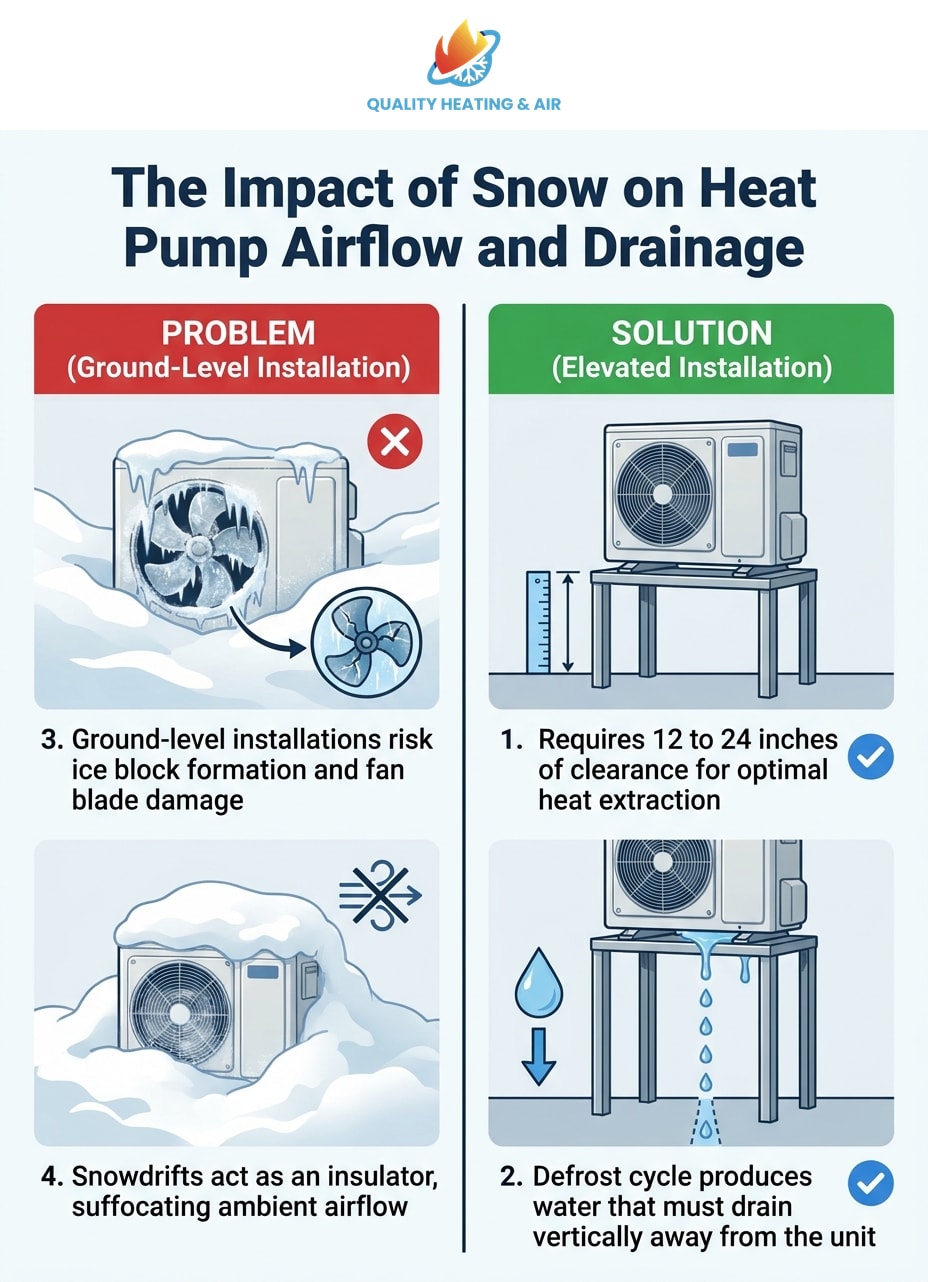
The clearance rule: Department of Energy (DOE) guidelines and major manufacturer specifications require 12 to 24 inches of physical clearance around the unit for proper airflow. When a unit sits flat on a concrete pad at ground level, it is highly vulnerable to blockages.
• Standard Ground-Level Pad — Airflow Reliability: Excellent in mild, snow-free climates. — Winter Vulnerability: High risk of suffocation from minor snow accumulation.
• Elevated Snow Stand (12"+) — Airflow Reliability: Maintains consistent intake across all seasons. — Winter Vulnerability: Resists standard snowfalls; keeps base clear.
• Wall-Mounted Bracket — Airflow Reliability: Maximum clearance; completely unobstructed. — Winter Vulnerability: Ideal for heavy drift zones; keeps unit above deep snow lines.
Standard ground-level installations are perfectly fine for mild, southern climates where snow is rare. But in heavy-snow regions, a unit sitting directly on the ground is a recipe for a mid-winter breakdown.
How Snow Acts as an Airflow Barrier
The physics of air intake rely on an open environment. The large fan inside your outdoor unit acts like a massive vacuum, pulling air through the delicate metal fins on the sides of the cabinet. As the air passes over the cold refrigerant coils inside, the refrigerant absorbs the heat.
• Insulation effect: Snow is an excellent natural insulator. When it packs against the sides of your heat pump, it creates a thermal barrier.
• Airflow restriction: Even a few inches of packed snow around the base drastically reduces the volume of air the fan can pull in.
• Efficiency drop: When the system cannot pull enough air, it has to run longer and harder to extract the same amount of heat, causing your energy usage to spike.
For homeowners in Northglenn CO, where winter storms can drop heavy, wet snow overnight, this barrier effect happens rapidly. Elevating the unit ensures that the lowest intake vents remain open, allowing the system to breathe even when the ground is covered.
Understanding the Winter Defrost Cycle and Drainage Needs
Airflow is only half of the equation. The other major reason for elevation involves how the system manages frost. During freezing weather, the outdoor coils get extremely cold—colder than the outside air—in order to absorb heat. Because outside air contains moisture, this moisture condenses on the freezing coils and quickly turns into frost.
The automatic defrost cycle: To prevent this frost from turning into a solid block of ice, your system runs an automatic defrost cycle. The unit temporarily reverses its operation, sending warm refrigerant back to the outdoor coils to melt the accumulated frost. This process produces a significant amount of melted water.
Here is where elevation becomes absolutely critical. That melted water must have enough vertical space to drain completely out of the bottom of the unit before the surrounding freezing air turns it back into ice. If the unit sits flat on a snow-covered pad, the water has nowhere to go. It pools at the base of the unit, creating a severe freezing hazard.
Ensuring your unit is elevated high enough to allow gravity to pull the water away is a core part of November pre-winter readiness. If you want to learn more about the intricate details of this process, reviewing how heat pumps operate in freezing weather can help you understand the delicate balance your system maintains during a freeze.
The Danger of Ice Blocks: When Ground-Level Installations Fail
When defrost drainage is blocked by snow, the consequences for your heating system are severe. It creates a destructive chain reaction that can permanently damage the equipment right when you need it most.
The chain of failure:
1. Snow blocks the base: Ground-level snow accumulation seals off the bottom drainage holes of the heat pump.
2. Water pools and refreezes: During the defrost cycle, the melted frost drips down but cannot escape. As soon as the cycle ends, this pooled water refreezes into solid ice.
3. Ice builds upward: With every subsequent defrost cycle, more water drips down, adding another layer to the ice block at the bottom of the unit.
4. Mechanical collision: The rising ice block eventually reaches the delicate aluminum fins and the spinning fan blades at the base of the unit.
When a high-speed fan blade strikes a solid block of ice, the blade can shatter, or the motor can burn out instantly. Furthermore, expanding ice can bend and rupture the pressurized copper coils, leading to a catastrophic loss of refrigerant. This specific mechanical failure results in a complete system lockout.
For residents in Northglenn CO, where temperatures can plunge well below freezing after a storm, this ice block formation happens quickly. Elevating the unit on a proper stand ensures that the defrost water falls harmlessly to the ground below, preventing this specific, expensive failure entirely.
Why Wind-Driven Snowdrifts Demand Specialized Elevation
Not all snow accumulation is created equal. There is a massive difference between a gentle, generic 3-inch ambient snowfall and the harsh, wind-driven snowdrifts common in the Colorado Front Range. Local geography and wind patterns create unique challenges for outdoor HVAC placement that standard installation manuals rarely cover in full detail.
The drift effect: Wind can sweep across an open yard and deposit snow directly against the side of your house, piling it several feet high in a matter of hours. A heat pump that is technically clear of a flat 4-inch snowfall can easily be swallowed whole by a 3-foot wind drift. This means that elevation must account for the local historical snow line and typical wind patterns on your specific property, not just the absolute minimum manufacturer recommendation.
This is why working with a contractor who understands specific regional weather anomalies is so important. Quality Heating & Air's local expertise and rigorous installation standards mean that our technicians anticipate these exact Colorado weather challenges. Out-of-state or budget contractors often slap units directly on a plastic ground pad, ignoring the reality of local upslope storms. A climate-aware installation automatically factors in the necessary height to keep your system breathing during a heavy drift.
If you live in Northglenn CO or any of our surrounding local service areas, specialized elevation tailored to your home's exposure to the wind is a necessity for uninterrupted winter warmth.
Why Elevating a Heat Pump is Not a DIY Project
Once homeowners understand the danger of snow accumulation, the immediate reaction is often to try and fix the problem themselves. However, attempting to build your own snow stand, prop the unit up on cinder blocks, or lift the equipment yourself is incredibly dangerous and can ruin your system.
The risk to pressurized lines: Your outdoor unit is connected to your indoor air handler via thick copper lines filled with chemical refrigerant under high pressure. These lines are relatively rigid. If you attempt to lift or shift the outdoor unit, you risk kinking, cracking, or completely snapping these lines. A broken refrigerant line will instantly vent the chemical charge, requiring major professional repairs and creating an environmental hazard.
The leveling requirement: Heat pumps must sit perfectly level. The compressor inside the unit contains lubricating oil. If the unit is tilted even slightly, this oil cannot circulate properly, which will cause the compressor motor to seize and fail prematurely. Additionally, an unlevel unit will not drain defrost water correctly, defeating the entire purpose of the elevation. Installing a snow stand or modifying the base requires a licensed HVAC professional with the tools to safely manage the refrigerant lines and perfectly level the new base.
We highly suggest incorporating this evaluation into your November pre-winter readiness checks. Having a professional assess your unit's clearance can be easily bundled into a routine HVAC maintenance plan visit.
What Homeowners Can Do Safely
While you cannot elevate the unit yourself, there are safe, proactive steps you can take during a storm to protect your equipment:
• Clear the perimeter gently: Use a soft-bristle broom to gently brush snow away from the top and sides of an already installed unit.
• Avoid sharp tools: Never use ice picks, metal shovels, or heavy scrapers near the unit. The aluminum fins are paper-thin and bend very easily, which ruins airflow.
• Monitor during storms: Keep an eye on the unit during heavy, windy snowstorms to ensure the 12-to-24-inch clearance zone remains open.
• Check the gutters: Ensure that your roof gutters are not leaking water directly onto the top of the heat pump, which can encase it in solid ice.
Secure Your Winter Comfort with Proactive Elevation
Elevating your heat pump above the snow line is the single most effective way to maintain proper airflow, allow critical defrost drainage, and prevent destructive ice damage to your fan blades and coils. It transforms your system from being vulnerable to the weather into a reliable, winter-ready heating source.
Proper installation and elevation are proactive measures. Waiting until your unit is frozen solid in the middle of a January blizzard is too late. As you finalize your November pre-winter readiness checklist, take the time to evaluate your outdoor equipment. Schedule a professional assessment to ensure your system has the proper clearance before the harsh winter weather sets in permanently, giving you the peace of mind that your home will stay warm no matter how deep the snow gets.
Frequently Asked Questions
How high should a heat pump be off the ground for snow?
A heat pump should generally be elevated between 12 and 24 inches off the ground, depending on your local historical snow line. The goal is to keep the base of the unit higher than the average snow accumulation in your specific area. This ensures the intake fins remain unobstructed and that melted defrost water has plenty of room to drain away.
Why does my heat pump freeze up in winter?
Heat pumps naturally accumulate frost in winter because they extract heat from cold, moisture-laden outdoor air. The system is designed to handle this by running an automatic defrost cycle that temporarily warms the coils to melt the frost. However, if the unit is buried in snow or has a broken defrost board, that frost can quickly turn into a solid block of ice.
Do I need a snow stand for my heat pump?
If you live in a region that receives regular snowfall or heavy winter drifts, a snow stand is highly recommended and often required. A stand keeps the unit elevated above the snowpack, protecting the delicate internal components from ice damage. In mild climates that rarely see freezing temperatures, a standard ground pad is usually sufficient.
How does a heat pump defrost in winter?
When internal sensors detect frost buildup, the heat pump temporarily reverses its refrigeration cycle. It takes warm refrigerant from inside the house and sends it back to the outdoor coils to melt the accumulated ice. Once the frost is melted and the water drains away, the system switches back to its normal heating mode.
Can a heat pump be completely covered in snow?
No, a heat pump should never be completely covered in snow. Snow acts as an insulator and a physical barrier, suffocating the unit and preventing it from pulling in the ambient air it needs to extract heat. If your unit gets buried, you should gently clear the snow away using a soft broom to restore airflow.
Is it safe to shovel the snow around my outdoor heat pump unit?
It is safe to clear snow around the unit, but you must be extremely careful not to strike the equipment. Never use a metal shovel, ice pick, or hard scraper near the unit, as you can easily bend the delicate aluminum fins or puncture a refrigerant line. Always use a soft brush or broom to gently sweep the snow away from the cabinet.

Testimonials
Neighbors trust Quality Heating & Air for honest work and fair pricing.
Service Areas