
Is Your Boiler Pressure Relief Valve Dripping? Why This is a Critical Pre-Winter Warning Sign

Noticing a Puddle? Why a Dripping Relief Valve is a Critical Pre-Winter Warning
Have you walked past your heating equipment recently and noticed a small, unexplained puddle forming on the floor? If you are dealing with a dripping boiler pressure relief valve, you might be tempted to just place a bucket underneath the pipe and forget about it. Many homeowners assume that a slow drip is just a minor plumbing nuisance—a seal that has slightly worn out over the summer. The reality is far more serious. That valve is a critical safety mechanism, and if it is dripping, it is actively trying to tell you something is wrong with your system's pressure management.
For homeowners relying on Colorado heating services, addressing early warnings is the difference between a scheduled diagnostic visit and a catastrophic system failure. As we approach the November first deep freezes, your heating equipment is about to shift from running occasionally to running constantly. Ignoring a dripping relief valve now could lead to severe equipment damage right when you need heavy heating loads the most.
The core issue is that a drip means one of two things: either the valve is successfully venting dangerous excess pressure to protect your home, or the mechanical seal inside the valve has failed. Neither situation resolves itself. Professional diagnostics are required to determine exactly what is happening inside the closed loop of your heating system before the real winter weather arrives.
Understanding Your Boiler's Ultimate Safety Mechanism
To understand why a dripping boiler pressure relief valve is such an urgent warning, you first need to understand what this component actually does. The pressure relief valve (often abbreviated as a PRV) is the absolute last line of defense against explosive structural failure in hydronic heating systems.
The 30 PSI Standard
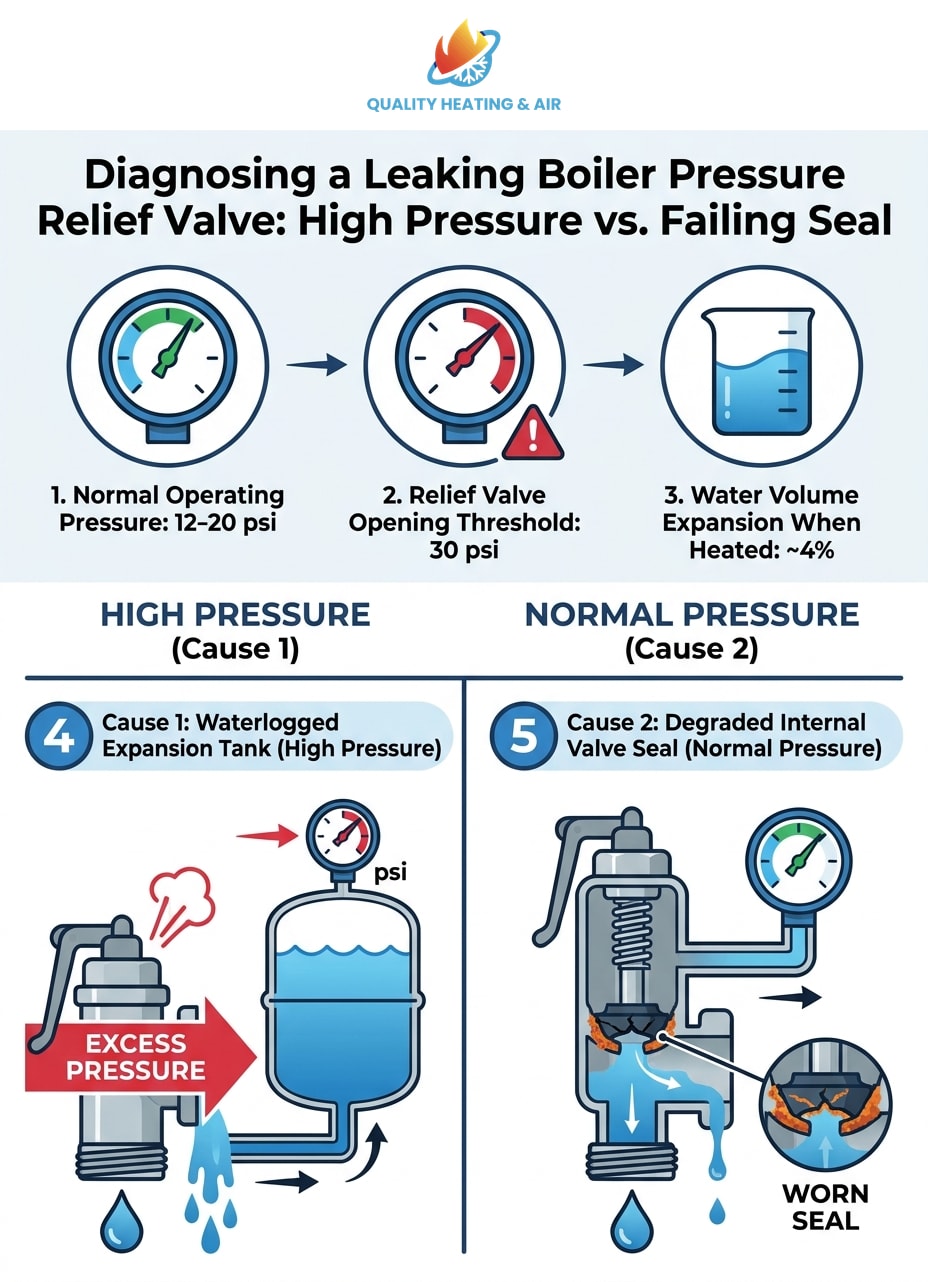
In many Northglenn CO homes with hydronic heating, the boiler operates as a closed-loop system. This means water is continuously circulated through your radiators or baseboards and back to the heat exchanger without ever being exposed to the open atmosphere. Because it is a closed loop, the pressure inside the pipes must be carefully regulated. According to strict ASME (American Society of Mechanical Engineers) standards, residential boiler pressure relief valves are typically designed to open automatically when system pressure reaches 30 psi (pounds per square inch).
How the Valve Protects Your Home
Under normal operating conditions, your heating system should run somewhere between 12 and 20 psi. If a malfunction causes the pressure to spike toward that 30 psi threshold, the spring-loaded mechanism inside the relief valve is forced upward. This opens a discharge port, releasing water and steam to instantly lower the pressure inside the boiler vessel. By venting this excess pressure, the valve prevents a dangerous rupture of the boiler tank or the surrounding piping.
Therefore, if you see a puddle, the valve is likely doing exactly what it was engineered to do. It is intervening in an overpressure situation. Because diagnosing the root cause of this pressure spike requires specialized gauges and an understanding of hydronic fluid dynamics, securing professional boiler repair is the only safe way to restore your system's integrity.
Thermal Expansion: The Most Common Culprit Behind the Drip
When a relief valve starts dripping, the valve itself is rarely the actual problem. Most of the time, the valve is just the messenger. The most common culprit behind the excess pressure is a physical phenomenon known as thermal expansion, combined with a failure of the boiler's expansion tank.
The Physics of Heated Water
The problem: Water expands approximately 4% in volume when it is heated from room temperature to near boiling. In an open pot on your stove, this expansion just causes the water level to rise slightly. In the closed loop of a boiler system, that extra 4% of water volume has nowhere to go. Because water is essentially incompressible, this expansion causes the pressure inside the solid metal pipes to spike rapidly every time the boiler fires up.
The Role of the Expansion Tank
The cause: To handle this extra volume, modern boilers are equipped with an expansion tank. This tank is divided into two sections by a flexible rubber diaphragm or bladder. One side is connected to the boiler water, and the other side is pre-charged with air. Because air can be compressed (unlike water), the expanding hot water pushes against the rubber diaphragm, compressing the air cushion and keeping the overall system pressure stable.
However, over years of use, that rubber bladder can degrade, tear, or lose its air charge. When this happens, the tank becomes "waterlogged"—completely filled with water. With the air cushion gone, the expanding water instantly spikes the system pressure past 30 psi, forcing the relief valve to open and drip.
Professional Resolution
The solution: A dripping valve caused by a waterlogged tank is a symptom of a tank issue, not a valve issue. Replacing the valve without testing the expansion tank will just result in a brand new valve that also drips. Evaluating the health of the expansion tank and its air charge is a critical step in any routine boiler maintenance plan, ensuring your system can handle the constant thermal cycling required during the November first deep freezes.
Failing Seals vs. High Pressure: Decoding the Symptoms
While a waterlogged expansion tank is the most common reason for a dripping valve, it is not the only reason. Broadly speaking, there are two distinct scenarios that lead to a puddle on your floor. To the untrained eye, both scenarios look completely identical, which is why professional diagnosis is paramount.
Scenario A: Genuine Over-Pressurization
In this scenario, the system pressure is actually spiking to dangerous levels. As discussed, this is often due to a failed expansion tank. However, it can also be caused by a faulty pressure reducing valve (the valve that feeds fresh water from your home's plumbing into the boiler) getting stuck open and constantly feeding high-pressure city water into the heating loop. High-temperature limit failures can also cause the water to overheat and expand beyond the tank's capacity.
Scenario B: Mechanical Valve Degradation
In this scenario, the boiler's internal pressure is perfectly normal (around 12 to 20 psi). Instead, the relief valve itself has failed. Over time, the internal rubber seal can become brittle, crack, or accumulate mineral deposits that prevent it from seating properly. Alternatively, the heavy metal spring that holds the valve closed can weaken after years of thermal stress, allowing water to seep past the seal even at normal operating pressures.
For Northglenn CO homes with hydronic heating, as well as those needing boiler repair in Thornton, determining which scenario is occurring requires a licensed technician to attach calibrated pressure gauges to the system.
• Intermittent dripping only when boiler is actively firing — System Pressure Gauge Reading: Spikes toward 30 psi during heating cycles — Likely Root Cause: Waterlogged expansion tank (loss of air cushion) — Professional Action Required: Replace or recharge expansion tank, verify relief valve integrity
• Constant dripping even when boiler is off and cold — System Pressure Gauge Reading: Normal (12-20 psi) — Likely Root Cause: Degraded internal valve seal or weakened spring — Professional Action Required: Drain system, replace relief valve with exact ASME match
• Heavy, continuous flow of water from discharge pipe — System Pressure Gauge Reading: Continuously climbing past 30 psi — Likely Root Cause: Failed pressure reducing valve (water feed stuck open) — Professional Action Required: Shut off water supply, replace pressure reducing valve
The Catastrophic Danger of Capping a Leaking Valve
When faced with a dripping pipe that is creating a mess on the utility room floor, it can be tempting to look for a quick DIY fix. A common, yet incredibly dangerous, misconception is that a dripping relief valve can simply be capped, plugged, or sealed with heavy-duty tape to stop the leak. You must never, under any circumstances, block the discharge pipe of a boiler pressure relief valve.
Removing the Only Fail-Safe
Capping a relief valve removes the boiler's only fail-safe against explosive over-pressurization. If the valve is dripping because the system is genuinely over-pressurizing (such as from a failed expansion tank), capping the pipe traps that expanding water inside a closed loop with an active heat source. Because water cannot be compressed, the pressure will continue to build exponentially as the temperature rises.
The Physics of a Rupture
If the pressure exceeds the structural limits of the boiler vessel or the cast-iron radiators, the system will violently rupture. Furthermore, if the water inside the boiler is heated past its atmospheric boiling point while under extreme pressure, a sudden rupture will cause that superheated water to instantly flash into steam. Water expands roughly 1,600 times its volume when turning to steam, which can literally blow a house off its foundation. This is why building codes mandate these valves and why they must remain unobstructed at all times.
Just as you would not ignore strange boiler noises that signal impending failure, you cannot ignore a leaking safety valve. If you discover a heavily leaking relief valve, the only safe response is to shut down the heating system at the thermostat, turn off the electrical breaker to the boiler, and immediately call a licensed technician. Do not attempt to thread a cap onto the pipe, especially as the November first deep freezes put maximum stress on your equipment.
How Sudden Temperature Drops Expose Hidden Boiler Vulnerabilities
The timing of a dripping boiler pressure relief valve is rarely a coincidence. Homeowners frequently notice this issue during late fall and early winter, just as the weather begins to shift dramatically. The Colorado front range is notorious for its rapid temperature drops, where a mild, sixty-degree afternoon can plummet into a freezing, snow-covered night in a matter of hours.
From Intermittent Cycling to Sustained Operation
During milder fall weather, your boiler likely cycles on and off intermittently. These short heating cycles might not generate enough sustained heat to fully expand the water in the system, which can easily mask early-stage expansion tank failures or minor pressure issues. However, when a sudden, severe temperature drop hits, hydronic systems are forced to ramp up to sustained, high-capacity operation. The boiler runs longer and gets hotter, maximizing the thermal expansion stress inside the pipes. A waterlogged expansion tank that managed to scrape by in October will instantly cause the relief valve to vent pressure during a November freeze.
The Value of Transparent Diagnostics
Because these hidden vulnerabilities are exposed so suddenly, it is critical to work with a professional who prioritizes transparent, trusted diagnostics. For Northglenn CO homes with hydronic heating, a good technician will not just blindly replace a dripping valve and hand you a bill. Instead, they will walk you through the diagnostic process. They will check the expansion tank bladder, test the pressure reducing valve, and verify the temperature limits.
More importantly, a trusted professional will physically show you what is failing—demonstrating how the expansion tank sounds dull and waterlogged when tapped, or showing you the exact reading on the pressure gauge. This level of transparency ensures you fully understand the safety implications of the repair, giving you peace of mind that the root cause has been resolved before the system is forced to run continuously during the harshest days of winter.
Frequently Asked Questions About Dripping Boiler Valves
Is it dangerous if my boiler pressure relief valve is leaking?
The short answer is yes, it can be highly dangerous. A leak often means the valve is successfully venting dangerous excess pressure that could otherwise cause the boiler vessel or piping to violently rupture. Even if the pressure is normal and it is just a faulty internal seal causing the drip, ignoring it can lead to significant water damage in your home and a sudden loss of heating capacity right when you need it most. You should always have a leaking safety valve evaluated by a licensed professional.
Why is my boiler leaking water from the pressure valve?
The two main reasons are excessive system pressure or a degraded internal seal. Excessive pressure is usually caused by a waterlogged expansion tank that can no longer absorb the natural expansion of heated water, or a faulty pressure reducing valve that is letting too much city water into the system. If the pressure gauges read normal (typically 12 to 20 psi), then the internal rubber seal of the relief valve has likely degraded, or its spring has weakened over time, allowing water to slip past.
Can I cap a leaking pressure relief valve?
Never under any circumstances should you cap or plug a leaking relief valve. Capping the valve traps expanding water inside the boiler, completely removing its primary safety mechanism. If the system is actively over-pressurizing, trapping that pressure will inevitably lead to ruptured pipes, destroyed heating equipment, or a catastrophic explosion that can cause severe structural damage to your home. The only safe action is to shut the system down and call for professional service.
What is normal boiler pressure when heating?
Most residential hydronic heating systems operate between 12 and 20 psi. When the boiler is completely cold, the pressure usually sits at the lower end of that range (around 12 to 15 psi). As the water heats up and expands, the pressure will naturally rise a few pounds. However, if the pressure gauge approaches or exceeds 30 psi, the system is in an over-pressurized state, and the relief valve is designed to open automatically to vent the excess pressure.
Why does my boiler pressure relief valve leak after replacement?
If a brand new valve continues to leak, the root cause of the over-pressurization was not addressed. The valve is simply doing its job by venting excess pressure. The most common reason for a recurring leak is that the technician replaced the dripping valve but failed to diagnose a waterlogged expansion tank or a broken pressure reducing valve. Until the component causing the pressure spike is fixed, every new relief valve you install will eventually open and leak.
How does an expansion tank full of water affect the relief valve?
A waterlogged expansion tank causes system pressure to spike rapidly, forcing the relief valve to open. An expansion tank relies on a compressible cushion of air to absorb the 4% volume expansion of heated water. If the internal bladder fails and the tank fills completely with water, that air cushion is gone. Because water cannot be compressed, the expanding heated water instantly drives the system pressure past the 30 psi safety limit, triggering the relief valve to dump water.
Secure Your Home's Heating System Before the Deep Freeze Hits
As the late fall weather gives way to harsh winter conditions, knowing that your heating equipment is safe, diagnosed correctly, and ready for peak operation is vital for your family's comfort. A dripping boiler pressure relief valve is a clear, undeniable signal that your system requires immediate professional evaluation. Whether the issue stems from a waterlogged expansion tank, a faulty water feed, or a degraded seal, ignoring the warning signs will only lead to more extensive damage and cold nights without heat.
For Northglenn CO homes with hydronic heating, proactive maintenance is the key to a stress-free winter. Do not wait for a minor drip to turn into a major system failure. Schedule a comprehensive diagnostic inspection to ensure your expansion tank, pressure valves, and temperature limits are functioning flawlessly before the coldest days arrive.

Testimonials
Neighbors trust Quality Heating & Air for honest work and fair pricing.
Service Areas