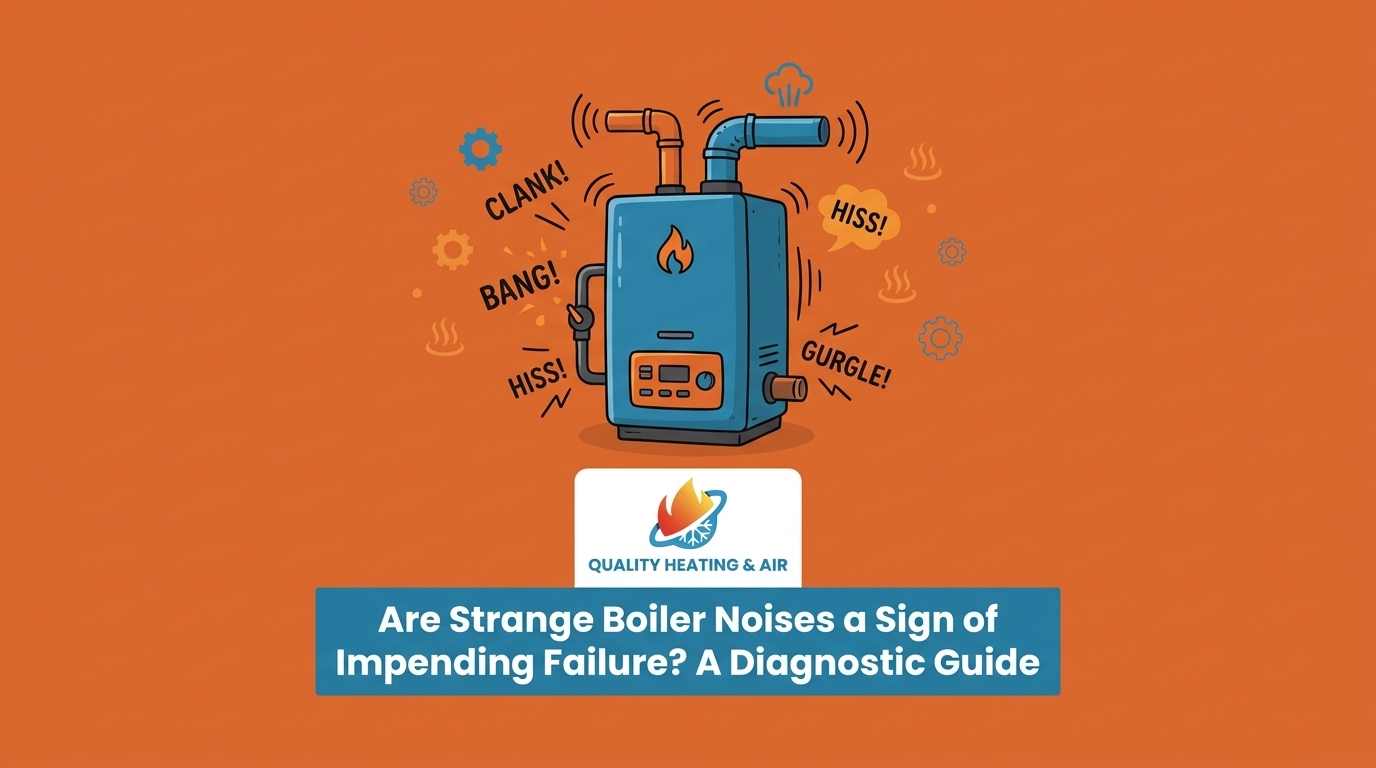
Are Strange Boiler Noises a Sign of Impending Failure?
Is That Noise Normal? Evaluating Your Commercial Boiler Before Winter Hits
Have you just flipped the switch on your building's heating system, only to wonder, are strange boiler noises a sign of impending failure? The short answer is that it depends entirely on the specific sound you are hearing. When conducting early fall pre-heating test-fires, facility managers face a critical decision point. You must distinguish between harmless thermal expansion—the normal sounds of metal warming up after months of summer dormancy—and the urgent auditory symptoms of an impending system breakdown.
Ignoring the wrong warning sign can lead to catastrophic equipment failure right when your building needs heat the most. Evaluating your commercial heating systems now, before the freezing weather sets in, is the only way to manage operational risk and ensure continuity for your tenants and employees.
Understanding the Sounds of Startup
Boilers are heavy-duty pieces of mechanical equipment. They expand and contract as temperatures fluctuate. During those initial September test-fires, some noise is completely expected. However, establishing a baseline of what is normal helps you identify when something has gone wrong.
• Light clicking or ticking — Typical Cause: Thermal expansion of metal pipes and casing — Action Required: None. Normal during startup and shutdown.
• Brief, soft whoosh — Typical Cause: The gas burners igniting smoothly — Action Required: None. Indicates normal burner operation.
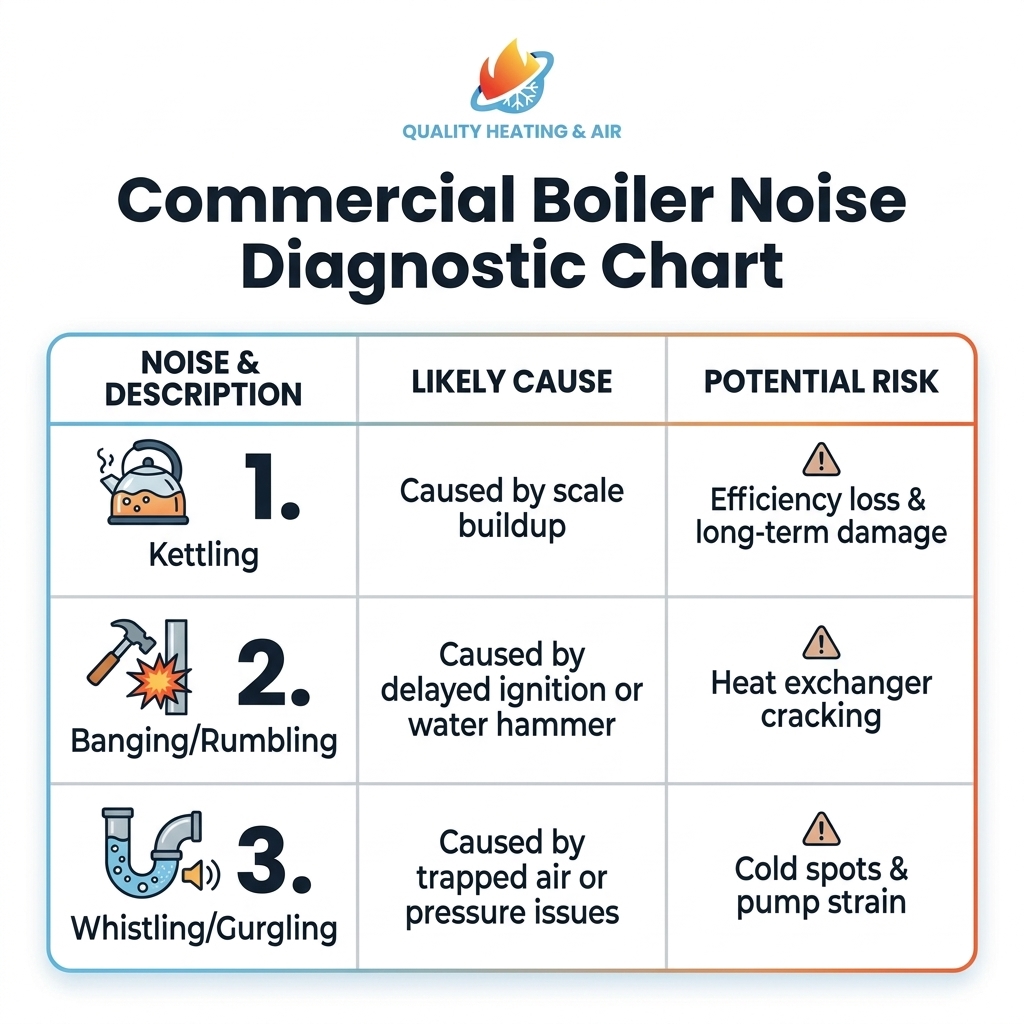
• Loud banging or booming — Typical Cause: Delayed ignition or water hammer — Action Required: Immediate professional diagnostic.
• Rumbling or whistling — Typical Cause: Scale buildup (kettling) or trapped air — Action Required: Schedule professional maintenance soon.
Setting a neutral, expert tone focused on risk management is essential. Your goal is not to panic over every click, but to listen critically for the specific patterns that indicate mechanical distress.
The High Stakes of Ignored Warnings in Northglenn Commercial Facilities
Operating a commercial building means preparing for harsh realities. The severe consequences of an unexpected commercial boiler failure extend far beyond a simple lack of heat. When a system goes down, facility managers face immediate downtime, a flood of tenant complaints, and the massive financial risk of frozen, bursting pipes.
The climate reality: The Colorado Front Range experiences rapid, punishing temperature drops in late fall. At Quality Heating & Air, we've seen firsthand how a mild afternoon can quickly transition into a freezing night. These sudden shifts leave absolutely no room for compromised equipment. If your system is struggling, the harsh winter weather will expose its weaknesses almost immediately.
This is why early fall is the definitive window for identifying and resolving mechanical issues. When our team gets dispatched for emergency commercial heating failures in January, it is often because a facility manager ignored auditory clues back in September. A strange rumble in early fall is a warning; that same rumble mid-winter often becomes a complete shutdown.
Addressing these sounds early often prevents the need for emergency professional boiler repair and replacement when the weather turns brutal. Proactive diagnostics keep your facility running smoothly, protecting your building's infrastructure and your operational budget.
Kettling: The Sound of Scale Buildup and Restricted Flow
One of the most common and concerning noises a commercial boiler can make is known as "kettling." If you hear a deep rumbling or a high-pitched whistling that sounds exactly like a boiling tea kettle on a stovetop, your system is crying out for help.
What Causes the Kettling Sound?
Kettling occurs when water flow inside the boiler's heat exchanger becomes severely restricted. Instead of moving smoothly through the system to distribute heat, the water gets trapped against the superheated metal surfaces. This trapped water boils rapidly, turning into steam bubbles. When these steam bubbles move to slightly cooler areas of the water, they collapse violently. This rapid formation and collapse of steam bubbles creates the distinct rumbling and whistling sounds you hear.
How Does Local Water Quality Play a Role?
The root cause of this restricted flow is almost always hard water scale accumulation. In our extensive experience servicing Northglenn facilities, our technicians consistently find that local water hardness levels contribute significantly to scale buildup inside commercial plumbing. As water is heated, the dissolved minerals (primarily calcium and magnesium) precipitate out and bake onto the inside of the heat exchanger. Over time, this creates a thick, insulating layer of limescale that narrows the passageways and traps the water.
What Are the Long-Term Risks of Kettling?
While a kettling boiler is not going to explode like a bomb, it is incredibly damaging to your equipment. The scale buildup acts as an insulator, forcing the burners to run longer and hotter to transfer the same amount of heat to the water. This causes massive long-term efficiency degradation and skyrocketing fuel bills. If left untreated, the intense localized heat will eventually warp, crack, or destroy the heat exchanger entirely, leading to a catastrophic system failure.
Banging and Rumbling: Delayed Ignition and Water Hammer Risks
While kettling is a slow, progressive issue, loud banging or booming noises often point to sudden, severe mechanical failures. These sounds are jarring, and they should never be ignored by a facility manager.
1. Diagnosing Water Hammer: If you hear a loud, sharp bang that echoes through the commercial pipes when a valve closes or a pump shuts off, you are likely experiencing water hammer. Our commercial HVAC team frequently encounters this in older Front Range buildings when fast-moving water is suddenly forced to stop. The kinetic energy creates a massive pressure surge (a shockwave) that slams into the pipes and fittings. Over time, water hammer can blow out seals, destroy valves, and cause major commercial leaks.
2. Understanding Delayed Ignition: A deep, booming rumble that occurs right when the boiler tries to start is a classic sign of delayed ignition. In a healthy system, the gas valve opens and the igniter lights the fuel immediately. If the burners are dirty, misaligned, or failing, the gas pools inside the combustion chamber for several seconds before finally catching a spark.
3. The Heat Exchanger Risk: When that pooled gas finally ignites, it creates a small explosion. This is the boom you hear. These repeated micro-explosions flex the metal of the commercial heat exchanger violently. The severe risk here is that the metal will eventually fatigue and crack, which can leak deadly carbon monoxide into your facility.
4. Strict Safety Boundaries: Facility managers must strictly enforce safety protocols. Never attempt DIY diagnostics for combustion issues. Do not open the boiler jacket to inspect the burners, and never attempt to clean or adjust gas valves yourself. This work requires specialized tools, combustion analyzers, and a licensed professional.
Whistling and Gurgling: Diagnosing Pressure and Trapped Air
Not all noises are violent bangs or deep rumbles. Sometimes, a commercial boiler will produce higher-pitched whistling, bubbling, or gurgling sounds. These noises typically point to issues with air infiltration and water pressure.
Why Is There Trapped Air in the System?
A commercial hydronic heating system is supposed to be a closed loop, completely filled with water. However, small leaks, recent repairs, or a failing automatic air vent can allow air to enter the pipes. When this trapped air moves through the system alongside the water, it creates a distinct gurgling or bubbling noise, much like water flowing over rocks in a stream.
What Does Whistling Indicate?
Whistling sounds often point to pressure imbalances. If the system pressure is too high or too low, water can be forced through narrow restrictions at high speeds, creating a whistling effect. Alternatively, a high-pitched squeal or whistle can indicate a failing bearing inside the main circulator pump. We regularly advise clients that if a pump is struggling to move water and begins to squeal, it will eventually seize up entirely.
How Do These Issues Affect Building Comfort?
Trapped air and pressure imbalances create severe cold spots throughout the building. Air bubbles naturally rise to the highest points in the system, often becoming trapped in top-floor radiators or baseboards. Because air does not transfer heat like water does, these units will remain cold, prompting immediate tenant complaints. Furthermore, the boiler has to overwork to try and push water past these air locks.
Connecting these symptoms to proactive care is vital. Routine system bleeding and pressure checks by a licensed technician, ideally structured within a proactive commercial maintenance plan, will easily resolve these air and pressure issues before they impact building comfort.
When to Shut Down the System and Call a Professional
Knowing when to simply monitor a noise and when to hit the emergency shut-off switch is a critical skill for any building supervisor. Establishing a definitive threshold for professional intervention is the best way to mitigate risk.
Immediate Shutdown Checklist:
• Continuous, violent banging: If the pipes are shaking or the boiler is booming loudly on every cycle, shut it down to prevent a cracked heat exchanger.
• Loud, aggressive kettling: If the rumbling is vibrating the floor, the system is overheating locally and needs to be powered off.
• Any smell of gas or exhaust: If noises are accompanied by unusual odors, shut down the system and clear the area immediately.
• Flashing error codes: Modern commercial boilers will often lock out and flash a code when they detect unsafe combustion or pressure levels. Never repeatedly reset a locked-out boiler.
Contrast these urgent warnings with the normal, brief expansion pings you hear during an initial startup. A few ticks as the pipes warm up are fine; a booming explosion is not. We cannot reiterate enough the dangers of untrained personnel attempting commercial boiler repairs. Working with high-voltage electricity, pressurized steam or water, and combustible natural gas requires strict adherence to safety codes.
Quality Heating & Air delivers rapid, transparent diagnostics and 24-hour emergency response capabilities to mitigate risks before they escalate. When critical systems fail, speed and transparency matter. Our team recently demonstrated this responsiveness when a local customer with an aging property urgently needed an AC start assist and a completely new furnace installation. We dispatched quickly, upgraded their equipment, and restored their comfort without delay. We bring that exact same urgency, transparency, and dedication to commercial boiler emergencies, ensuring you know exactly what to expect during a professional diagnostic visit.
Preventing Future Noises with Comprehensive Fall Inspections
The most effective way to handle strange boiler noises is to prevent them from happening in the first place. Transitioning from reactive panic to proactive solutions ensures your facility remains warm and operational all winter long.
Following ASHRAE guidelines on commercial boiler maintenance is the industry standard for reliability. These guidelines emphasize that annual, comprehensive inspections are not optional for commercial facilities—they are mandatory for safe operation. A major focus of this maintenance is maintaining water quality. By checking the pH levels and adding the proper chemical inhibitors, technicians can stop hard water scale accumulation before it causes kettling.
During early fall pre-heating test-fires, a comprehensive inspection should cover every critical component. When our Quality Heating & Air technicians perform these pre-season tune-ups, we verify gas pressure, clean the burner assemblies to prevent delayed ignition, test all safety limit switches, and inspect the expansion tanks and circulator pumps.
Planned maintenance extends equipment lifespan and ensures steady winter operation. By catching a failing pump bearing while it is just starting to whistle, you avoid a complete pump failure in January. You can learn more about the specific steps involved in a successful commercial boiler inspection to see exactly how professionals keep these massive systems running quietly and efficiently.
Frequently Asked Questions About Commercial Boiler Noises
Why is my commercial boiler making a loud banging noise?
A loud banging noise is often caused by delayed ignition in the combustion chamber or water hammer in the piping. Because these micro-explosions carry severe heat exchanger cracking risks, the system requires immediate professional inspection.
Is boiler kettling dangerous to the facility?
Kettling indicates restricted water flow and localized boiling inside the heat exchanger. While it is not immediately explosive, it causes severe long-term damage, massive efficiency loss, and will eventually destroy the equipment if ignored.
What does a kettling boiler sound like?
A kettling boiler mimics the whistling, bubbling, or deep rumbling sound of a tea kettle on a hot stove. This noise typically occurs when the boiler is actively firing and trying to heat the water.
Should I turn off my boiler if it's making a loud noise?
Yes, if the noise is a violent bang, a continuous aggressive rumble, or is accompanied by flashing error codes, you should turn the system off. Shutting down prevents further mechanical damage while you await a licensed technician.
How does local water hardness affect commercial boilers?
Hard water accelerates limescale buildup directly on the internal surfaces of the heat exchangers. This mineral insulation leads directly to kettling, restricts water flow, and requires professional chemical descaling to resolve.
Secure Reliable Heating Before the Colorado Winter Arrives
Translating strange system noises into decisive action is the cornerstone of effective facility management. For Northglenn commercial facilities, reliable heating is not a luxury; it is an absolute operational necessity. By understanding the difference between normal thermal expansion and the warning signs of kettling, delayed ignition, or failing pumps, you can protect your building's infrastructure.
If you are still asking yourself, are strange boiler noises a sign of impending failure, the safest approach is to let an expert find out for sure. There is immense peace of mind that comes with professional diagnostics. Schedule a comprehensive inspection with Quality Heating & Air now, before the peak season arrives, to ensure your commercial boiler is ready to handle whatever the Colorado winter brings.

Testimonials
Neighbors trust Quality Heating & Air for honest work and fair pricing.
Service Areas