The Anatomy of a Successful Commercial Boiler Inspection in Arvada
The Hidden Risks Lurking in Aging Heating Systems Before Winter
When managing an aging commercial heating system, understanding the anatomy of a successful commercial boiler inspection in Arvada is the most effective way to prevent carbon monoxide leaks and unexpected downtime as the September transition to heating season begins. Your facility's boiler is a heavy-duty workhorse, and ignoring the wear and tear it accumulates over the years is a risk that can lead to catastrophic failures right when you need heat the most. At Quality Heating & Air, our team has seen firsthand how proactive maintenance saves facilities from winter disasters. To get started on protecting your property, explore our commercial heating services or schedule a comprehensive commercial boiler inspection and service today.
Facility managers face a highly demanding challenge during the early fall. The window to prepare a large-scale heating system for continuous winter operation is remarkably short. Many property owners mistakenly assume that a basic visual check—similar to what a homeowner might do for a residential furnace—is sufficient for a commercial building. However, the rigorous demands placed on commercial boilers require a vastly different approach.
The difference in scale and risk: A commercial boiler operates at higher pressures, handles significantly larger volumes of water, and consumes fuel at a rate that dwarfs residential systems. Consequently, when a commercial system fails, the fallout is amplified. A comprehensive inspection is not just a routine chore to check off a to-do list; it is a critical safety and compliance measure. Our licensed technicians are looking for microscopic stress fractures, testing automated fail-safes, and analyzing exhaust gases to ensure the building remains safe for occupants.
• System Scale — Basic Residential Check: Single-family load, intermittent cycling — Commercial-Grade Inspection: High-capacity, continuous operation demands
• Safety Testing — Basic Residential Check: Basic flame sensor and rollout switch checks — Commercial-Grade Inspection: Rigorous testing of LWCO, pressure relief, and high-limit controls
• Gas Analysis — Basic Residential Check: Basic visual flame check — Commercial-Grade Inspection: Precision combustion analysis tracking carbon monoxide ppm
• Compliance — Basic Residential Check: Manufacturer recommendations — Commercial-Grade Inspection: Strict adherence to local commercial safety regulations
Setting the stage for a safe winter means moving beyond a cursory glance. By understanding the detailed breakdown of the inspection anatomy that follows, facility managers can better appreciate the depth of technical expertise required to keep a commercial building warm, safe, and fully operational through the coldest months of the year.
Why the Local Climate Demands a Commercial-Grade Safety Protocol
Operating a business in the Arvada service area means preparing for harsh, freezing winters that force commercial heating systems to run continuously at peak capacity. This relentless environmental stress amplifies the daily wear and tear on aging boiler components. When temperatures plummet and stay below freezing for days or weeks at a time, your boiler does not have the luxury of cycling off to rest.
Continuous operation creates unique stressors:</p
• Thermal fatigue: The constant expansion and contraction of metal components under extreme heat compromises the structural integrity of the heat exchanger over multiple winters.
• Pressure fluctuations: High-demand periods cause significant pressure variations within the system, testing the limits of aging valves, seals, and gaskets.
• Fuel consumption: Running at peak capacity requires massive amounts of natural gas or oil, which increases the volume of combustion byproducts that must be safely vented.
The risks of catastrophic cold-weather failures extend far beyond temporary discomfort. If an aging boiler in an Arvada commercial facility shuts down during a deep freeze, the building is immediately at risk for frozen and bursting pipes. The resulting water damage, combined with prolonged facility downtime, can create massive operational losses for a business.
Furthermore, thermal stress over multiple winters severely compromises heat exchangers. When the metal walls of a heat exchanger develop hairline cracks, the barrier between the combustion chamber and the building's air supply is broken. This drastically increases the risk of hazardous gas leaks, allowing dangerous exhaust fumes to circulate through the facility. Because of these severe local climate demands, proactive, pre-season evaluations are absolutely non-negotiable. Waiting for an emergency repair in the dead of winter is a gamble that commercial property managers simply cannot afford to take.
Phase 1: Visual Assessment and System Integrity Checks
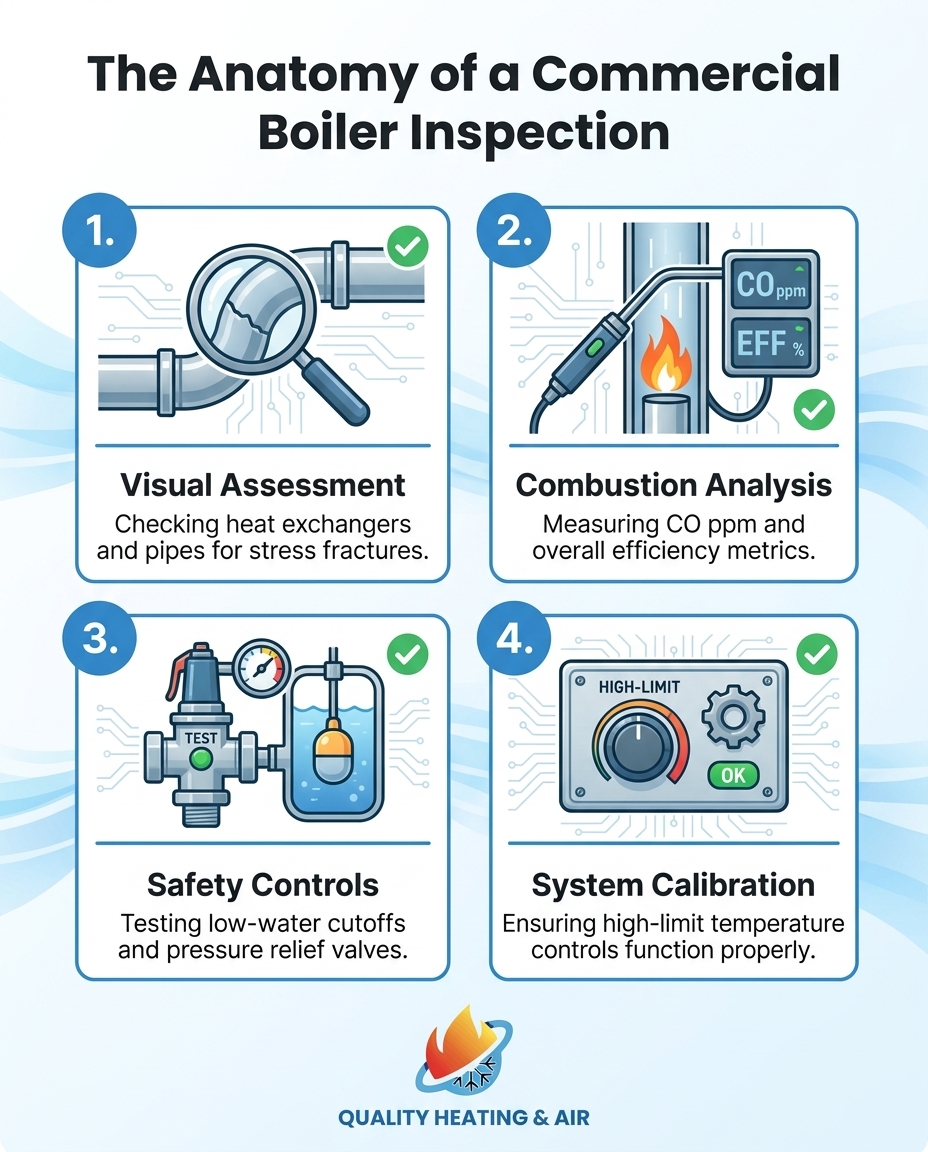
The first phase of the inspection anatomy focuses on a thorough physical evaluation of the equipment. Our technicians begin by meticulously examining the boiler's exterior, piping, and insulation. We are looking for any visible signs of wear, corrosion, or active water leaks. Even a minor drip can indicate a failing seal that will only worsen once the system is under the immense pressure of winter operation.
1. Exterior and Piping Inspection: Technicians trace the critical piping networks, checking for rust, corrosion, and degraded insulation that could lead to heat loss or pipe freezing.
2. Heat Exchanger Evaluation: This is a critical safety check. Technicians use specialized tools to inspect the heat exchanger for cracks or stress fractures. Even microscopic damage here can allow lethal exhaust gases to escape the combustion chamber.
3. Ventilation and Flue Verification: The venting system must be completely unobstructed. Technicians verify that flue passages are clear of debris, soot, or scaling so that toxic byproducts can safely exit the building.
4. Burner Assembly Assessment: The burner and ignition systems are evaluated for proper alignment, clean operation, and immediate ignition to prevent delayed fuel combustion.
Identifying Early Warning Signs of Metal Fatigue
During the visual assessment in Arvada commercial facilities, our Quality Heating & Air technicians pay close attention to early warning signs of metal fatigue. A pattern we see often is the presence of scaling and soot buildup. Scaling occurs when minerals in the water supply attach to the metal surfaces inside the boiler. This scale acts as an insulator, forcing the metal to overheat in order to transfer warmth to the water. Over time, this localized overheating causes the metal to warp, fatigue, and eventually crack.
Additionally, we meticulously check seals and gaskets. These pliable components are often the first to degrade under the stress of high-temperature commercial operation. Identifying a hardened, brittle, or weeping gasket in the early fall allows for a simple replacement before it fails completely under heavy winter pressure, saving the facility from an unexpected shutdown.
Phase 2: Rigorous Combustion Analysis and Gas Testing
While visual checks are foundational, a professional commercial inspection truly distinguishes itself through rigorous technical measurements. Combustion analysis is a mandatory, highly specialized procedure for commercial-grade heating equipment. It involves using advanced diagnostic tools to measure the exact composition of the gases in the flue exhaust. This analysis ensures the boiler is burning fuel safely and efficiently.
During this phase, our licensed technicians insert a probe into the exhaust flue to measure specific gases. We are looking closely at oxygen (O2) levels, carbon dioxide (CO2), and, most importantly, carbon monoxide (CO). By utilizing specialized equipment, technicians can detect dangerous carbon monoxide levels before they ever have a chance to enter the facility's breathable air.
There is a direct connection between a properly tuned burner and optimal fuel efficiency. When a boiler is starved for oxygen, it produces excessive carbon monoxide and wastes fuel. When it has too much oxygen, it wastes heat by pushing it straight up the chimney. Achieving the perfect balance reduces fuel waste, lowers utility costs, and minimizes harmful emissions.
Understanding Safe Operating Thresholds
Technicians read and interpret exact data points from the combustion analyzer to determine if the system is operating safely. For example, tracking carbon monoxide ppm and combustion efficiency metrics provides a clear picture of the burner's health.
• Carbon Monoxide (CO) — What It Measures: Parts per million (ppm) of toxic gas in exhaust — Why It Matters for Safety & Efficiency: High levels indicate incomplete combustion and a severe safety hazard.
• Oxygen (O2) — What It Measures: Percentage of excess air in the combustion process — Why It Matters for Safety & Efficiency: Ensures the flame is stable and not wasting heat or starving for air.
• Stack Temperature — What It Measures: The heat of the exhaust gases leaving the flue — Why It Matters for Safety & Efficiency: Excessive heat indicates poor heat transfer and wasted energy.
Precise calibration is necessary to maintain safe air quality inside the building. If the metrics fall outside of acceptable thresholds, our technicians must adjust the gas pressure, air intake, or burner alignment until the combustion process is fully optimized and safe for commercial operation.
Phase 3: Safety Control Testing and Calibration
Commercial boilers are equipped with a network of automated safety mechanisms designed to shut the system down if conditions become hazardous. Phase 3 of the inspection anatomy involves our licensed professionals rigorously testing these controls to ensure they will activate instantly when needed.
1. Low-Water Cutoff (LWCO) Testing: The LWCO switch is a vital component that prevents the boiler from firing if there is inadequate water in the system. Firing a dry boiler can cause catastrophic damage or even an explosion. Technicians safely simulate a low-water condition to verify that the burner shuts off immediately.
2. Pressure Relief Valve Verification: This valve acts as a physical fail-safe. If system pressure exceeds safe limits, the valve must open to release the excess pressure. Technicians check the valve for corrosion and ensure it is seated properly and capable of opening.
3. High-Limit Temperature Control Calibration: These controls prevent the system from overheating. Technicians calibrate the sensors to ensure the boiler will shut down if the water temperature rises above the designated safety threshold.
4. Documentation and Compliance: Every test is meticulously recorded. Documenting these safety tests is essential for local compliance, insurance requirements, and maintaining accurate facility records.
Tracking these specific safety tests alongside carbon monoxide ppm and combustion efficiency metrics ensures nothing is left to chance. Failing to verify these automated fail-safes is one of the common reasons commercial boilers fail inspections in Arvada, making this phase an absolute necessity for compliance and peace of mind.
The Value of Transparent, Step-by-Step Communication
A comprehensive inspection is only as valuable as the information it provides to the facility manager. Treating a commercial boiler inspection as a 'black box'—where a technician simply works in the mechanical room and hands over an invoice—leaves property managers completely in the dark about their system's true health. At Quality Heating & Air, our focus on transparent, step-by-step communication is what transforms a highly technical process into actionable knowledge for our clients.
Just this past season, our Quality Heating & Air team was called out by a local property manager who required boiler service on short notice. Our technician was dispatched quickly and made it a priority to explain the entire diagnostic process step-by-step. Because the facility manager was shown exactly what we were testing and why, they gained a clear understanding of their equipment's condition and felt confident continuing a long-term maintenance relationship with us.
Walking through the safety checklist with the client ensures they understand the rigorous standards being applied. When our technician clearly explains carbon monoxide ppm and combustion efficiency metrics, the facility manager can see the tangible data behind our recommendations. This clear communication regarding potential issues empowers managers to make informed, proactive decisions about whether to invest in repairs or plan for a system replacement. Ultimately, a thorough explanation of system details builds long-term trust and ensures the facility is genuinely prepared for the weather ahead.
Moving from Inspection to Ongoing Reliability
An inspection is a critical event, but it is only one part of a broader strategy for continuous proactive care. The detailed data gathered during the evaluation—such as pressure readings, efficiency percentages, and safety control response times—forms a vital baseline for future performance monitoring. By comparing next year's readings to this year's baseline, our technicians can identify slow-developing issues before they cause a breakdown.
There is a distinct difference between a single, reactive tune-up and a structured, ongoing strategy for boiler health. A one-time fix addresses the immediate symptoms, but a continuous care approach manages the entire lifecycle of the equipment. Regular, scheduled interventions are proven to extend the lifespan of aging commercial equipment, maximizing the return on the initial hardware investment.
By addressing these needs during the September pre-heating season transition, facility managers secure the peace of mind that comes from knowing the system is fully prepared for continuous winter operation. Establishing a routine preventative maintenance plan ensures that the rigorous safety standards achieved during the inspection are maintained month after month, year after year.
Frequently Asked Questions About Commercial Boiler Inspections
What is included in a commercial boiler inspection?
A comprehensive inspection covers visual assessments, safety control testing, and performance analysis. Technicians inspect the heat exchanger for cracks, verify the integrity of piping and seals, and test critical automated fail-safes like the low-water cutoff switch. Additionally, they perform a full combustion analysis to ensure the system is burning fuel efficiently and safely.
How do you test a commercial boiler for carbon monoxide?
Technicians test for carbon monoxide using a specialized digital combustion analyzer. A probe is inserted directly into the exhaust flue to measure the exact parts per million (ppm) of CO and other gases leaving the system. This precise carbon monoxide ppm and combustion efficiency metrics data allows the technician to adjust the burner for safe operation before toxic gases can enter the building.
Why is combustion analysis important for aging boilers?
Combustion analysis is critical because aging boilers are more prone to drifting out of safe calibration. Over time, wear and tear on the burner and heat exchanger can alter the fuel-to-air ratio, leading to incomplete combustion and hazardous carbon monoxide production. Regular analysis ensures the system remains highly efficient and strictly within safe operational thresholds.
How often should a commercial boiler be inspected in Colorado?
Commercial boilers generally require at least an annual comprehensive inspection to ensure safety and compliance. The State of Colorado enforces specific boiler safety regulations and periodic inspection requirements for commercial facilities. We highly recommend scheduling these evaluations during the early fall, prior to the heavy demands of the winter heating season.
What are the safety requirements for commercial boilers?
Safety requirements mandate that commercial boilers operate with fully functional automated fail-safes. This includes a working low-water cutoff switch, a properly rated pressure relief valve, and accurate high-limit temperature controls. Furthermore, the system must meet strict local codes regarding ventilation, exhaust clearance, and acceptable carbon monoxide emission levels.
How does a commercial boiler inspection differ from residential maintenance?
Commercial inspections are significantly more rigorous due to the larger scale, higher pressures, and continuous operation demands of the equipment. While residential maintenance often focuses on basic cleaning and filter changes, a commercial inspection requires advanced combustion analysis, detailed documentation of safety control tests, and strict adherence to commercial safety compliance codes.
Ensure Your Facility is Ready for the Cold Ahead
Preparing an aging commercial heating system for the harsh winter months requires far more than a passing glance. A rigorous, transparent inspection process is the only way to uncover hidden vulnerabilities, verify automated safety controls, and ensure that hazardous exhaust gases are properly managed. By tracking exact data points and testing every fail-safe, facility managers can eliminate the guesswork from their winter preparations.
Take action during the critical September pre-heating season transition to secure your building's comfort and safety. We encourage you to schedule a professional evaluation with Quality Heating & Air to establish a baseline for your system's health and address any emerging issues early. By prioritizing the anatomy of a successful commercial boiler inspection in Arvada, you ensure your facility achieves the ultimate goal: safe, reliable, and highly efficient operation all winter long.

Testimonials
Neighbors trust Quality Heating & Air for honest work and fair pricing.
Service Areas