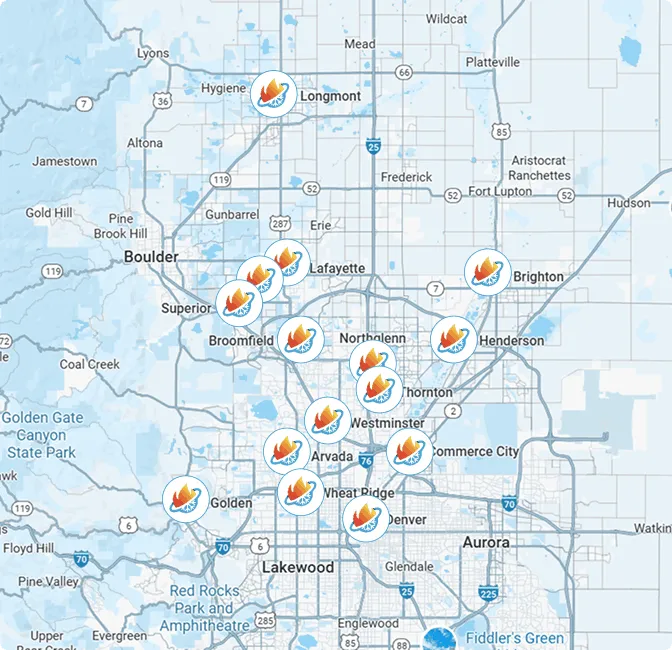
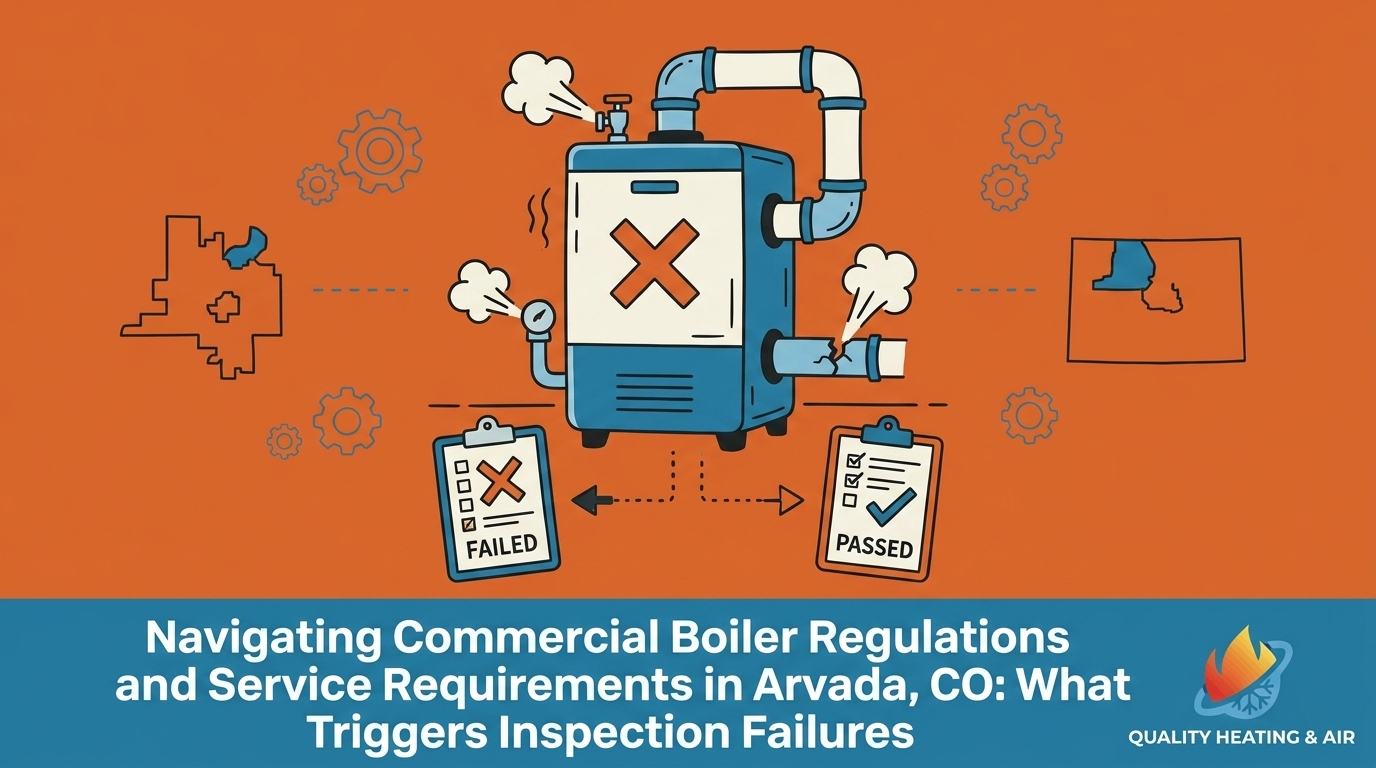
Navigating Commercial Boiler Regulations and Service Requirements in Arvada
The August Deadline: Why Commercial Facilities Fail Fall Inspections
Your mechanical room is quiet, the outdoor temperatures are still high, and winter feels months away—but a critical deadline is already closing in. Navigating Commercial Boiler Regulations and Service Requirements in Arvada requires proactive planning, yet many building owners wait until the first cold snap to schedule their mandatory compliance checks. By the time October arrives, state inspectors are booked solid, and unaddressed minor issues suddenly become catastrophic roadblocks to legally operating your heating system.
Here at Quality Heating & Air, we have spent years conducting inspections across local mechanical rooms, and we consistently see facilities failing their compliance checks due to easily preventable oversights that should have been caught during late summer (August) pre-heating prep. When a commercial boiler fails a state inspection, the resulting red tag doesn't just mean fines; it means your building cannot legally provide heat until repairs are made, re-tested, and re-certified. This is why partnering with a qualified mechanical contractor for comprehensive commercial heating services and dedicated commercial boiler service is not just about comfort—it is about strict regulatory survival.
Understanding Colorado OPS and Municipal Boiler Codes
Commercial boiler operation in Colorado is heavily regulated to protect life safety in high-occupancy buildings. The primary governing body is the Colorado Division of Oil and Public Safety (OPS), which enforces strict periodic inspection schedules for all commercial pressure vessels. However, compliance is rarely a single-layered process. Facility managers must also navigate local municipal codes that dictate how these systems interact with building safety, fire codes, and ventilation standards.
When the Quality Heating & Air team performs compliance evaluations in Arvada commercial districts, we often find that building owners misunderstand the overlapping jurisdictions. The state OPS inspector is primarily concerned with the pressure vessel itself and its immediate safety controls. Meanwhile, local municipal codes may dictate broader mechanical room requirements, such as emergency egress, carbon monoxide monitoring, and structural clearances. Failing to satisfy either set of regulations results in a failed inspection.
State vs. Local Compliance Focus
• Colorado OPS (State) — Primary Inspection Focus: Pressure vessel integrity, safety limits, CSD-1 documentation — Common Failure Triggers: Expired relief valves, failed low-water cutoffs, missing logbooks
• Municipal Code (Local) — Primary Inspection Focus: Mechanical room safety, ventilation, fire code adherence — Common Failure Triggers: Blocked combustion air, improper clearances, inadequate CO monitoring
Because these regulations frequently update to reflect new safety standards, what passed inspection five years ago might not pass today. Property managers in Arvada and surrounding service areas must work with commercial boiler specialists who stay current on both state mandates and local amendments to prevent unexpected shutdowns.
Demystifying CSD-1 Testing for Commercial Heating Systems
For any facility manager handling commercial boiler compliance and service expertise, the term "CSD-1" is unavoidable. The American Society of Mechanical Engineers (ASME) established the CSD-1 standard (Controls and Safety Devices for Automatically Fired Boilers) to ensure that every safety mechanism on a commercial boiler functions perfectly under simulated failure conditions. This is not a cursory visual check; it is a rigorous, mandatory testing protocol.
What CSD-1 Testing Actually Involves
During a CSD-1 test, licensed commercial technicians intentionally push the boiler's safety limits to verify that the system will shut itself down before a catastrophic failure occurs. The testing protocol covers several critical components:
• Low Water Cutoffs (LWCO): Simulating a loss of water to ensure the burner shuts down before the dry vessel overheats and cracks.
• High-Pressure and Temperature Limits: Verifying that the system cuts fuel supply if internal pressures or temperatures exceed safe operational thresholds.
• Flame Safeguard Controls: Testing the sensors that detect burner ignition failure, preventing raw fuel from flooding the combustion chamber.
• Operating Controls: Ensuring the staging and modulation controls respond accurately to the building's heating demand.
The Documentation Requirement: One of the most common reasons facilities fail this portion of their state inspection is a lack of proper documentation. The state requires a meticulously maintained logbook detailing every CSD-1 test, the specific results, and the signature of the licensed professional who performed it. If the state inspector arrives and the logbook is missing, incomplete, or out of date, the boiler fails the inspection automatically. Because this testing involves deliberately bypassing operating controls to test safety limits, it must exclusively be performed by licensed mechanical professionals with specific commercial credentials.
How Elevation Impacts Combustion and Compliance
A unique challenge for facilities in Arvada commercial districts is the environmental reality of operating heavy mechanical equipment at high altitude. At elevations exceeding 5,300 feet, the air is significantly thinner, meaning there is less oxygen available for the combustion process per cubic foot of air. This physical reality has a profound impact on commercial boiler performance, emissions, and safety compliance.
When a commercial boiler is manufactured and shipped from a factory near sea level, its fuel-to-air ratio is calibrated for dense, oxygen-rich air. If that same boiler is fired up in Colorado without specialized high-altitude combustion tuning, it will run "rich"—meaning there is too much fuel and not enough oxygen. This improper combustion generates excessive soot, which coats the heat exchanger and drastically reduces efficiency. More alarmingly, incomplete combustion produces dangerously high levels of carbon monoxide (CO).
Our technicians at Quality Heating & Air frequently see emissions failures during compliance inspections because systems were not properly adjusted for altitude. If the CO levels exceed the legal limits due to poor high-altitude tuning, the system will be red-tagged. Furthermore, the extreme cold typical of our winters combined with high altitude places a heavy, continuous load on these boilers. If a system is not precisely tuned to extract maximum heat safely from the thinner air, it will struggle to maintain building temperatures, risking frozen pipes and severe structural damage. Proper combustion analysis and tuning by local commercial experts are non-negotiable steps for both compliance and winter reliability.
First-Hand Observations: Minor Oversights That Trigger Major Failures
In our years serving Northglenn, Arvada, and surrounding communities, the Quality Heating & Air commercial team has documented the exact failure points that consistently trip up building managers. Because we provide commercial boiler compliance and service expertise directly in these mechanical rooms, we know that massive, catastrophic equipment failures are rarely what cause a failed inspection. Instead, it is almost always a cascade of minor, overlooked maintenance items that trigger a red tag.
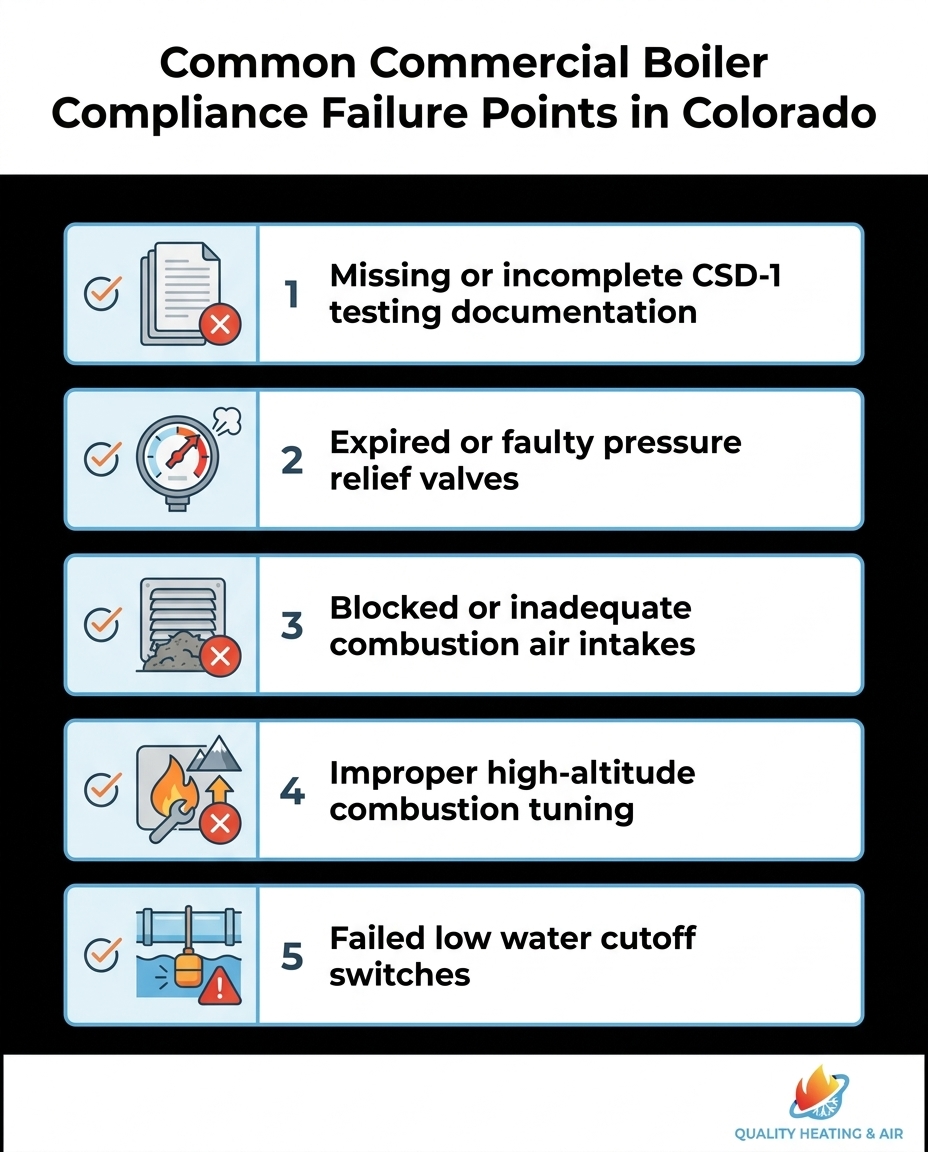
The Most Common Compliance Roadblocks
1. Expired Safety Relief Valves: Pressure relief valves are designed to vent excess pressure safely. However, these valves have a strict expiration date stamped directly on their tags. What we consistently see in mechanical rooms is a perfectly functioning boiler failing inspection simply because the relief valve is five years old and was never swapped out during routine service.
2. Blocked Combustion Air Intakes: Boilers require a massive volume of fresh air to operate safely. Often, facility staff will unknowingly block louvered doors or stack storage boxes in front of the combustion air intakes. When the inspector notes that the room lacks adequate ventilation, the system fails due to the high risk of carbon monoxide buildup.
3. Seized Low-Water Cutoff Switches: If a boiler is not blown down regularly to remove sediment, the float inside the low-water cutoff switch becomes encased in sludge and seizes. During a CSD-1 test, this switch will fail to drop and shut off the burner, resulting in an immediate safety failure.
4. Missing or Incomplete Logbooks: As mentioned earlier, a pristine boiler will still fail if the paperwork is not in order. We frequently find that logbooks have been lost during staff turnover or left completely blank since the previous heating season.
The cascading effect of these failures is severe. If your facility fails an inspection in October, finding a licensed contractor to perform the necessary repairs, source the commercial parts, and schedule a re-inspection can take weeks. During that time, your building remains without legally compliant heat.
Structuring a Proactive Late-Summer Maintenance Strategy
The key to avoiding the stress and operational downtime of a failed inspection is shifting the timeline. As students head back to school and the late-summer cooling season winds down, facility managers must view August pre-heating prep as the hard deadline for compliance readiness, rather than waiting for the state inspector's notice to arrive in the mail.
A comprehensive pre-heating season prep strategy begins with scheduling a full professional evaluation with Quality Heating & Air before Labor Day. This timing is critical for supply chain reasons. Commercial boiler parts—such as specific high-capacity relief valves, specialized aquastats, or proprietary flame sensors—are rarely stocked on local shelves. If our technicians identify a failing component during an August walkthrough, there is ample lead time to order the part, install it, and re-test the system before the heating season begins.
The Value of Consistent Maintenance: The most effective way to guarantee compliance is by removing the burden of scheduling entirely. Enrolling your facility in a routine maintenance plan ensures that licensed professionals are systematically checking your equipment, blowing down sediment, analyzing high-altitude combustion, and keeping your CSD-1 logbooks meticulously updated year-round. When the state inspector finally arrives, your mechanical room is already fully prepared, documented, and operating safely within regulatory bounds.
When Compliance Issues Signal It's Time for an Upgrade
There comes a point in every commercial building's lifecycle where maintaining an aging boiler becomes an exercise in diminishing returns. While our commercial boiler compliance and service expertise allows us to keep older systems running safely, some units become too obsolete to pass rigorous modern CSD-1 testing without prohibitive, ongoing costs.
Signs that a commercial boiler is nearing the end of its compliant lifespan include parts that are no longer manufactured, heat exchangers that show signs of structural fatigue, and a chronic inability to maintain safe emissions levels despite repeated high-altitude tuning. When a facility manager is spending a significant portion of their operating budget just to force an old boiler past the state inspector year after year, the long-term ROI heavily favors replacement. Upgrading to a high-efficiency model may also qualify your facility for utility incentives or energy tax credits—be sure to verify current programs with your utility provider.
Upgrading to a modern, high-efficiency commercial boiler system resolves compliance headaches instantly. Modern units feature advanced, integrated safety controls, precise modulation for high-altitude environments, and significantly lower operating costs. If your aging infrastructure is becoming a regulatory liability, exploring modern commercial boiler replacement solutions is the most financially sound decision for the future of your facility.
Frequently Asked Questions About Commercial Boiler Compliance in Colorado
How often do commercial boilers require inspection in Colorado?
The Colorado Division of Oil and Public Safety (OPS) dictates the inspection frequency based on the specific type and size of the boiler. Generally, high-pressure commercial boilers require an internal and external inspection annually. Low-pressure heating boilers typically require a certificate inspection every two years, though local municipal codes or insurance providers may require more frequent evaluations. It is critical to verify your specific equipment's classification to ensure you do not miss a mandatory inspection window.
What is CSD-1 testing for commercial boilers?
CSD-1 stands for Controls and Safety Devices for Automatically Fired Boilers, a standard established by ASME. This testing protocol requires a licensed professional to systematically test and document the function of every safety limit on the boiler, including low-water cutoffs and high-pressure limits. The goal is to verify that the boiler will safely shut itself down during a malfunction, preventing catastrophic pressure events or fires.
What causes a commercial boiler to fail a state inspection?
State inspections are rigorous, and failures are often triggered by a combination of minor oversights rather than total system breakdowns. The most common causes include expired pressure relief valves, missing or incomplete CSD-1 testing logbooks, inadequate combustion air ventilation in the mechanical room, and safety switches that fail to trigger during simulated tests. Keeping up with late-summer preventative maintenance is the best way to catch these issues before the inspector arrives.
What are the requirements for a commercial boiler room?
Regulatory requirements for the mechanical room itself focus heavily on life safety and proper equipment operation. The room must feature adequate, unblocked combustion air intakes to ensure safe burner operation and prevent carbon monoxide generation. Additionally, the space must adhere to strict clearance requirements around the equipment for safe servicing, feature accessible emergency shutoff switches located outside the immediate boiler area, and maintain active, commercial-grade carbon monoxide monitoring systems.
Can a facility manager perform their own CSD-1 testing?
No, a facility manager or unlicensed maintenance staff member cannot legally perform or sign off on CSD-1 testing. Because the testing process involves deliberately bypassing operating controls to push the boiler to its safety limits, it requires specialized knowledge and tools. The State of Colorado strictly requires that this testing be performed and documented by a licensed mechanical contractor holding the appropriate commercial credentials.
Secure Your Facility's Heating Compliance Before Winter
The window for proactive late-summer maintenance is short, and the consequences of missing it are severe. Waiting until the fall heating rush to address your mechanical room leaves your facility vulnerable to failed state inspections, unexpected red tags, and catastrophic winter downtime. By leveraging Quality Heating & Air's commercial boiler compliance and service expertise in August, you ensure that every safety valve, low-water cutoff, and logbook entry is perfectly aligned with Arvada and Colorado state regulations. Do not leave your building's winter reliability to chance—schedule your comprehensive commercial boiler walkthrough with our team today and secure your compliance long before the first freeze hits.

Testimonials
Neighbors trust Quality Heating & Air for honest work and fair pricing.
Service Areas