When Should a Property Manager Call for 24-Hour Emergency Boiler Repair?
Late-Night Boiler Failures: Making the Right Dispatch Decision
Your phone rings at 11 p.m. on a Saturday with a tenant reporting a sudden heating or hot water loss, leaving you to quickly decide: when should a property manager call for 24-hour emergency boiler repair? Balancing your maintenance budget against tenant satisfaction and safety is one of the most stressful parts of managing a multi-family property. Dispatching a technician in the middle of the night for a minor issue wastes valuable funds, but ignoring a critical failure can lead to severe liability, structural damage, or uninhabitable conditions.
A typical pattern we see involves unexpected boiler symptoms popping up during August pre-season testing and late-summer domestic hot water demand. Because commercial boilers often handle both space heating and the building's domestic hot water supply, a failure doesn't only happen in the dead of winter. Knowing exactly how to triage these symptoms allows you to protect your asset and your tenants without unnecessarily inflating your operating expenses. For comprehensive support, establishing a relationship for commercial heating services ensures you always have a trusted partner ready when true emergencies strike.
The High Stakes of Misdiagnosis
Property managers are not expected to be licensed HVAC technicians, but you do need a reliable framework for making dispatch decisions. Misdiagnosing a true emergency as a nuisance issue can result in frozen pipes, extensive water damage, or carbon monoxide exposure. Conversely, panicking over a noisy but functioning circulator pump drains your emergency repair budget. The key is separating immediate liabilities from issues that can safely wait for regular business hours.
When to Call 24/7 Emergency Boiler Service vs. Waiting
To help you make fast, confident decisions, we have categorized the most common boiler symptoms into a clear triage checklist. This framework is especially useful for managing Northglenn multi-family complexes, where a single boiler failure can impact dozens of units simultaneously.
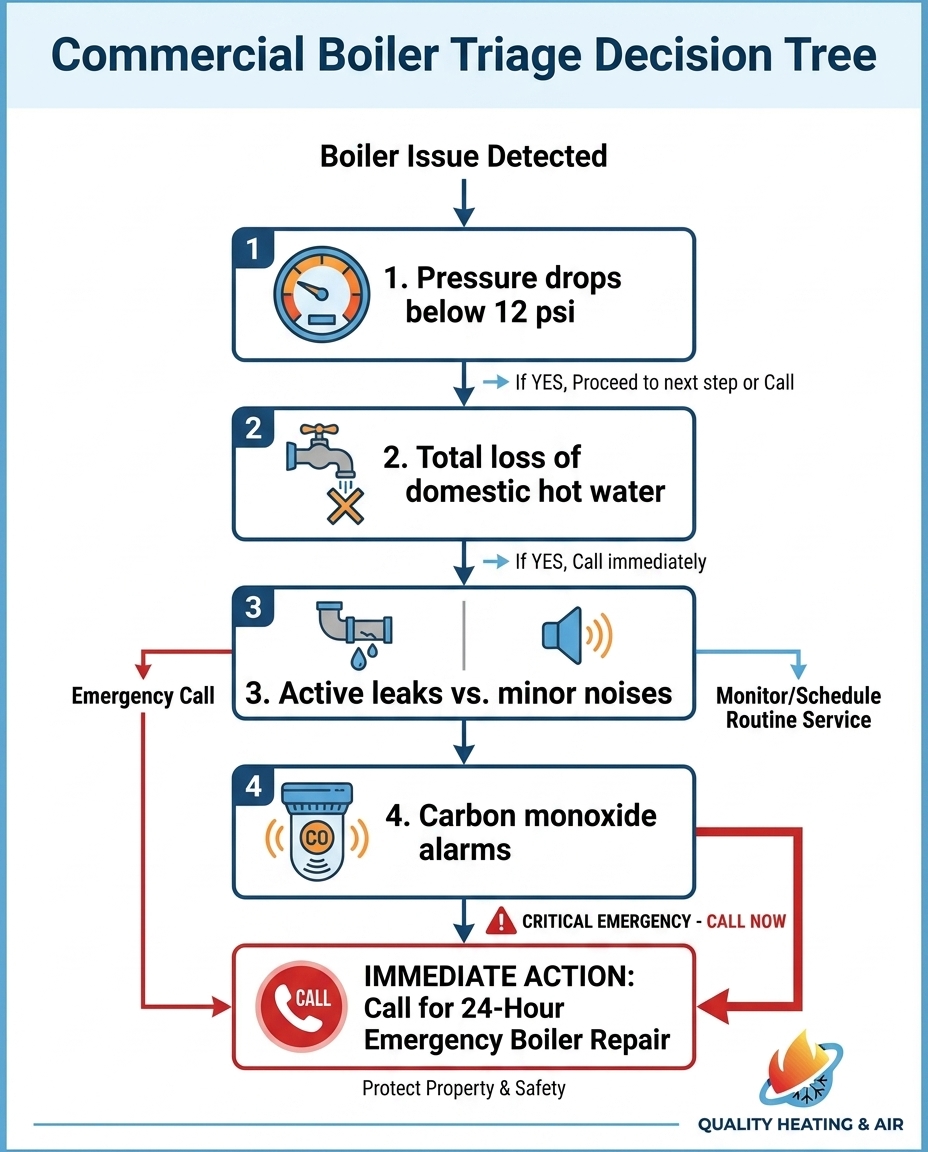
• Active water pooling around the base — Immediate Liability Risk?: High (Structural damage, electrical risk) — Action Required: Call for 24-hour emergency dispatch immediately.
• Carbon monoxide detector alarms sounding — Immediate Liability Risk?: Critical (Life safety hazard) — Action Required: Evacuate affected area, call 911, then call for emergency repair.
• Total loss of domestic hot water to the building — Immediate Liability Risk?: High (Habitability violation) — Action Required: Call for emergency dispatch to restore essential services.
• Pressure gauge drops below 12 psi — Immediate Liability Risk?: Moderate to High (System shutdown imminent) — Action Required: Monitor closely; if accompanied by heat/water loss, call immediately.
• Uneven heating in a single unit (others fine) — Immediate Liability Risk?: Low (Nuisance issue) — Action Required: Schedule a standard service call during business hours.
• Unusual humming or clicking noises — Immediate Liability Risk?: Low (Component wear) — Action Required: Wait for business hours unless accompanied by a loss of service.
When the triage checklist points to a critical failure, you need a partner who understands the scale of commercial systems. Quality Heating & Air provides reliable 24/7 emergency dispatch and commercial-grade expertise, ensuring you never have to guess if a technician can handle your building's capacity. If you are facing an active liability, secure emergency boiler repair services without delay.
Decoding the Pressure Gauge: Is a Drop an Immediate Emergency?
One of the most intimidating components for a non-technical property manager to interpret is the boiler's pressure gauge. Standard commercial boiler operating pressure typically sits between 12 and 15 psi (pounds per square inch). This pressure is necessary to push heated water all the way up to the highest floors of your multi-family building.
What it means when the pressure gauge dropping below 12 psi occurs:
A sudden or steady drop in pressure indicates that the system is losing water or that the pressure-reducing valve has failed. If the pressure falls too low, the boiler will trigger a safety lockout and shut down completely to prevent the internal components from cracking or melting due to dry firing.
How Low Pressure Impacts Tenant Services
When pressure drops, the first tenants to notice will be those on the upper floors. They will likely report lukewarm water, cold radiators, or a complete lack of flow. If you check the mechanical room and see the pressure gauge dropping below 12 psi, you are on the clock.
The dispatch decision: If the gauge is hovering right at 10 or 11 psi but the building still has hot water and no active leaks are visible, you can often safely wait until Monday morning for a scheduled inspection. However, if the gauge drops rapidly, hits zero, or triggers a total system lockout, you must treat it as an immediate middle-of-the-night emergency. Do not attempt to manually feed water into the system yourself, as introducing cold water to a hot, dry boiler can cause the cast iron sections to crack violently.
Evaluating August Pre-Season Testing Failures and Hot Water Outages
The Problem: Many property managers assume boiler emergencies only happen during winter blizzards. However, a significant number of urgent calls occur during August pre-season testing and late-summer domestic hot water demand. Tenants expect hot showers year-round, and if your commercial boiler provides that domestic hot water, a summer failure is just as disruptive as a winter heating loss.
The Cause: During the summer months, the boiler is not working as hard because the space heating loop is inactive. This lower operational state can mask underlying issues with pilot assemblies, gas valves, or pressure regulators. When August pre-season maintenance testing in Colorado is conducted—which is critical to preventing catastrophic winter freezing emergencies—these hidden vulnerabilities are often exposed. The sudden demand or the testing sequence itself can cause a fragile component to finally fail, resulting in a sudden loss of domestic hot water for the entire complex.
The Solution: Landlords have a strict legal responsibility to provide running hot water, regardless of the season. If a late-summer failure leaves your building without domestic hot water, it requires an immediate emergency dispatch. To prevent these untimely outages, the most effective strategy is enrolling in a routine boiler maintenance plan. Professional technicians can safely conduct pre-season testing, clean burners, and calibrate controls long before the heavy winter demand begins, ensuring seamless operation for both heating and domestic hot water.
Tenant Safety and Liability: Carbon Monoxide and Active Leaks
When managing Northglenn multi-family complexes, your primary directive is protecting tenant safety and mitigating liability. Certain boiler symptoms leave no room for debate regarding emergency dispatch. If you encounter these issues, budget concerns regarding after-hours service rates must immediately take a back seat to safety.
Carbon Monoxide: The Silent Threat
Commercial boilers burn fuel (typically natural gas) to generate heat. If the heat exchanger cracks or the venting system becomes blocked, deadly carbon monoxide (CO) can spill into the mechanical room and seep into tenant living spaces.
• Immediate Action: If CO detectors in the mechanical room or adjacent apartments sound, this is a life-safety emergency. Evacuate the affected area, call emergency services, and immediately dispatch your 24-hour boiler technician.
• Liability Risk: Failing to act instantly on a CO alarm exposes ownership to massive legal liability and puts lives at severe risk.
Active Leaking and Structural Damage
A few drops of water weeping from a valve is a maintenance issue; a steady stream or pooling water on the mechanical room floor is an emergency. Commercial boilers hold a massive volume of water. An active leak can quickly flood the mechanical room, destroying expensive electrical panels, water heaters, and structural foundations.
Furthermore, the Colorado Warranty of Habitability strictly outlines landlord responsibilities regarding functioning plumbing and essential services. An active leak usually requires shutting down the main water feed to the boiler, which instantly deprives the building of heat and hot water. To protect your property and comply with local regulations across all local service areas, active leaks require an immediate emergency response.
Nuisance Boiler Symptoms That Can Wait Until Monday Morning
Not every strange noise or minor tenant complaint requires a midnight dispatch. Learning to identify nuisance symptoms helps you conserve your maintenance budget for true emergencies. If the boiler is still maintaining normal pressure and providing hot water to the majority of the building, the issue can usually wait.
• Noisy circulator pumps: A grinding or whining sound from the pumps is annoying, but if the pressure gauge is normal and water is flowing, the pump is still functioning. You can safely schedule a replacement during regular hours.
• Isolated uneven heating: If one tenant complains their unit is cold, but the rest of the building is fine, the boiler is working. The issue is likely a localized zone valve, a trapped air pocket in that specific apartment's baseboard, or a faulty thermostat. This does not warrant a full commercial boiler emergency call.
• Minor valve weeping: A slow drip that evaporates before it hits the floor or leaves a small, manageable puddle can be monitored over the weekend. Place a bucket underneath and schedule a Monday repair.
• Intermittent pilot clicking: If the electronic ignition is clicking more than usual but the burners eventually light and the building has hot water, the sensor needs cleaning. It is not an immediate crisis.
Managing Tenant Expectations
When you decide to wait until regular business hours, clear communication is essential. Inform the affected tenants that the issue has been logged, a professional assessment is scheduled for the next business day, and explain that the main building systems are secure.
If you find yourself constantly dealing with these nuisance issues, the equipment may be nearing the end of its operational lifespan. Repeatedly paying for after-hours repairs on a failing system drains your budget rapidly. In these cases, exploring affordable boiler replacement options is a more fiscally responsible long-term strategy than endless patchwork fixes.
Frequently Asked Questions About Commercial Boiler Emergencies
What constitutes a commercial boiler emergency?
A true commercial boiler emergency involves a total loss of heat during freezing temperatures, a complete loss of domestic hot water, active water leaks, or carbon monoxide detection. These situations threaten tenant safety, risk severe property damage, and violate habitability laws. If any of these conditions are present, an immediate 24-hour dispatch is required.
Is a leaking boiler an emergency?
Yes, if the leak is active and significant, it risks severe property damage and complete system failure. A steady flow of water can flood mechanical rooms and destroy nearby electrical equipment. However, minor weeping at a valve can often be monitored with a bucket until morning, provided you schedule a professional assessment promptly.
How fast must landlords fix hot water in Colorado?
Under the Warranty of Habitability, landlords must address a lack of hot water promptly, as it is considered an essential service. Failure to provide running hot water makes a residential unit legally uninhabitable. Property managers should dispatch a technician immediately to restore domestic hot water, even outside of the winter heating season.
Is a boiler pressure drop dangerous?
A drop below standard operating levels indicates a leak, a failing valve, or a compromised system boundary. While low pressure is not typically an explosive hazard, it leads to a total system shutdown (lockout) to prevent dry-firing, which will leave your building without essential services. If the pressure drops rapidly, it requires professional diagnosis to prevent internal cracking.
What should a property manager check before calling for emergency repair?
Check the main thermostat settings, verify that the main power switch to the boiler was not accidentally bumped off, and observe the pressure gauge reading. Do not attempt to adjust valves, manually feed water, or reset lockouts repeatedly. Gathering this basic symptom information helps the dispatcher understand the severity of the issue before the technician arrives.
Can a pilot light failure wait until regular business hours?
It depends entirely on the building's current demand. If the pilot fails during the summer and the boiler only provides winter space heating, it can wait. However, if that boiler also supplies the building's domestic hot water, a pilot failure means no hot showers for tenants, elevating it to an emergency dispatch situation.
Secure Reliable 24-Hour Commercial Boiler Support
The peace of mind that comes with knowing exactly when to dispatch an emergency technician is invaluable for property managers. By understanding the difference between a nuisance noise and a critical liability—like a pressure gauge dropping below 12 psi or an unexpected failure during August pre-season testing and late-summer domestic hot water demand—you can protect your budget while keeping tenants safe.
However, triage is only half the battle; you also need a trusted commercial partner ready to answer the call when a midnight failure does occur. Don't wait until the mechanical room is flooding to find a reliable contractor. Save your emergency dispatch number now, establish a preventative maintenance routine, and ensure your multi-family property is protected around the clock.

Testimonials
Neighbors trust Quality Heating & Air for honest work and fair pricing.
Service Areas