Step-by-Step Guide to Tankless vs Tank Water Heaters
## Tankless vs Tank Water Heater for Your Home: What Thornton Homeowners Need to Know
Choosing a tankless vs tank water heater for your home is one of the most practical decisions you can make as a homeowner — and it affects your energy bills, your hot water supply, and your long-term comfort every single day. If your current water heater is aging, leaking, or just not keeping up with your household's demand, you're probably wondering which direction to go. Here's a quick answer before we dive deeper:
Quick Answer: Tankless vs Tank Water Heater
| Factor | Tank Water Heater | Tankless Water Heater | | --- | --- | --- | | How it works | Stores and continuously heats 30–80 gallons | Heats water on demand as you use it | | Hot water supply | Limited to tank capacity | Continuous, as long as sized correctly | | Energy efficiency | Lower — loses heat while sitting idle | Higher — no standby heat loss | | Upfront cost | Lower | Higher | | Lifespan | 8–12 years on average | 15–20+ years with proper maintenance | | Space needed | Larger footprint | Compact, wall-mounted | | Best for | Smaller budgets, simpler installs | Long-term savings, high-demand households |
Most homeowners in the Thornton and Northglenn area are choosing between these two systems when it's time to replace an aging unit — often without much warning. A cold shower or a puddle on the basement floor tends to force the decision fast. The good news is that once you understand how each system actually works, the right choice for your home becomes much clearer.
Tankless vs tank water heater for your home vocab explained:
- energy efficient water heater options - how to choose the right water heater
How Tank and Tankless Systems Deliver Hot Water
To truly evaluate which system fits your household's lifestyle, it helps to look under the hood. While both options have the same ultimate goal—delivering hot water to your taps—their methods for achieving this are fundamentally different.
Understanding the Tankless vs Tank Water Heater for Your Home
A tankless water heater is often referred to as an "on-demand" or "instantaneous" system. Instead of storing hot water for future use, it remains idle until you turn on a hot water tap.
When you open a faucet, cold water flows into the unit. A sensor detects this flow and immediately activates a heating source—either a high-powered gas burner or an electric heating element. The water is rapidly heated as it passes through a sophisticated component called a heat exchanger.
Because there is no storage tank to empty, a tankless system provides a continuous flow of hot water. As long as water is running through the unit, it will keep heating it. However, the amount of hot water it can deliver at any single moment is limited by its flow rate, which is measured in gallons per minute (GPM). If you exceed this flow rate by running too many appliances at once, the water temperature may drop.
To explore these mechanics further, you can read our detailed Tankless vs Tank Water Heater Comparison guide.
Traditional Storage Tank Mechanics
A traditional storage tank water heater operates like a thermal battery. It features an insulated reservoir—typically holding anywhere from 30 to 80 gallons of water—that constantly maintains a set temperature, usually around 120 to 140 degrees Fahrenheit.
Cold water enters the bottom of the tank, where it is heated by a gas burner underneath or by electric elements suspended inside the tank. As hot water is used, it is drawn from the top of the tank and distributed to your home.
The primary drawback of this design is standby energy loss. Because the tank must keep those 50 or so gallons hot 24 hours a day, the burner or heating elements must cycle on and off repeatedly, even when everyone is asleep or away from home. Additionally, once the stored hot water is fully depleted, the system requires "recovery time" to heat a fresh tank of cold water, which can take anywhere from 30 to 60 minutes depending on the fuel source.
Evaluating a Tankless vs Tank Water Heater for Your Home
When comparing these two technologies, energy efficiency and daily operating expenses are usually at the top of every homeowner's list.
By eliminating standby heat loss, tankless systems are significantly more efficient. For households utilizing 41 gallons or less of hot water daily, tankless water heaters can be 24% to 34% more energy efficient than conventional storage tank models. Even in busier households that consume around 86 gallons of hot water per day, tankless systems remain 8% to 14% more energy efficient.
Over time, these efficiency gains translate into noticeable utility savings. In fact, choosing a tankless system can reduce water-heating energy costs by 60% or more compared to a standard 50-gallon electric tank heater, saving homeowners up to 40% on their water-heating bills. On average, this helps local families save $100 or more annually on their energy bills.
To help you visualize the differences, we have compiled an overview of how these systems compare across key operational categories:
| Feature | Traditional Storage Tank | Tankless (On-Demand) | | --- | --- | --- | | Standby Energy Loss | High (constantly reheats stored water) | None (heats only on demand) | | Typical Efficiency Rating | 60% – 65% UEF | 80% – 99% UEF | | Hot Water Limit | Limited to the size of the tank | Endless (within GPM capacity) | | Space Required | High (requires dedicated floor space) | Extremely low (wall-mounted) | | Risk of Water Damage | Higher (tank can burst or leak over time) | Low (no large reservoir to rupture) |
When deciding which option is best for your home, consider these key decision factors:
- Length of Home Ownership: If you plan to stay in your Thornton or Northglenn home for more than a decade, the long-term energy savings and durability of a tankless system make it highly appealing. - Daily Hot Water Habits: Large families who frequently run out of hot water during morning showers often find the endless supply of a tankless unit to be a game-changer. - Available Fuel Sources: Gas-fired tankless units generally offer higher flow rates than electric models, making them the preferred choice for homes with existing gas lines.
To learn more about maximizing your home's utility savings, check out our resource on Energy Efficient Water Heater Options and read our analysis on Is a Tankless Water Heater Worth It.
Installation, Space, and Maintenance Requirements
The physical footprint and installation environment of your water heater play a major role in your final decision.
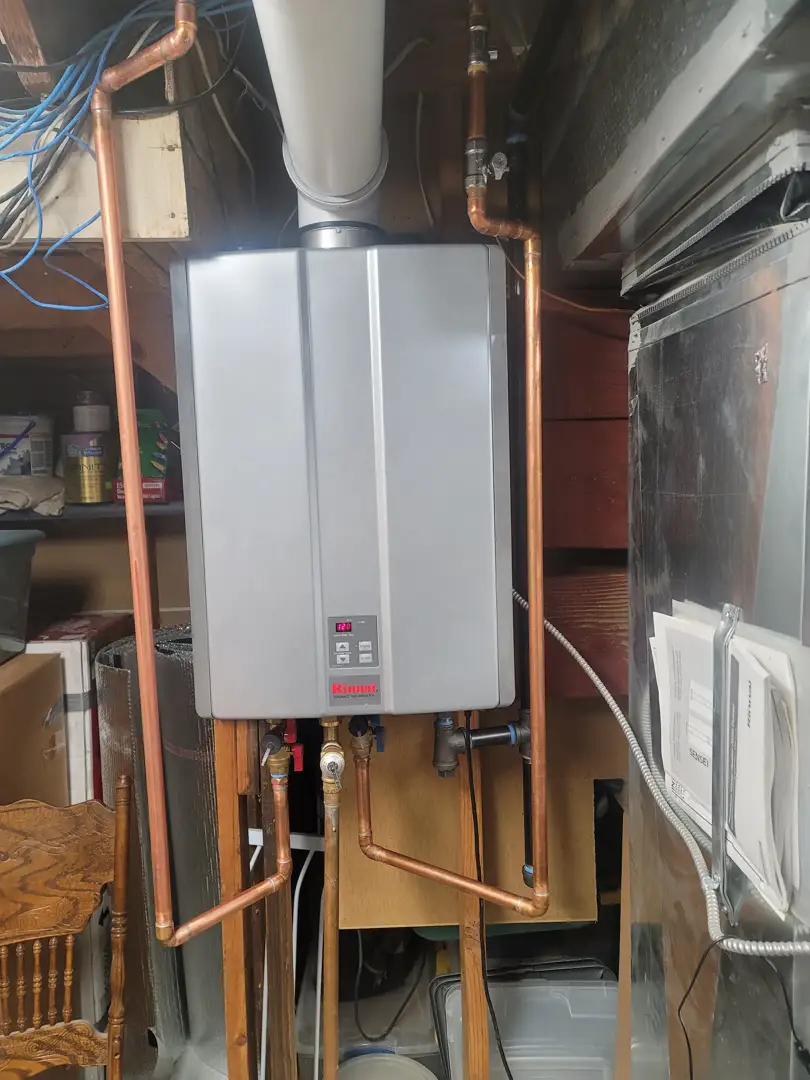
Traditional tanks are bulky, floor-standing units that require a significant amount of dedicated space in a basement, utility closet, or garage. Conversely, tankless water heaters feature a compact, wall-mounted design. This small physical footprint allows them to be installed in tight spaces, such as closets or pantries, freeing up valuable floor space in your home.
However, retrofitting a tankless unit into a home designed for a tank system is rarely a simple "plug-and-play" process. Tankless gas systems require specialized Category III stainless steel or specific PVC venting to handle highly acidic condensation and high-temperature exhaust. Furthermore, because tankless units require a large burst of energy to heat water instantly, they often demand upgraded gas lines (typically transitioning from a 1/2-inch to a 3/4-inch line) or significant electrical panel upgrades to handle the high amperage.
For a smooth transition that complies with local building codes, professional installation is essential. You can learn more about how our expert team handles these projects by visiting our page on Water Heater Installation Westminster Co.
Maintenance Needs for Tankless vs Tank Water Heater for Your Home
To keep either system operating safely and efficiently, routine maintenance is required.
For tankless water heaters, the primary maintenance task is annual flushing and descaling. Because water is heated and rapidly inside the heat exchanger, dissolved minerals like calcium and magnesium can quickly settle out of the water and form scale. If left unaddressed, this mineral scale acts as an insulator, forcing the heat exchanger to work harder, reducing efficiency, and potentially shortening the unit's lifespan by 30% to 40%.
Traditional tank heaters require a different maintenance approach. Over time, heavy sediment settles at the bottom of the tank, which can cause popping noises and reduce heating efficiency. Homeowners should perform an annual flush to clear out this debris.
Additionally, tank systems rely on a sacrificial anode rod to attract corrosive elements in the water, protecting the steel tank lining from rusting. This rod should be inspected and replaced every 3 to 5 years. Neglecting this simple step can lead to catastrophic failure; nearly 75% of traditional tank heaters eventually burst or leak, spilling 30 to 80 gallons of rusty water into basements or utility rooms.
For a complete breakdown of how to care for your system, see our comprehensive Water Heater Maintenance Guide Clayton Co.
Lifespan, Reliability, and Household Demand
Investing in a new water heater is a long-term commitment, making system longevity a vital consideration.
A traditional tank water heater typically provides 8 to 12 years of reliable service. Because the tank is constantly filled with water, rust and corrosion are inevitable over time.
In contrast, most tankless water heaters have a life expectancy of more than 20 years. Because they do not store water, they are far less prone to corrosion. Additionally, tankless systems are designed with highly serviceable, replaceable parts, meaning a technician can often swap out a single worn component rather than replacing the entire system.
To learn more about maximizing the life of your equipment, explore our detailed guides on How Long Does a Water Heater Last, our Tankless Water Heaters Lifespan Guide 2026, and our practical tips on How to Extend the Life of Your Water Heater.
While tankless systems excel in longevity, they do have limitations when it comes to simultaneous household demand. If you have a large family where multiple people need to shower, run the dishwasher, and wash clothes at the same time, a single tankless unit might struggle to keep up.
Another common characteristic of tankless systems is the "cold-water sandwich" effect. This occurs when a hot water tap is turned off and quickly turned back on. A small pocket of cold water that entered the system while the burner was restarting can travel down the pipe, resulting in a brief, unexpected blast of cold water mid-shower. Fortunately, this can be easily resolved by installing a small buffer tank or a recirculation pump.
Sizing and Climate Considerations
In Colorado, our local climate plays a major role in water heater performance. During our cold winters, the temperature of incoming groundwater drops significantly.
Because the incoming water is much colder, your water heater must work harder to raise the temperature to a comfortable level. For a tankless system, this larger "temperature rise" means the unit must slow down the flow of water to ensure it gets fully heated, which reduces the available gallons per minute (GPM) at your faucets. A unit that easily supplies three simultaneous showers in a warmer climate might only support one or two during a cold Colorado winter.
If you are looking for an alternative that combines the benefits of both systems, a hybrid heat pump water heater is an excellent option. These systems feature a built-in storage tank but utilize advanced heat pump technology to pull heat from the surrounding air and transfer it to the water.
Heat pump water heaters are incredibly efficient, often operating at 200% to 400% efficiency. However, because they rely on ambient air temperature, they work best when installed in unconditioned basements or utility rooms that maintain a temperature above 40 degrees Fahrenheit year-round.
Frequently Asked Questions About Water Heaters
How long do tankless water heaters last compared to tank models?
Tankless water heaters typically last 15 to 20 years or more with proper annual maintenance, which is roughly double the lifespan of traditional tank models (which average 8 to 12 years). Because tankless units do not store water, they suffer from far less internal corrosion.
Can a tankless water heater handle multiple showers at once?
Yes, provided the unit is sized correctly for your household's peak demand and local groundwater temperatures. In colder climates like Colorado, a high-capacity gas tankless water heater is usually required to run multiple showers simultaneously.
Is it difficult to convert from a tank to a tankless system?
Converting from a tank to a tankless system is a common project, but it does require professional expertise. The process involves removing the old tank, mounting the new unit, installing specialized venting, and often upgrading your home's gas lines or electrical panel to meet the higher energy demands of on-demand heating.
To learn more about the replacement process, check out our guide on Water Heater Replacement Westminster Co.
Conclusion
Choosing a tankless vs tank water heater for your home comes down to finding the right fit for your household's daily habits, long-term plans, and property layout. While traditional tanks remain a reliable and cost-effective option for many families, tankless systems offer unmatched space savings, long-term energy efficiency, and an endless supply of hot water.
At Quality Heating and Air, we are proud to serve our neighbors in Thornton, Northglenn, and the surrounding Denver metro communities. Our team of experienced, friendly technicians is dedicated to helping you find the perfect comfort solutions for your home, treating every property we visit just like our own.
Whether you need routine maintenance to extend the life of your current system or are ready to explore a high-efficiency upgrade, we are here to help. Contact us today to schedule your consultation!
Explore our full range of services:
- Water Heater Services Westminster Co - Quality Heating and Air Water Heaters

Testimonials
Neighbors trust Quality Heating & Air for honest work and fair pricing.
Service Areas