Pros and Cons of Tankless Water Heaters: What to Know
## Are Tankless Water Heaters Worth It? A Quick Look at the Pros and Cons
The pros and cons of tankless water heaters come down to a straightforward trade-off: you get better energy efficiency, endless hot water, and a longer lifespan — but you'll pay more upfront and face some real limits on how much hot water you can deliver at once.
Here's a quick breakdown before we dive deeper:
Pros of Tankless Water Heaters
- Heats water on demand, so no standby energy loss - Can be 24%–34% more energy efficient for average households - Lasts 20+ years compared to 10–15 years for traditional tanks - Wall-mounted design saves significant floor space - No large tank means lower risk of flooding or water damage
Cons of Tankless Water Heaters
- Higher upfront cost and more complex installation - Limited flow rate (typically 2–5 gallons per minute for electric, up to 10 GPM for gas) - Running multiple hot water fixtures at once can exceed capacity - May require gas line upgrades, new venting, or electrical panel work - Requires electricity to operate — no hot water during power outages - Annual descaling maintenance is essential, especially in hard water areas
If you're a homeowner in Thornton, Colorado weighing whether to upgrade your water heater, you're not alone. The question comes up constantly: stick with the familiar tank model in the basement, or make the switch to a tankless system that promises lower bills and hot water that never runs out? The honest answer is that tankless water heaters are a smart choice for many homes — but not every home. Your fuel source, household size, daily hot water habits, and even Colorado's cold groundwater temperatures all play a role in whether going tankless actually pays off for you.
This guide walks through every major factor so you can make a confident, informed decision.
Understanding the Pros and Cons of Tankless Water Heaters
To truly understand the pros and cons of tankless water heaters, we have to look at how they manage water heating compared to traditional storage tanks.
Traditional water heaters keep a large reservoir—usually between 40 and 80 gallons—hot 24 hours a day, 7 days a week. Whether you are fast asleep, at work, or away on vacation, that tank is constantly firing up to combat "standby heat loss." This is the natural cooling that happens as heat escapes through the walls of the tank. It is highly reliable, but it is not particularly energy efficient.
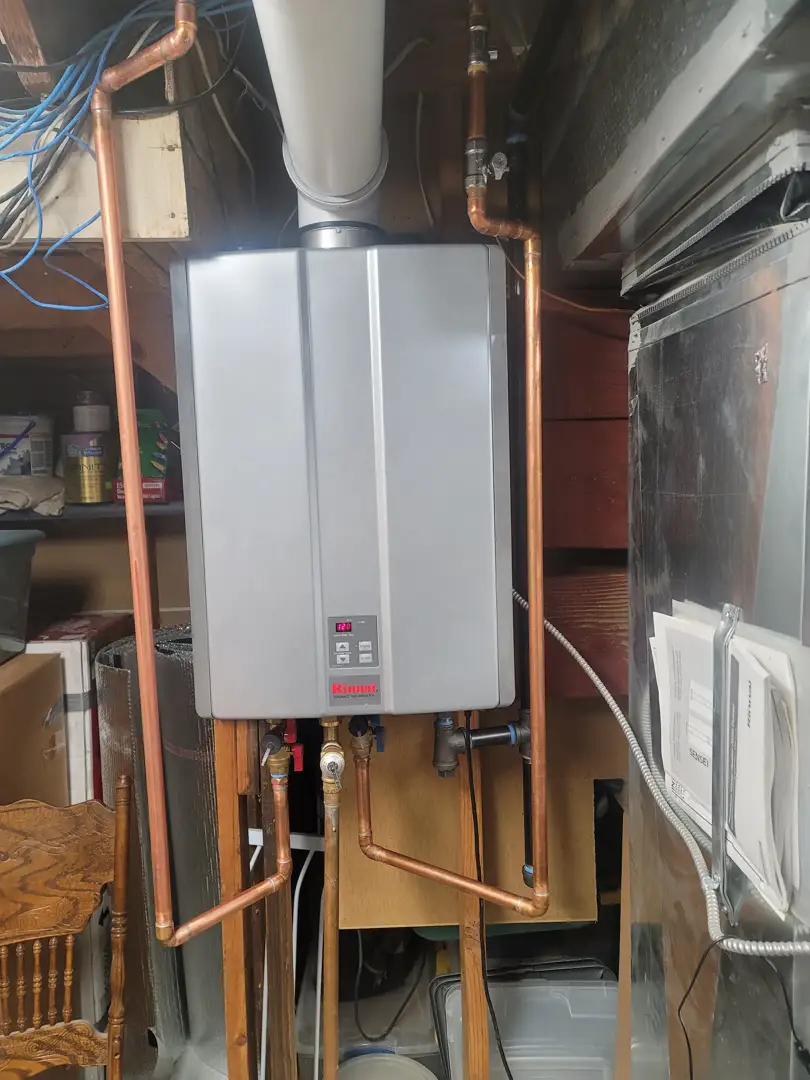
Tankless water heaters, often called "demand-type" or "instantaneous" water heaters, completely eliminate the tank. When you turn on a hot water tap, cold water travels into the unit. A flow sensor registers this movement and immediately activates either a high-powered gas burner or an electric heating element. The water circulates through a compact heat exchanger, warms up instantly to your target temperature, and flows straight to your faucet.
The moment you close the tap, the system shuts down. No standby loss, no wasted fuel, and no heating water when you do not need it.
To help you visualize the differences, here is a direct comparison of the two technologies:
| Feature | Tankless Water Heaters | Traditional Tank Water Heaters | | --- | --- | --- | | Primary Benefit | Endless hot water & high energy efficiency | Lower upfront cost & simple installation | | Lifespan | 20+ years (with proper maintenance) | 10–15 years | | Standby Energy Loss | None | Continuous | | Space Required | Minimal (wall-mounted, small suitcase size) | Large footprint (takes up closet/floor space) | | Flow Rate | Limited by GPM capacity of the unit | High initial flow (limited by tank volume) | | Power Outage Operation | Will not run without electricity | Gas models with standing pilots can still run | | Water Damage Risk | Extremely low (no stored water) | Moderate to high (tank rupture risk) |
For a deeper dive into how these two systems match up side-by-side, check out our comprehensive Tankless vs Tank Water Heater Comparison.
Key Advantages of Going Tankless
Making the switch to a tankless system offers several compelling benefits that go far beyond just saving a bit of money on your monthly bills. Let's look at the primary reasons homeowners choose to go tankless.
Energy Efficiency and Lower Utility Bills
The most common reason homeowners ask us about tankless systems is the promise of lower utility bills. Because they only heat water on demand, tankless systems are significantly more efficient than storage tanks.
According to the U.S. Department of Energy:
- For homes using 41 gallons or less of hot water daily, tankless water heaters can be 24% to 34% more energy efficient than conventional storage tank models. - For larger households with higher hot water demands (around 86 gallons per day), they still offer an 8% to 14% efficiency advantage.
By eliminating standby heat loss, a tankless unit can save the average household over $100 per year on utility bills. Over the course of the system's long lifespan, those savings add up to thousands of dollars. If you are interested in exploring other ways to cut your home's energy consumption, take a look at our guide on Energy Efficient Water Heater Options.
Extended Lifespan and Durability
A traditional tank water heater is constantly holding water, which means it is in a perpetual race against rust and corrosion. Even with a sacrificial anode rod working to protect the steel tank, most storage models only last between 10 and 15 years before the tank rusts through and must be replaced.
Tankless water heaters have a major advantage here. Because they do not store water, they are far less prone to corrosion. Most high-quality tankless systems have an expected lifespan of more than 20 years—nearly double that of a traditional tank. Furthermore, tankless units are built with modular, highly replaceable parts. If a heat exchanger or a control board fails, we can replace that specific component rather than scrapping the entire unit.
To learn more about how long different systems last and how to maximize their service life, explore our resources on How Long Does a Water Heater Last and our updated Tankless Water Heaters Lifespan Guide 2026.
Endless Hot Water Supply
We have all been there: you are the third person in line for the morning shower, and by the time you lather up, the water turns icy cold. With a traditional tank, once you use up the 40 or 50 gallons of stored hot water, you have to wait 20 to 45 minutes for the tank to recover.
With a tankless system, recovery time is a thing of the past. Because the unit heats water continuously as it flows, you get an endless supply of hot water. You can take a 45-minute shower, and the water temperature will remain exactly the same from the first minute to the last. This is an absolute game-changer for larger families or households that love back-to-back showers.
Key Disadvantages and Limitations
While the advantages of tankless systems are impressive, they are not magic. There are some real-world limitations and installation hurdles that you must consider before making the switch.
Flow Rate Limitations and Sizing Challenges
While a tankless water heater can provide hot water endlessly, it cannot provide it infinitely all at once. The system is limited by its flow rate, measured in Gallons Per Minute (GPM).
A typical tankless unit can deliver between 2 and 5 GPM for electric models, and 5 to 10 GPM for gas-fired models. To put that into perspective:
- A standard shower head uses about 2.0 to 2.5 GPM. - A kitchen faucet uses about 1.5 to 2.2 GPM. - A washing machine uses around 1.5 to 2.0 GPM.
If you try to run two showers, the washing machine, and the dishwasher all at the exact same time, you might exceed the GPM capacity of your tankless unit. When this happens, the water pressure will drop, or the unit will struggle to keep the water at your desired temperature. Proper sizing is absolutely essential to prevent this issue. For a look at how to evaluate water heating options for your home, see our Water Heater Replacement Longmont Guide.
Higher Upfront Investment and Installation Complexity
The initial cost of purchasing and installing a tankless water heater is higher than a standard tank model. This is not just because the unit itself is a highly sophisticated piece of technology, but because retrofitting a tankless unit into an older home often requires significant infrastructure upgrades:
- Gas Line Resizing: Traditional gas tank water heaters typically require around 30,000 to 40,000 BTUs of gas. A gas tankless unit, which must heat water instantly, can require up to 199,000 BTUs. To supply this massive burst of energy, we often have to upgrade your gas line from a standard 1/2-inch pipe to a 3/4-inch pipe. - Venting Upgrades: Non-condensing gas tankless units produce extremely hot exhaust gases that require specialized Category III stainless steel venting. Condensing models are more efficient and can use cheaper PVC venting, but they still require dedicated venting to the outdoors and a drain line for acidic condensate water. - Electrical Panel Upgrades: If you choose an electric tankless water heater, it will place a massive draw on your electrical system. Many electric units require multiple dedicated 40-amp or 60-amp double-pole breakers, which might necessitate upgrading your entire electrical panel to 150 or 200 amps.
Because of these complexities, professional installation is non-negotiable. To learn more about what to expect during the installation process, check out our guide on Water Heater Installation Denver Co.
Maintenance Requirements and Hard Water Issues
Some marketing materials claim that tankless water heaters are completely maintenance-free, but that is a myth. In fact, skipping annual maintenance on a tankless unit can lead to catastrophic system failure.
Because tankless units heat water rapidly using a very compact heat exchanger, they are highly sensitive to mineral scale buildup. If you live in an area with hard water—which is very common in many Colorado communities—calcium and magnesium minerals will quickly bake onto the hot surfaces of the heat exchanger. Over time, this scale acts as an insulator, forcing the unit to run hotter and work harder to heat the water. This decreases efficiency and can eventually crack the heat exchanger, which is an expensive repair.
To protect your investment, we recommend:
- Annual Descaling: Flushing the unit with food-grade white vinegar once a year to dissolve mineral scale. - Water Softeners: Installing a water softener or whole-home filtration system if your water is exceptionally hard.
For professional assistance keeping your system running smoothly, visit our Water Heater Services Broomfield Co page.
Is a Tankless Water Heater Right for Your Home?
Now that we have weighed the pros and cons of tankless water heaters, how do you decide if the upgrade is actually a smart move for your specific household?
Evaluating the Pros and Cons of Tankless Water Heaters for Large Families
For families with high hot water demands, tankless systems are often a wonderful fit, but they require careful planning. If you have teenagers who take back-to-back showers, a tankless unit will ensure that nobody gets stuck with cold water.
However, if your family tends to run multiple hot water fixtures simultaneously—such as running the dishwasher, doing laundry, and showering all at the same time—you must size the system correctly. In larger homes with multiple bathrooms, we often recommend installing a high-BTU gas unit, or even installing two smaller, dedicated tankless units (one for the master suite and one for the rest of the house) to keep up with peak GPM demand.
If you are located in the northern Denver metro area and want to explore sizing options for your family, our Water Heater Replacement Thornton Co guide offers helpful local insights.
Analyzing the Pros and Cons of Tankless Water Heaters in Cold Climates
Living in Colorado means dealing with cold winters, which directly impacts how a tankless water heater performs.
The flow rate of a tankless system is tied to the temperature of the incoming groundwater. In the summer, groundwater might enter your home at a mild 55°F. To reach a comfortable shower temperature of 120°F, the water heater only needs to raise the temperature by 65 degrees (known as the "temperature rise").
In the dead of winter, however, that incoming groundwater can drop to a chilly 35°F or 40°F. Now, the unit has to achieve an 80-to-85-degree temperature rise. Because the water must spend more time in contact with the heat exchanger to get that hot, the maximum GPM flow rate of the unit will drop. A system that easily delivers 8 GPM in July might only deliver 5 GPM in January. When installing a tankless unit in cold climates, we always size the system based on winter groundwater temperatures to make sure you never experience a drop in performance when you need it most.
Frequently Asked Questions about Tankless Water Heaters
Do tankless water heaters work during power outages?
No. This is a common point of confusion, especially for homeowners looking at gas-fired tankless units. While gas units use natural gas or propane as their primary fuel source, they still rely on electricity to power the digital control board, the electronic ignition spark, the flow sensors, and the safety solenoid valves.
If the power goes out, your tankless water heater will not operate. If you live in an area prone to frequent winter power outages, you may want to consider pairing your tankless unit with a battery backup system or a home generator.
What is the "cold water sandwich" effect?
The "cold water sandwich" is a minor quirk unique to tankless systems. Imagine you turn on the hot water to wash your hands, turn it off for thirty seconds, and then turn it back on.
When you first turn the tap on, hot water flows. When you turn it off, a small pocket of unheated water enters the unit before the burners can fire up again. When you turn the tap back on, you will get the hot water that was already in the pipes, followed by a brief "sandwich" of cold water, followed by hot water again. Modern tankless units have largely resolved this issue by using small internal buffer tanks or advanced modulating burners, but it is still something to be aware of in older or budget-friendly models.
Are there tax credits or rebates available for tankless systems?
Yes! Because tankless water heaters are highly energy efficient, they frequently qualify for financial incentives that can help offset the initial installation cost.
Under current federal guidelines in 2026, Energy Star-certified gas tankless water heaters are eligible for federal tax credits (often up to 30% of the project cost, with a cap around $600). Additionally, local Colorado utility companies frequently offer rebates for homeowners who upgrade from a standard tank to a high-efficiency condensing tankless system. We always recommend checking with your local utility provider and tax professional to see what current savings you can claim.
Conclusion
Upgrading your home's water heating system is a significant decision. When weighing the pros and cons of tankless water heaters, it is clear that they offer incredible benefits: endless hot water, a massive reduction in energy waste, a compact footprint, and a lifespan that easily doubles that of a traditional tank. However, they also require a larger initial investment, professional installation, and a commitment to annual maintenance.
At Quality Heating and Air, we believe in providing honest, practical advice tailored to your home, your family's habits, and your budget. We proudly serve Thornton, Northglenn, Denver, and the surrounding Colorado communities, treating every home we visit just like our own. Whether you decide that a high-efficiency tankless system is the perfect upgrade or prefer the reliable simplicity of a traditional tank, our experienced team is here to help you find the perfect fit.
Ready to explore your options? Schedule your professional water heater consultation with Quality Heating and Air today, and let us help you enjoy reliable, efficient comfort all year round!

Testimonials
Neighbors trust Quality Heating & Air for honest work and fair pricing.
Service Areas