A Practical Guide to Federal Tax Credits for Furnace and AC Replacement

## What You Need to Know About Federal Tax Credits for Furnace and AC Replacement
Federal tax credits for furnace and ac replacement are available right now — and if you're planning an HVAC upgrade, they can put real money back in your pocket. Through December 31, 2025, the Energy Efficient Home Improvement Credit (Section 25C) lets homeowners claim 30% of the cost of qualifying HVAC equipment, up to set annual limits.
Here's a quick summary of what's available:
| Equipment Type | Max Annual Credit | Key Requirement | | --- | --- | --- | | Central air conditioner | $600 | SEER2 ≥ 17.0, EER2 ≥ 12.0 (split systems) | | Gas furnace | $600 | AFUE ≥ 97% | | Heat pump (air source) | $2,000 | Must meet CEE highest efficiency tier | | Combined annual max | $3,200 | Includes all improvements combined |
A few important things to know upfront:
- The credit equals 30% of your qualified installation costs, not a flat dollar amount - It is nonrefundable — it reduces what you owe in taxes, but won't generate a refund if it exceeds your tax bill - It applies only to your primary residence (with some exceptions for heat pumps and AC) - You claim it by filing IRS Form 5695 with your tax return for the year the equipment is installed - Starting in 2025, equipment must come from a qualified manufacturer, and you'll need to include a manufacturer ID code (QMID) on your return
Heating and cooling make up about 43% of the average homeowner's energy costs. That means upgrading to a more efficient system doesn't just help at tax time — it can lower your utility bills every single month going forward. Whether you're replacing an aging furnace, swapping out an old central air conditioner, or considering a switch to a heat pump, understanding these credits can help you make a smarter decision.
This guide walks through everything you need to know: how the credit works, which systems qualify, what efficiency ratings are required, and how to claim it correctly.
How Federal Tax Credits for Furnace and AC Replacement Work
When you replace an outdated HVAC system, the federal government rewards your energy-conscious decision through Section 25C of the Internal Revenue Code. Known officially as the Energy Efficient Home Improvement Credit, this program allows you to offset a substantial portion of your installation expenses.
Under these rules, you can claim a tax credit equal to 30% of the total qualified cost of purchasing and installing eligible heating and cooling equipment. Unlike standard tax deductions, which merely reduce your taxable income, a tax credit is a dollar-for-dollar reduction of your actual tax liability. If you owe the IRS money at the end of the year, this credit directly wipes away up to $3,200 of that debt depending on the systems you install.
However, it is vital to remember that Section 25C is a nonrefundable tax credit. This means:
- The credit can reduce your tax liability to zero, but the IRS will not write you a check for any leftover credit amount. - If you have a total tax liability of $1,000 but qualify for a $1,200 credit, your tax bill drops to $0, but the remaining $200 is forfeited. - Unlike some other clean energy credits, any unused portion of the 25C credit cannot be carried forward to future tax years.
To get the most out of your purchase, it helps to understand how these incentives fit into a broader household strategy. Upgrading to an Energy Efficient HVAC system lowers your monthly utility bills while simultaneously maximizing your tax savings.
Qualifying Systems for Federal Tax Credits for Furnace and AC Replacement
Not every heating and cooling system sitting on a distributor's shelf qualifies for a tax break. The IRS restricts these incentives to high-efficiency equipment to ensure public funds support actual fossil fuel and electricity reductions.
The primary categories of qualifying residential energy property include:
- Natural Gas, Propane, or Oil Furnaces: Must meet exceptionally high annual fuel utilization efficiency standards. - Central Air Conditioners: Split systems and packaged units must meet strict seasonal energy efficiency ratios. - Electric or Natural Gas Heat Pumps: Air-source and geothermal systems are eligible, with air-source systems carrying the highest standalone credit limits. - Hot Water Boilers: Highly efficient gas or oil boilers designed for hydronic heating.
To verify if a specific model qualifies before making a purchase, you should refer to the manufacturer's certification statement or consult with an expert technician. Understanding these guidelines prevents the disappointment of installing a system that misses the efficiency cutoff. For a deeper dive into modern cooling standards, read our guide on What SEER2 Rating Should I Look For? to align your comfort preferences with federal tax requirements.
Credit Limits for Traditional Systems vs. Heat Pumps
The federal government structures Section 25C to encourage homeowners to transition toward electric heat pump technology. Because of this, the annual credit limits are split into two distinct categories:
1. The Traditional HVAC & Envelope Limit ($1,200): This is the maximum combined credit you can claim in a single tax year for central air conditioners, gas furnaces, boilers, insulation, windows, and exterior doors. Within this $1,200 cap, individual equipment limits also apply. For example, central air conditioners and furnaces are capped at $600 each. 2. The Heat Pump Limit ($2,000): Electric or natural gas heat pumps and heat pump water heaters enjoy a separate, higher annual limit of $2,000.
Because these caps can be combined, the absolute maximum credit a homeowner can claim in a single tax year is $3,200.
Here is a breakdown of the annual credit caps by equipment type:
- Electric Air-Source Heat Pump: 30% of cost up to $2,000 - Heat Pump Water Heater: 30% of cost up to $2,000 - Central Air Conditioner: 30% of cost up to $600 - Natural Gas or Propane Furnace: 30% of cost up to $600 - Hot Water Boiler: 30% of cost up to $600 - Home Energy Audit: 30% of cost up to $150
Technical Efficiency Requirements for HVAC Upgrades
To claim federal tax credits for furnace and ac replacement, the equipment you install must meet rigid performance thresholds established by the Consortium for Energy Efficiency (CEE) and the International Energy Conservation Code (IECC). These ratings determine how effectively a system converts fuel or electricity into heating and cooling.
If your new system falls even a fraction short of these metrics, the IRS will disallow the credit.
Furnace Efficiency Standards
For a new gas furnace to qualify for the $600 tax credit, it must achieve an Annual Fuel Utilization Efficiency (AFUE) rating of 97% or higher. AFUE measures how efficiently a furnace combusts fuel over the course of an entire heating season. A 97% AFUE rating means that 97% of the gas consumed is converted directly into usable heat for your home, while only 3% escapes through the exhaust flue.
If you are replacing an old, standard-efficiency furnace (which typically operate at 80% AFUE or lower), upgrading to a qualifying model represents a massive jump in performance.
- If you live in the northern Denver metro area, we can help you select a compliant system through our Furnace Replacement Thornton CO service page. - For those residing closer to the city center, check out our options for Furnace Replacement Denver CO to ensure your new system meets the strict 97% AFUE federal standard.
Central Air Conditioner Efficiency Standards
For central air conditioning systems, the efficiency standards are determined by two primary metrics: SEER2 (Seasonal Energy Efficiency Ratio 2) and EER2 (Energy Efficiency Ratio 2). These updated "2" ratings reflect newer, more realistic testing procedures that account for the static pressure of household ductwork.
To qualify for the $600 cooling credit:
- Split Systems: Must meet or exceed 17.0 SEER2 and 12.0 EER2. - Packaged Systems: Must meet or exceed 16.0 SEER2 and 11.5 EER2.
Choosing a system that meets these benchmarks ensures lower summer operating costs and complete tax compliance.
- If you are located in the Westminster area, our local experts can guide you through qualifying systems on our Air Conditioning Replacement Westminster CO page. - If you reside further north, you can explore eligible high-efficiency cooling units on our Air Conditioning Replacement Longmont CO page.
Important Rules, Exclusions, and 2025/2026 Changes
Claiming these incentives requires navigating several IRS rules regarding property ownership, usage, and manufacturing standards.
First, the Energy Efficient Home Improvement Credit is primarily designed for existing homes used as your principal residence.
- New Construction: You cannot claim the Section 25C credit for equipment installed in a newly constructed home. - Second Homes: While you can claim the credit for certain energy property (like heat pumps) installed in a second home you use as a residence, standard central air conditioners and furnaces are generally restricted to your primary residence. - Rentals and Landlords: If you own property but rent it out to tenants without living there yourself, you cannot claim the 25C credit for HVAC upgrades on that property. However, a tenant who pays for and installs qualified equipment in their rented home may be eligible to claim the credit.
How to Claim Federal Tax Credits for Furnace and AC Replacement on Your Taxes
Claiming your tax credit is a straightforward process, but it requires diligent record-keeping. You must file IRS Form 5695 (Residential Energy Credits), Part II alongside your standard Form 1040 tax return.
To make sure your tax filing goes smoothly, follow these best practices:
1. Keep Your Receipts: Save the detailed invoice from your HVAC installer. It must clearly break down the cost of the equipment and the labor charges. 2. Obtain the Manufacturer’s Certification Statement: This is a signed document from the manufacturer certifying that the specific model number meets the necessary CEE efficiency tiers. Keep this in your tax folder. 3. File in the Correct Tax Year: You must claim the tax credit for the taxable year in which the system was fully installed and placed in service, not the year it was purchased (if the dates differ). 4. Retain Records: Keep all documentation, including invoices, receipts, and certification sheets, for at least three years in case of an IRS audit.
The Impact of Rebates and Utility Incentives
If you take advantage of local utility rebates or state subsidies, you must adjust your tax calculations. The IRS requires you to subtract any utility rebates or financial subsidies from the total cost of the project before calculating your 30% tax credit.
For example, if a qualifying furnace installation costs $4,000, and your local utility provider gives you a $200 instant rebate, your net qualified expenditure is $3,800. Your 30% tax credit is calculated from this $3,800 base, resulting in an $1,140 credit (which is then capped at the $600 maximum for furnaces).
Here is a quick comparison of how federal tax credits and local utility rebates interact for Colorado residents:
| Incentive Type | Source | How It's Applied | Effect on Tax Credit | | --- | --- | --- | --- | | Federal Tax Credit (25C) | IRS | Reduces year-end federal tax liability | Calculated after subtracting utility rebates | | Xcel Energy Rebate | Local Utility | Cash-back or instant invoice discount | Reduces the qualified cost basis for the tax credit | | United Power Rebate | Local Utility | Mail-in rebate or bill credit | Reduces the qualified cost basis for the tax credit |
Frequently Asked Questions About HVAC Tax Credits
Can I claim the credit for both a furnace and an AC in the same year?
Yes, you can replace and claim both a furnace and a central air conditioner in the same tax year. However, because both traditional systems fall under the combined $1,200 annual cap, your total credit for installing both will be capped at $1,200 (up to $600 for the AC and up to $600 for the furnace).
If you want to maximize your tax savings, you can strategically time your replacements. If your budget and system health allow, you could install a qualifying central air conditioner at the end of one calendar year (claiming a $600 credit) and replace your furnace at the start of the following calendar year (claiming another $600 credit).
What are the manufacturer PIN and QMID requirements?
To combat fraudulent claims, the IRS implemented strict manufacturer tracking requirements. For qualifying HVAC units installed, the product must be produced by a qualified manufacturer.
When filing your tax return, you must include the manufacturer’s unique Qualified Manufacturer Identification Number (QMID) or product PIN on Form 5695. Your HVAC installer should provide this code upon completion of the project.
When does the current HVAC tax credit program expire?
The Energy Efficient Home Improvement Credit (Section 25C) is currently scheduled to remain in effect through December 31, 2025. While there are occasionally discussions in Congress regarding future program extensions or restructuring, homeowners planning upgrades should aim to have their qualifying systems installed and running before the end of 2025 to guarantee eligibility under the current rules.
Conclusion
Upgrading your home’s heating and cooling systems is a major investment, but utilizing federal tax credits makes transitioning to energy-efficient comfort much more affordable. By combining the 30% federal tax credit with local utility rebates, you can offset a significant portion of your upfront costs while locking in lower monthly energy bills for years to come.
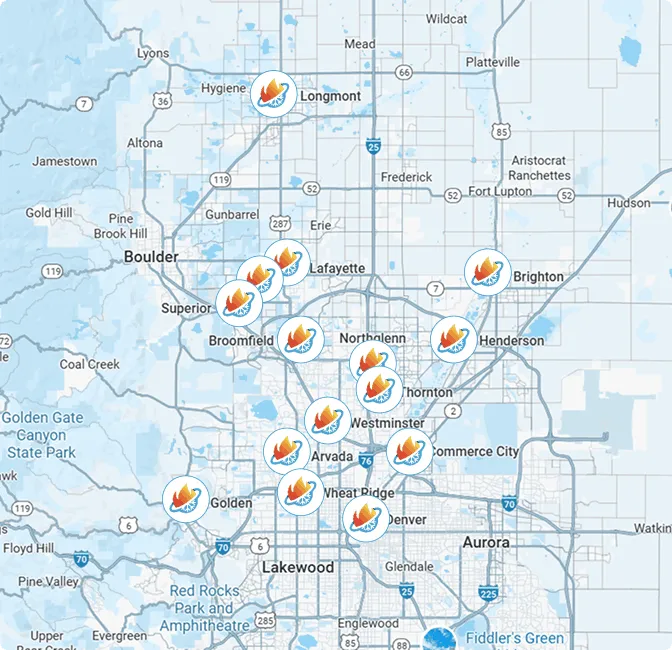
At Quality Heating and Air, we take pride in helping our neighbors in Thornton, Northglenn, Denver, and the surrounding areas navigate these technical efficiency standards. We make sure your new system is sized correctly, installed perfectly, and fully compliant with all IRS tax credit requirements.
If you're ready to improve your home's comfort and take advantage of these great incentives, explore our Quality Heating and Air Services or give us a call today to schedule a consultation!

Testimonials
Neighbors trust Quality Heating & Air for honest work and fair pricing.
Service Areas