How Do I Know If My Commercial HVAC System Needs a Complete Overhaul?
Is It Time to Stop Patching Your Commercial Rooftop Unit?
If you are fielding tenant complaints about hot and cold spots this August, you are likely asking yourself: how do I know if my commercial HVAC system needs a complete overhaul? It is a critical question for any property manager. At Quality Heating & Air, our team sees the undeniable reality of August late-summer cooling wear firsthand. We regularly visit commercial rooftop units (RTUs) that are struggling to maintain consistent temperatures across different building zones. The heat is relentless, the repair invoices are mounting, and you are faced with a difficult decision point.
Do you authorize yet another end-of-season patch repair on an aging unit, or is it time to plan a comprehensive system overhaul before the winter heating season begins? Making the wrong choice can lead to emergency breakdowns when the weather turns freezing, not to mention the ongoing drain on your operating budget. If you need expert guidance on managing these complex systems, exploring professional commercial HVAC services is the best place to start.
The core challenge: Property managers need a transparent, data-driven diagnostic framework to evaluate system health. Relying on guesswork or waiting for a catastrophic failure is simply not an option when tenant satisfaction and building profitability are on the line. By stepping back and looking at the hard data—repair frequency, energy trends, and system age—you can make an informed choice that protects your property's bottom line.
Evaluating System Age and Refrigerant Obsolescence
Age alone does not dictate when a rooftop unit must be replaced, but it provides the essential baseline for evaluating all other failure signs. When our technicians assess Northglenn CO commercial properties, understanding the expected lifecycle of your equipment is always our first step in determining whether a repair is a wise investment or a waste of capital.
The American Society of Heating, Refrigerating and Air-Conditioning Engineers (ASHRAE) provides industry-standard benchmarks for commercial equipment. However, in our experience, these benchmarks are heavily influenced by how the equipment has been treated over its lifetime. To properly evaluate your system's age and obsolescence, we recommend following these steps:
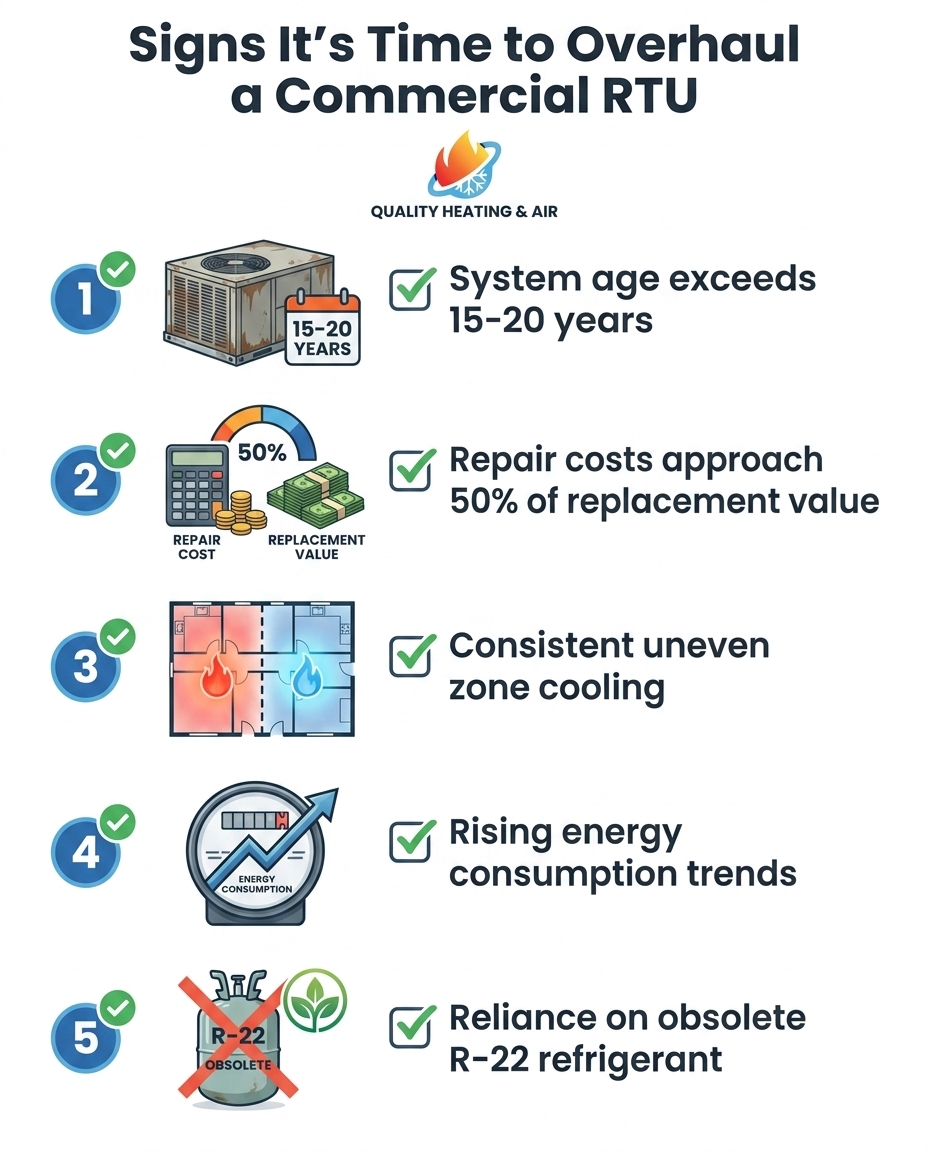
1. Establish the baseline lifespan: ASHRAE estimates the median lifespan of a commercial rooftop unit to be 15 to 20 years. If your unit is approaching or exceeding this window, it is officially in its twilight years, and major component failures become highly probable.
2. Review the maintenance history: A unit that has received consistent, professional tune-ups may push past the 20-year mark with relative grace. Conversely, a unit that has suffered from deferred maintenance will likely show severe degradation long before its 15th birthday.
3. Identify the refrigerant type: This is often the deciding factor for older units. The EPA has phased out the production and import of R-22 refrigerant (commonly known as Freon). If your aging RTU relies on R-22, sourcing this obsolete refrigerant for leak repairs is increasingly difficult and highly impractical for long-term operation.
4. Contextualize age with performance: A 12-year-old system that requires constant repairs might be a better candidate for replacement than a well-maintained 16-year-old system that runs flawlessly. Age is the context, not the sole trigger.
If you are unsure how to weigh these factors, reviewing the signs your HVAC needs replacing can help clarify whether your aging system is simply experiencing normal wear or reaching the end of its functional life.
The Frequency and Compounding Cost of Late-Summer Breakdowns
As the cooling season peaks, the strain on commercial HVAC systems reaches its absolute maximum. The trend of increasing repair calls during this time is a massive red flag. August late-summer cooling wear exposes every weakness in a system, turning minor inefficiencies into major operational failures.
The 50% Rule of HVAC Replacement
When analyzing repair frequency, our industry professionals rely on the 50% rule. This guideline states that when the cost of a single repair—or the cumulative cost of ongoing patch repairs over a short period—approaches half the value of a complete system replacement, an overhaul is generally the better financial decision. Pouring substantial capital into a failing unit only resets the clock until the next major component breaks.
Calculating the Hidden Costs of Downtime
The true cost of a breakdown extends far beyond the technician's invoice. For commercial property managers, the hidden costs of downtime are severe and compounding:
• Tenant dissatisfaction: Uncomfortable working environments lead to immediate complaints and, eventually, lease non-renewals.
• Lost productivity: Retail spaces lose foot traffic, and office environments see a sharp decline in employee output when indoor temperatures become unbearable.
• Emergency service premiums: Reactive repairs often require expedited shipping for parts and emergency labor rates, inflating your maintenance budget unnecessarily.
Tracking this repair history meticulously is vital. It allows you to move away from reactive panic and toward strategic capital planning. By documenting the compounding costs of these late-summer breakdowns, you can easily justify the necessary capital expenditures to building owners. Implementing a proactive maintenance plan helps track these metrics accurately, ensuring you always have the data needed to make the right call.
Uneven Zone Cooling and Airflow Inconsistencies
One of the most persistent complaints property managers face is uneven temperature distribution. When one office is freezing and the adjacent conference room is sweltering, it is rarely a simple thermostat issue. Instead, these airflow inconsistencies are typically physical symptoms of a failing commercial HVAC system.
Aging commercial units simply lose the mechanical power required to push conditioned air evenly across large, complex building zones. In our years servicing Northglenn CO commercial properties, we've found that this problem is heavily amplified by the local climate. Northglenn's high altitude means the air is thinner, requiring blower motors to work significantly harder to move the necessary volume of air to achieve the desired cooling or heating effect. Combined with the extremely dry air and drastic temperature swings from blazing afternoons to cool nights, commercial RTUs experience accelerated wear and tear compared to systems in moderate, sea-level climates.
Diagnosing the Root Causes of Uneven Temperatures
Understanding the mechanical failures behind these hot and cold spots helps differentiate between a quick fix and a necessary overhaul. Here is a breakdown of common symptoms we see, their causes, and what they indicate about your system's overall health:
• Weak airflow at distant vents — Underlying Cause: Failing blower motor or degraded fan belts struggling against high-altitude air density. — Overhaul Indicator (The Verdict): If the motor is drawing excessive amperage just to run, it is nearing total failure.
• Persistent hot and cold spots — Underlying Cause: Compromised ductwork, failing dampers, or a struggling compressor unable to maintain pressure. — Overhaul Indicator (The Verdict): Indicates end-of-life system fatigue; the unit can no longer meet the building's load demands.
• High humidity indoors despite AC running — Underlying Cause: The system is short-cycling or the evaporator coil is heavily degraded. — Overhaul Indicator (The Verdict): A critical sign that the system is improperly sized or mechanically exhausted.
When these symptoms persist despite basic repairs, it is a clear sign of end-of-life system fatigue. To ensure your building can handle the load, upgrading your commercial air conditioning infrastructure is often the only way to permanently resolve these persistent airflow inconsistencies.
Tracking Rising Energy Consumption Trends
Your building's utility bills serve as one of the most accurate diagnostic tools for evaluating commercial HVAC health. As mechanical components age, they inevitably lose efficiency. A compressor with worn internal valves or a blower motor with failing bearings requires significantly more electricity and natural gas to achieve the exact same temperature setpoints it hit effortlessly a decade ago.
How to Conduct a Basic Energy Audit for Your RTU
To determine if your system is quietly draining your operating budget, our team recommends looking at the historical data. Property managers should pull utility records from the past three to five years. Compare your current energy usage (measured in kilowatt-hours and therms) against historical data from previous years.
Normalizing for weather: It is important to account for extreme weather anomalies. If this August was significantly hotter than last August, a slight increase in energy usage is expected due to the severe late-summer cooling wear. However, if the weather has been relatively consistent but your energy consumption has spiked by 15% or 20%, your HVAC system is the most likely culprit.
The financial impact of operating an inefficient, aging RTU versus a modern, high-efficiency system is staggering over a 12-month cycle. Modern commercial systems utilize variable-speed technology and advanced staging compressors that match their output precisely to the building's current needs, rather than running at full blast all the time.
While generic energy rebates or tax credits may apply to qualifying high-efficiency upgrades, it is important to remember that the primary financial benefit comes from drastically reduced daily operational costs. Stopping the month-over-month energy bleed often justifies the capital expenditure of an overhaul entirely on its own.
Building a Transparent Case for Property Owners
Recognizing that a commercial system needs an overhaul is only half the battle; the other half is proving it to the building owner. Property managers need clear, objective data to justify a major capital expenditure. Approaching an owner with a vague request for a new system will likely be met with resistance. Approaching them with a transparent, data-driven diagnostic report changes the conversation entirely.
Compiling the Diagnostic Report
To build a cohesive replacement justification, you must compile three key pieces of data:
• Documented repair histories: Show the frequency of breakdowns and apply the 50% rule to demonstrate that patch repairs are no longer financially viable.
• Energy consumption trends: Present the year-over-year utility data proving the current system is wasting operational funds.
• Tenant complaint logs: Highlight the specific zones experiencing uneven cooling to prove the system is failing to meet basic lease obligations.
Emphasize the importance of partnering with an HVAC provider that prioritizes objective diagnostics over aggressive sales tactics. Because of Quality Heating & Air's family-owned approach, our team believes in transparent diagnostics. This means explaining every step of the assessment to property managers, ensuring they have the exact, unvarnished data needed to make cost-effective decisions with building owners.
A thorough, transparent assessment doesn't always lead to a total replacement. For example, last spring, a local property owner reached out regarding an older building that seemingly needed a complete heating and cooling overhaul. Because we rely on transparent diagnostics rather than blanket sales pitches, our assessment revealed that while the aging furnace did require a full replacement, the air conditioning unit only needed a specific start assist component to restore its efficiency. By replacing only what was necessary and repairing the rest, the property's HVAC needs were met with expert installation and responsiveness, building long-term trust. Informed decisions protect the property's bottom line and ensure uninterrupted comfort for everyone inside.
Frequently Asked Questions About Commercial HVAC Replacement
What is the life expectancy of a commercial HVAC system?
The median lifespan of a commercial HVAC system is 15 to 20 years. However, this expectancy depends heavily on the unit's maintenance history and its operating environment. Systems subjected to extreme weather swings or poor upkeep often fail much earlier than the industry average.
When should a commercial rooftop unit be replaced?
A commercial rooftop unit should be replaced when repair costs approach 50% of the unit's replacement value. Additionally, replacement is recommended if the unit relies on obsolete R-22 refrigerant or when utility bills show an unexplained, consistent upward trend in energy consumption.
What are the signs a commercial HVAC system is failing?
The most common signs a commercial HVAC system is failing include uneven zone cooling, frequent breakdowns during peak seasons, and strange noises or odors emanating from the ductwork. If the system struggles to maintain basic thermostat setpoints, it is likely reaching the end of its functional life.
How does high altitude affect commercial HVAC performance?
High altitude affects commercial HVAC performance because thinner air reduces the system's overall cooling and heating capacity. This environmental factor forces blower motors and compressors to work significantly harder to move air, which accelerates component wear and shortens the system's lifespan.
Is it better to repair or replace a commercial HVAC unit at the end of summer?
The end of summer is the ideal time to replace a failing unit after assessing full-season wear. Replacing an exhausted system before winter arrives prevents emergency mid-season heating failures, ensuring your building remains comfortable and safe during freezing temperatures.
How do you justify commercial HVAC replacement to property owners?
You justify a commercial HVAC replacement by using a combination of repair frequency data, rising energy consumption trends, and the 50% rule. Presenting a transparent, data-driven diagnostic report from a trusted HVAC partner provides the objective proof owners need to authorize capital expenditures.
Secure Your Building's Comfort Before Winter Arrives
Managing commercial properties in Northglenn CO requires staying ahead of extreme weather shifts. Having a clear, data-driven framework for HVAC decisions empowers you to stop wasting money on temporary patch repairs and start investing in long-term reliability. Addressing late-summer wear right now is the most effective way to prevent catastrophic winter emergencies when the temperature drops.
Do not wait for the first freeze to find out your rooftop unit cannot handle the heating load. Schedule a transparent, objective system assessment with our Quality Heating & Air technicians today to evaluate your equipment's true health. By securing a professional heating system replacement before the season turns, you can confidently justify the investment to property owners and guarantee a clear, comfortable environment for every tenant in your building.

Testimonials
Neighbors trust Quality Heating & Air for honest work and fair pricing.
Service Areas