Why Thornton Commercial Properties Need Specialized Furnace Tuning

The Hidden Mechanical Toll on Commercial Heating Systems
Your facility's rooftop units are running non-stop to keep up with the morning chill, but certain zones are still struggling to reach the set temperature. If you are experiencing this kind of uneven heating, you might be wondering why Thornton commercial properties need specialized furnace tuning before the winter rush. The answer lies in the hidden mechanical strain these massive systems endure day in and day out. At Quality Heating & Air, our technicians see firsthand that standard residential checkups simply do not cover the rigorous demands placed on equipment operating in Thornton's light industrial parks. To protect your property, you need dedicated commercial heating services designed specifically for heavy-duty applications.
Commercial furnaces operate on a completely different scale than residential units. A home furnace might run for a few hours a day to maintain a comfortable 70 degrees in a strictly insulated environment. In contrast, heating systems in warehouses, manufacturing floors, and large retail spaces must combat constant heat loss from loading dock doors, high ceilings, and massive square footage. This results in continuous heating cycles that accelerate wear on critical components, from blower motors to heat exchangers.
Right now, during the September pre-heating season, facility managers face a critical decision point. You can choose to bring in a contractor for a specialized commercial tune-up, or you can risk winter downtime by relying on a basic, residential-grade checkup. In our experience, choosing the latter often leaves hidden mechanical degradation undiscovered until the first major freeze forces your system to work at maximum capacity. By understanding the distinct, highly technical approach required for commercial HVAC maintenance, you can secure your facility's operations and avoid costly emergency repairs when the snow starts falling.
Understanding the Demands of Light Industrial Heating Cycles
To fully grasp why generic maintenance falls short, our team always points to the sheer volume of air these systems move. Commercial heating demands are heavily dictated by airflow volume, measured in cubic feet per minute (CFM). While a typical home furnace might push 1,200 to 2,000 CFM, the robust units servicing Thornton's light industrial parks often push upwards of 10,000 CFM. Moving that much air requires incredibly powerful blower motors and heavy-duty mechanical linkages that must be precisely calibrated.
Zoning complexity: Industrial facilities rarely have uniform heating needs. A single building might feature a climate-controlled office space, a drafty shipping and receiving bay, and a manufacturing floor that generates its own ambient heat. Complex zoning demands force commercial furnaces to work harder and longer to balance these drastically different environments. Dampers constantly open and close, and the system frequently ramps up and down to satisfy multiple thermostats simultaneously.
Continuous cycling impact: This constant shifting takes a severe mechanical toll. The continuous heating cycles degrade contactors, stress electrical connections, and wear down moving parts at an accelerated rate. When a system is running at high capacity for 10 to 14 hours a day, the margin for error shrinks significantly. A minor misalignment that might take years to cause a problem in a home can destroy a commercial blower motor in a matter of months.
Because of this high-capacity operation, securing a specialized HVAC maintenance plan is not just a recommendation—in our professional opinion, it is an operational necessity. A dedicated plan ensures that technicians are actively monitoring the specific stress points created by light industrial heating cycles, rather than just changing filters and wiping down cabinets.
How High Altitude Amplifies Furnace Wear and Tear
Beyond the internal mechanical strain, commercial heating systems in our region must fight an invisible environmental battle. Thornton sits at an elevation of over 5,300 feet, which significantly lowers the local air density. Thinner air holds less oxygen per cubic foot, and oxygen is a critical component of the combustion process. When a massive commercial burner ignites, it requires a precise mixture of fuel and oxygen to burn cleanly and safely.
Because of this elevation, commercial units require strict high-altitude airflow calibration according to ASHRAE guidelines. Our commercial specialists frequently encounter units suffering from incomplete combustion because a generic maintenance technician failed to adjust the air-to-fuel ratio for the altitude. This not only wastes fuel and drives up utility costs, but it also creates excessive soot buildup inside the heat exchanger. Over time, this buildup insulates the metal, forcing the system to run even hotter to transfer the same amount of heat into the building.
Furthermore, the high altitude paired with Colorado's notoriously dry winter air interacts poorly with high-capacity heating. Dry air feels colder, prompting occupants to push thermostats higher, which forces the system into even longer continuous cycles. The lack of humidity also increases static electricity and airborne dust, which can clog commercial filtration systems faster than expected. If you want to dive deeper into these regional challenges, learning how Colorado's altitude impacts HVAC performance is a great next step for any facility manager.
Generic maintenance checklists often completely overlook these altitude-specific adjustments. Technicians accustomed to residential units or those following national corporate guidelines may not carry the specialized diagnostic tools required to verify proper combustion at 5,300 feet, leaving your facility's heating system vulnerable to premature failure.
Heat Exchanger Stress and High Static Pressure Risks
One of the most expensive and dangerous failures a commercial heating system can experience is a cracked heat exchanger. In our years working across Thornton's light industrial parks, we've found the primary culprit behind this catastrophic failure is high static pressure. Static pressure is essentially the resistance to airflow within your ductwork. When a commercial blower pushes thousands of cubic feet of air into a complex zoning system, it encounters significant resistance.
If the static pressure is too high, the blower motor struggles to move air across the heat exchanger fast enough. The heat generated by the burners gets trapped inside the metal chamber. This continuous thermal stress causes the metal to expand and contract far beyond its design limits. Eventually, this constant flexing leads to stress fractures.
The risks of a cracked commercial heat exchanger are severe. Not only does it result in total system failure, but it also compromises indoor air quality by allowing carbon monoxide and other exhaust gases to mix with the breathable air circulating through your facility. Preventing this requires a highly technical diagnostic process.
The specialized diagnostic process for static pressure:
1. Initial baseline testing: Licensed technicians use digital manometers to measure the pressure differential between the supply and return sides of the commercial ductwork.
2. Zoning load verification: The system is tested under various zoning scenarios to see how dampers closing affects the overall pressure resistance.
3. Blower performance analysis: Technicians cross-reference the static pressure readings with the manufacturer's fan performance data to ensure the blower is delivering the correct CFM.
4. Heat exchanger visual and structural inspection: Using high-definition combustion analysis and visual inspection cameras, the structural integrity of the heat exchanger is verified under actual operating conditions.
A basic residential tune-up rarely includes digital manometer testing, meaning high static pressure can easily go unnoticed until the heat exchanger actually cracks.
Heavy-Duty Belt Degradation and Pulley Tensioning
While residential furnaces typically rely on direct-drive blower motors, large commercial rooftop units and industrial furnaces utilize belt-driven blowers to move massive volumes of air. These heavy-duty belts and pulleys are the workhorses of your facility's heating system, and they require a completely different level of maintenance.
Belt degradation is a constant threat in commercial HVAC. As the system cycles on and off, the belts stretch, fray, and lose their grip on the pulleys. If a belt is too loose, it slips, causing the blower to spin slower than required. This drops the CFM, spikes the static pressure, and overheats the system. If a belt is tensioned too tightly, it places immense side-load stress on the motor bearings, leading to catastrophic blower failure and expensive motor replacement.
A specialized commercial tune-up actively measures and adjusts this tension. Our technicians use specialized gauges to ensure the belt deflection is perfectly aligned with the manufacturer's specifications. We also check the pulleys for alignment; even a slight angle deviation can shred a heavy-duty belt in a matter of weeks.
One local facility manager reached out to us during a winter cold snap last year because their heating system was struggling to maintain temperature. Our Quality Heating & Air technician arrived, identified that the blower belts had stretched significantly, and properly tensioned the pulleys. More importantly, we walked the manager through the process, explaining how the belts degrade and providing valuable maintenance advice. Because of that thorough servicing, the system ran efficiently for the rest of the winter, proving that taking the time to explain the mechanics helps property owners better manage their facilities.
Why Residential-Grade Checklists Fail Commercial Facilities
When facility managers hire generic corporate contractors, they often receive a standardized 10-point residential checklist applied to a massive industrial system. This approach completely misses the mark. Residential checklists do not account for complex commercial zoning, high-altitude combustion calibration, or heavy-duty belt tensioning. They are designed for a 3-ton home unit, not a 25-ton commercial rooftop package.
Furthermore, servicing commercial properties requires a deep understanding of specific industrial building codes, ventilation requirements, and fire safety regulations. A residential tech might clean a flame sensor and change a filter, but they will not verify that your makeup air unit is properly synchronized with your exhaust fans to maintain neutral building pressure.
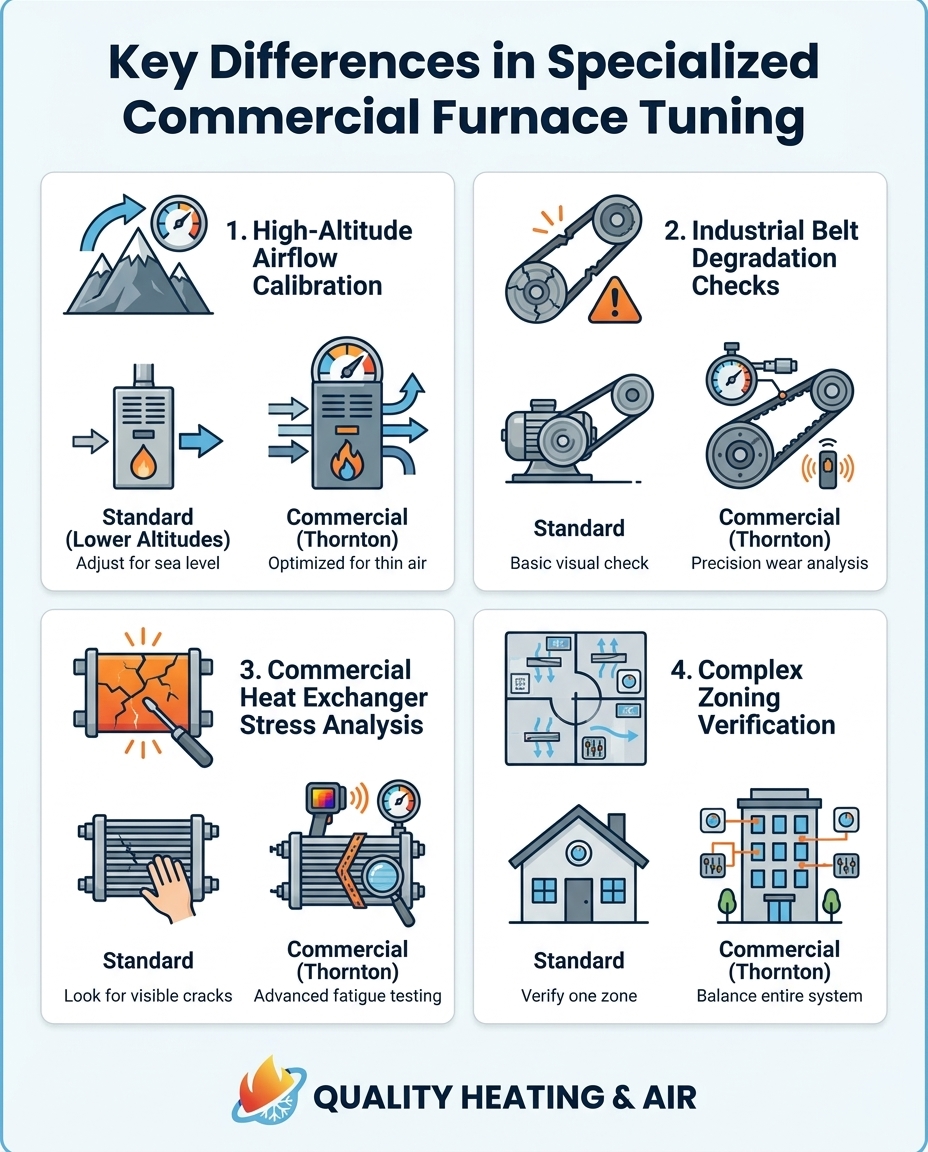
• Airflow & Blowers — Generic Residential Checklist: Basic visual check of direct-drive motor — Specialized Commercial Tuning: Belt tensioning, pulley alignment, and static pressure testing
• Combustion — Generic Residential Checklist: Standard flame check — Specialized Commercial Tuning: High-altitude air-to-fuel calibration and draft analysis
• Zoning — Generic Residential Checklist: Checks single home thermostat — Specialized Commercial Tuning: Verifies complex damper operation and multi-zone controls
• Structural Integrity — Generic Residential Checklist: Visual look at cabinet — Specialized Commercial Tuning: Commercial heat exchanger stress tests and load balancing
This is why partnering with local experts is so critical. Working with our team at Quality Heating & Air means you are relying on local commercial specialists who deeply understand Thornton's industrial codes and specific high-altitude wear patterns. We do not apply generic corporate templates to your unique facility. If your property is located within the Thornton service area, you need a provider who knows exactly what the local climate and industrial demands require.
Securing Facility Operations During the Pre-Heating Window
Timing is everything when it comes to commercial HVAC maintenance. We always advise our clients that the September pre-heating season is the critical window for identifying mechanical stress before the continuous winter cycles begin. Right now, the weather is mild enough that taking a rooftop unit offline for a few hours for a comprehensive tune-up will not disrupt your building's operations or make your employees uncomfortable.
Waiting until November or December changes the equation entirely. An emergency HVAC breakdown during peak Q4 business operations carries a massive financial and operational impact. If a heat exchanger cracks or a blower motor seizes during a freeze, your facility might be without heat for days while specialized commercial parts are ordered and freight-shipped. This can lead to frozen pipes, halted manufacturing lines, and severe productivity losses.
Proactive, specialized tuning does more than just prevent these breakdowns; it significantly extends the lifespan of expensive commercial HVAC equipment. By keeping static pressure in check, belts tensioned, and burners calibrated, you reduce the daily wear and tear on the system. Facility managers should finalize their maintenance strategies now, before the temperatures drop, to ensure their equipment is locked in and ready for the grueling months ahead.
Common Questions About Commercial Furnace Tuning in Thornton
Why do commercial furnaces require different maintenance than residential?
Commercial units handle much higher CFM, run on continuous cycles, and feature complex components like heavy-duty belts and advanced zoning controls. Because they heat massive spaces like Thornton's light industrial parks, the mechanical strain is exponentially higher. Standard residential checklists simply do not cover the industrial-grade parts or the advanced diagnostic testing required to keep these large systems safe.
What causes commercial furnace heat exchangers to fail?
High static pressure, improper airflow calibration, and continuous thermal stress from long heating cycles are the primary culprits. When the blower cannot push air across the heat exchanger fast enough, the trapped heat forces the metal to expand and contract aggressively. Over time, this constant flexing causes the metal to crack, which requires immediate system shutdown.
How does altitude affect commercial heating systems?
Lower air density at elevation alters the air-to-fuel ratio, requiring specific adjustments to maintain combustion efficiency and prevent component damage. At over 5,300 feet, furnaces pull in less oxygen per cubic foot of air. If the burners are not calibrated for this altitude, the system will suffer from incomplete combustion, wasting fuel and causing excessive soot buildup.
What is included in a specialized commercial HVAC tune-up?
A proper commercial tune-up includes belt tensioning, static pressure analysis, high-altitude combustion calibration, and commercial heat exchanger stress tests. Technicians will also verify the operation of complex zoning dampers and check the electrical draw on massive multi-phase blower motors to ensure everything is operating within manufacturer specifications.
How often should Thornton industrial properties schedule furnace servicing?
Commercial properties should schedule servicing at least annually, ideally during the early fall pre-heating season, to ensure readiness for continuous winter operation. Facilities with high-dust environments, such as manufacturing floors, may require quarterly filter changes and bi-annual mechanical inspections to keep airflow unrestricted and static pressure low.
Protect Your Commercial Property with Specialized Maintenance
Standard checkups simply cannot protect light industrial heating systems from the unique demands of Thornton's climate and high-capacity operations. From high-altitude combustion challenges to the constant threat of heavy-duty belt degradation, commercial furnaces require an expert touch. Relying on basic maintenance checklists leaves your property vulnerable to catastrophic failures right when you need heat the most.
Facility managers must take proactive steps during the September pre-heating season to prevent mid-winter breakdowns. By securing specialized commercial tuning now, you protect your equipment, lower your utility costs, and ensure your building remains operational through the toughest months of the year. Reach out to our commercial HVAC experts at Quality Heating & Air today to schedule a comprehensive evaluation of your facility's heating systems before the winter weather officially arrives.

Testimonials
Neighbors trust Quality Heating & Air for honest work and fair pricing.
Service Areas