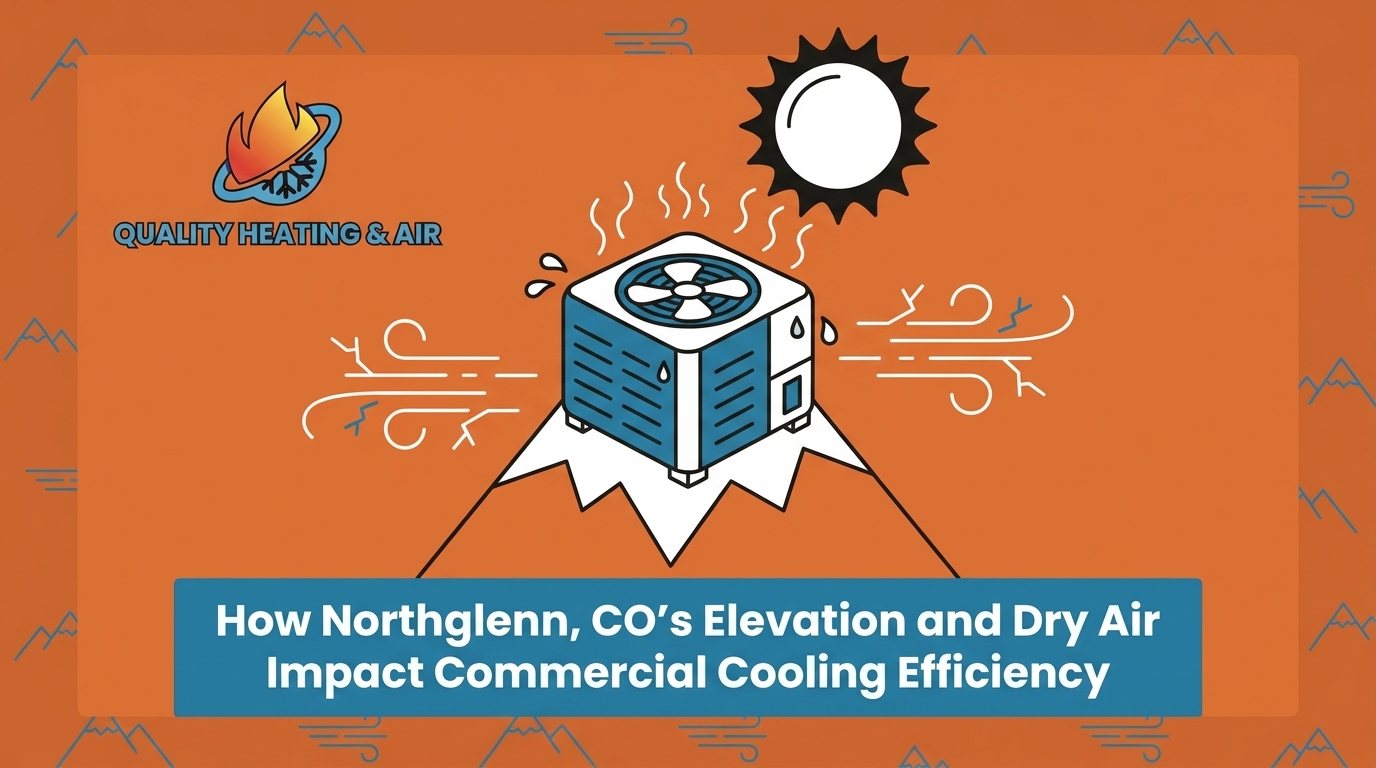
How Northglenn's Elevation and Dry Air Impact Commercial Cooling Efficiency
The Hidden Strain on Commercial Cooling Systems in Late Summer
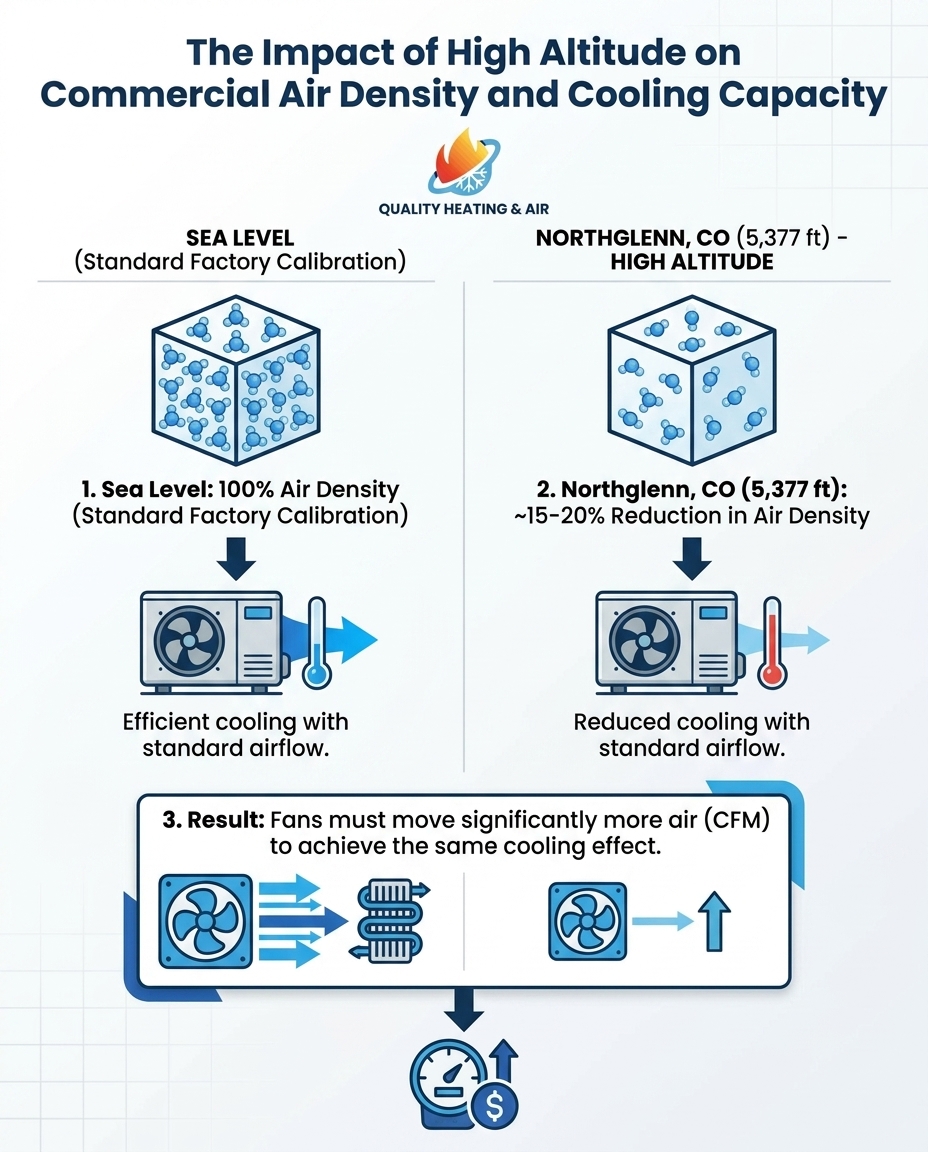
At elevations above 5,000 feet, air density drops by a staggering 15 to 20 percent, fundamentally altering the way mechanical systems operate. In our years of managing commercial climate control across the region, our team at Quality Heating & Air has seen firsthand that understanding exactly how Northglenn's elevation and dry air impact commercial cooling efficiency is the key to preventing catastrophic equipment failure. When the thermometer spikes, commercial rooftop units (RTUs) are forced to work exponentially harder just to maintain basic indoor comfort. This atmospheric reality creates a concrete problem for businesses: standard commercial systems are not inherently designed for Colorado's unique environmental stressors, leading to units that run constantly without ever satisfying the thermostat.
For property managers, this creates an urgent decision point. You must choose between letting these struggling units run to failure—risking complete operational downtime—or investing in professional tuning that calibrates the equipment for the local atmosphere. Addressing this strain requires targeted expertise. By prioritizing professional Commercial HVAC Services and proactive Air Conditioning Tuning and Repair, you can protect your expensive equipment from the severe late-August heat and end-of-season cooling wear that plagues so many local businesses.
The Physics of High Altitude: Why Thin Air Demands More Work
To understand why commercial cooling systems struggle in this region, you have to look at the basic physics of heat transfer. Air conditioning does not actually "create" cold air; it removes heat from the indoor space and transfers it outside. This process relies entirely on the mass of the air moving over the system's evaporator coil. Because the air in Northglenn CO (5,300+ ft elevation) is significantly thinner than air at sea level, we often have to remind facility managers that there is simply less physical mass available in every cubic foot to absorb and carry that heat away.
The derating effect: When air density drops, the cooling capacity of a standard HVAC system is "derated," meaning its effective performance is reduced. To extract the exact same amount of heat as it would at sea level, the system's blower fans must move a significantly higher volume of air. This forces the equipment to compensate continuously, placing immense mechanical strain on blower motors, belts, and compressors. Without adjustments, the system is essentially running a marathon while breathing through a straw.
Understanding Mass Flow Rate and Heat Transfer
The core concept at play here is "mass flow rate." In simple terms, mass flow rate is the actual weight of the air moving through your ductwork over a given period. Because thinner air weighs less, a commercial RTU must increase its volumetric airflow—measured in Cubic Feet per Minute (CFM)—to achieve the necessary mass flow rate for effective heat transfer.
• Sea-Level Operation: Standard air density allows fans to run at factory default speeds while still moving enough air mass to cool the building efficiently.
• High-Altitude Operation: Thinner air requires fans to spin faster and move up to 20% more total volume (CFM) just to match standard sea-level heat removal.
• The Mechanical Cost: Forcing a standard motor to move this extra volume without proper calibration leads to overheating, increased energy consumption, and premature component degradation.
Sensible vs. Latent Heat in Colorado's Dry Climate
Elevation is only half of the equation; the other major factor is the region's notoriously low-humidity, semi-arid climate. In the HVAC industry, the heat a system removes is divided into two categories: sensible heat and latent heat. Sensible heat is the actual temperature change you feel and read on a thermometer. Latent heat is the energy the system expends to remove moisture (humidity) from the air. In humid environments like the Gulf Coast, a commercial AC might spend up to 30% of its energy simply dehumidifying the building before the temperature ever drops.
In Northglenn CO (5,300+ ft elevation), the dynamic is entirely different. The sensible heat ratio is exceptionally high. Because the air is already dry, the air conditioner spends almost no energy removing humidity. While dry air feels cooler to human skin, it completely shifts the operational burden of the HVAC system. The unit must dedicate 100% of its effort to lowering the sensible temperature by moving massive amounts of air.
This extreme shift requires precise airflow calibration. If the system is not tuned for a high sensible heat load, it will cycle improperly, leading to uneven cooling and wasted energy. For property managers looking into equipment upgrades, Choosing an AC System for Colorado Altitude means selecting units that are specifically engineered to handle high sensible heat ratios without relying on the latent cooling capacity that standard units factor into their factory ratings.
The Danger of Relying on Sea-Level Factory Settings
One of the most overlooked realities of commercial property management is how HVAC equipment is manufactured. Almost all commercial rooftop units are rated, tested, and calibrated by manufacturers based on "Standard Air" conditions—which assumes operation at sea level with a specific baseline temperature and humidity. When a brand-new RTU is shipped to Colorado and installed directly out of the box, it is fundamentally handicapped from day one.
The consequences of "out-of-the-box" installation:
• Fan Speed (CFM) — Standard Factory Setting (Sea Level): Calibrated for dense, heavy air mass. — Impact in Northglenn (5,300+ ft): Moves insufficient air volume, causing poor heat transfer.
• Refrigerant Charge — Standard Factory Setting (Sea Level): Balanced for standard airflow rates. — Impact in Northglenn (5,300+ ft): Can lead to freezing evaporator coils due to low air mass.
• Run Times — Standard Factory Setting (Sea Level): Standard cycling based on latent/sensible mix. — Impact in Northglenn (5,300+ ft): Constant running as the system struggles to satisfy the thermostat.
Relying on these sea-level default settings leads directly to poor cooling performance, frozen coils, and skyrocketing utility bills. This is where localized expertise becomes critical. At Quality Heating & Air, our technicians actively override these generic factory settings. In our field experience, we've found that taking the time to tune fan speeds, adjust motor sheaves, and recalculate airflow specifically for the local altitude is the only way to ensure the equipment performs exactly as it should in this unique environment.
Cumulative Stress: Surviving the August Heatwave
Commercial HVAC systems do not typically fail on the first hot day of the year. Instead, they fail after months of operating under continuous mechanical stress. Operating in thin, dry air compounds the wear and tear on blower belts, condenser fan motors, and compressors. By the time the late-August heat and end-of-season cooling wear arrive—often aligning with the back-to-school transition—a system that has been running on generic factory settings is frequently pushed past its mechanical limits.
This cumulative stress is exactly why late summer is the most common time for catastrophic commercial AC failures. When a unit begins running continuously without cycling off, we see many property managers take a "wait and see" approach, hoping the weather will break soon. We strongly advise against this dangerous gamble. Continuous operation in thin air means the compressor is running hot, the blower motor is over-amping, and the risk of a complete system breakdown increases daily. Ignoring a struggling unit often leads to extensive operational downtime, unhappy tenants, and lost revenue.
Signs Your RTU is Nearing its Breaking Point
Catching the symptoms of cumulative altitude stress early can save thousands in emergency repairs. Watch for these distinct warning signs that our technicians look for during commercial inspections:
• Continuous operation: The unit runs for hours at a time without ever fully satisfying the thermostat set point.
• Unusual mechanical noises: High-pitched squealing from over-stressed belts or grinding sounds from overworked blower motors.
• Inconsistent zone cooling: Certain areas of the commercial property remain stubbornly warm while others are freezing, indicating insufficient volumetric airflow.
• Frequent breaker trips: Motors pulling too much electrical current (over-amping) as they struggle to move enough thin air.
Professional Tuning for High-Altitude Efficiency
Optimizing a commercial HVAC system for this specific environment goes far beyond changing air filters and clearing debris. It requires specialized diagnostic tools and a deep understanding of atmospheric physics. Professional tuning for high altitude involves physically adjusting the system's mechanical components to increase volumetric airflow (CFM) and compensate for the low air density.
The high-altitude tuning process includes:
1. Adjusting fan speeds and sheaves: Technicians modify the drive pulleys (sheaves) on belt-driven blower motors to safely increase the fan speed, ensuring the system moves the higher volume of air required in Northglenn.
2. Verifying refrigerant charge: Because airflow is altered, the refrigerant charge must be meticulously checked and balanced. Improper refrigerant levels combined with thin air will quickly cause the evaporator coil to freeze solid.
3. Recalibrating static pressure: Ensuring the ductwork can handle the increased CFM without causing excessive noise or damaging draft conditions inside the building.
It is important to note that these adjustments require a licensed professional; attempting to modify fan sheaves or refrigerant pressures without the proper gauges and training will severely damage the equipment. At Quality Heating & Air, we don't just "repair" broken units; our team engineers the operational parameters to match Colorado's exact atmospheric demands. Integrating these specific adjustments into a routine Commercial HVAC Maintenance Plan is the most effective way to extend the lifespan of expensive commercial equipment and maintain consistent efficiency year after year.
Frequently Asked Questions About How Northglenn's Elevation and Dry Air Impact Commercial Cooling Efficiency
How does high altitude affect commercial air conditioning?
High altitude affects commercial air conditioning by significantly reducing the density of the air moving through the system. At elevations above 5,000 feet, there is less air mass available to absorb heat from the evaporator coil. This forces the system's blower fans to work much harder and move a higher volume of air to achieve the exact same cooling effect as it would at sea level.
Does high altitude require a bigger AC unit for my business?
Not necessarily. While the cooling capacity is derated at high altitudes, simply installing a larger unit often leads to "short-cycling," where the system turns on and off too quickly. Instead of automatically upsizing the equipment, our team usually recommends having a professional adjust the fan speeds and airflow parameters of a properly sized unit to compensate for the thinner air.
Why is my commercial AC running constantly in the dry heat?
Your commercial AC is likely running constantly because it is struggling to move enough air mass to satisfy the thermostat setting. In a dry, high-altitude climate, the system must overcome both a high sensible heat load (actual temperature) and low air density. If the unit is still operating on sea-level factory settings, it will run continuously in a futile attempt to reach the target temperature.
How does dry air affect overall AC efficiency?
Dry air shifts the system's workload entirely toward sensible cooling (lowering the temperature) rather than latent cooling (removing moisture). Because the AC does not have to expend energy dehumidifying the building, it can be highly efficient—but only if the airflow is professionally calibrated to handle the specific demands of a 100% sensible heat load.
Can standard commercial RTUs be adjusted for Colorado's climate?
Yes, standard commercial rooftop units can absolutely be adjusted for the local climate. A licensed professional can override the generic sea-level factory settings by adjusting motor sheaves, increasing fan speeds to boost CFM, and fine-tuning the refrigerant charge to match the realities of Northglenn CO (5,300+ ft elevation).
Protect Your Commercial Comfort Before the Season Ends
Northglenn's 5,300+ foot elevation and semi-arid dry air are permanent environmental factors that your commercial HVAC system must be specifically tuned to handle. Relying on out-of-the-box factory settings is a guaranteed path to poor performance, high energy bills, and premature mechanical failure. However, property managers can take comfort in knowing that struggling units can often be optimized and recalibrated rather than entirely replaced, provided the intervention happens before the equipment breaks down completely. Additionally, optimizing your system's efficiency may help your facility qualify for generally applicable utility incentive programs or energy rebates designed to reward reduced energy consumption.
Do not wait for the late-August heat and end-of-season cooling wear to push your rooftop units past their breaking point. By understanding how Northglenn's elevation and dry air impact commercial cooling efficiency, you can make informed decisions about your property's maintenance needs. Schedule a professional evaluation with our team to adjust your system's airflow and ensure your business remains comfortable, efficient, and fully operational through the end of the season and beyond.

Testimonials
Neighbors trust Quality Heating & Air for honest work and fair pricing.
Service Areas