Translating HVAC Jargon: What Your Technician Means When Discussing Refrigerant Levels

The Diagnosis Dilemma: Making Sense of Your AC's Health
When your air conditioner starts blowing warm air in the middle of a heatwave, translating HVAC jargon: what your technician means when discussing refrigerant levels is usually the last thing you want to worry about. You just want your home to be comfortable again. However, when a service professional hands you a diagnostic report filled with technical terms, it can feel like you are being asked to read a foreign language. This confusion makes it incredibly difficult to make confident decisions about your home's comfort system.
The frustration of an AC breakdown is stressful enough without the added burden of trying to decipher complex terminology. When you are facing an unexpected repair estimate during peak August late-summer cooling, you need clear facts, not confusing industry speak. The biggest challenge for most homeowners we work with is deciding whether to authorize an extensive leak search or major repair when they do not fully grasp the underlying problem. Without a clear understanding, you are essentially guessing at what is best for your home and your budget.
This is exactly why our team at Quality Heating & Air emphasizes relying on professional air conditioning services to properly diagnose the root cause of the issue, rather than relying on guesswork or quick fixes. A skilled professional should always take the time to translate these technical terms into plain English. By breaking down the jargon, you gain the power to make informed, confident choices about your cooling system. Furthermore, enrolling in a proactive maintenance plan can help prevent these sudden end-of-season surprises entirely, keeping your system running smoothly before the hottest days arrive.
What Does 'Refrigerant Charge' Actually Mean?
One of the most common phrases you will hear during an AC service call is "refrigerant charge." While it sounds highly technical, the concept is actually quite simple. The "charge" simply refers to the exact amount of cooling fluid—often known by brand names like Freon or Puron—that the manufacturer requires your specific air conditioning system to hold. Every system is designed to operate with a very precise volume of this fluid to move heat efficiently from inside your home to the outside.
A helpful way to understand refrigerant charge is to think of it like blood pressure in the human body. Just as your body needs a specific blood pressure to function correctly, your AC needs a precise refrigerant pressure.
• Too low: The system struggles to circulate enough cooling power, causing systemic strain and poor performance.
• Too high: The compressor works significantly harder than it should, risking catastrophic mechanical failure.
• Just right: The system operates efficiently, providing maximum comfort with minimal energy use.
A critical fact that many homeowners do not realize is that refrigerant is never "used up" like gas in a car. Your air conditioner operates on a closed-loop system. If one of our technicians tells you that your system is low on charge during the heavy demands of August late-summer cooling, it means only one thing: there is a leak somewhere in that closed loop. Refrigerant does not evaporate or burn off over time.
Often, cumulative wear and tear over the cooling season makes these slow, microscopic leaks suddenly apparent. The constant vibration of the unit, combined with temperature fluctuations, can cause tiny stress fractures in the copper lines. Just recently, a local homeowner reached out to our team because they needed to understand different HVAC scenarios and options after a system failure. Our technician took the time to explain things very well, covering various scenarios and options, so the customer felt completely informed and educated about their HVAC system's true health and why a leak had developed.
Demystifying Superheat and Subcooling
When a technician connects their digital gauges to your outdoor unit, they are looking for two very specific measurements: superheat and subcooling temperatures. These are not just arbitrary numbers pulled from a textbook; they are vital vital signs that tell the technician exactly where the heat transfer process is failing inside your system.
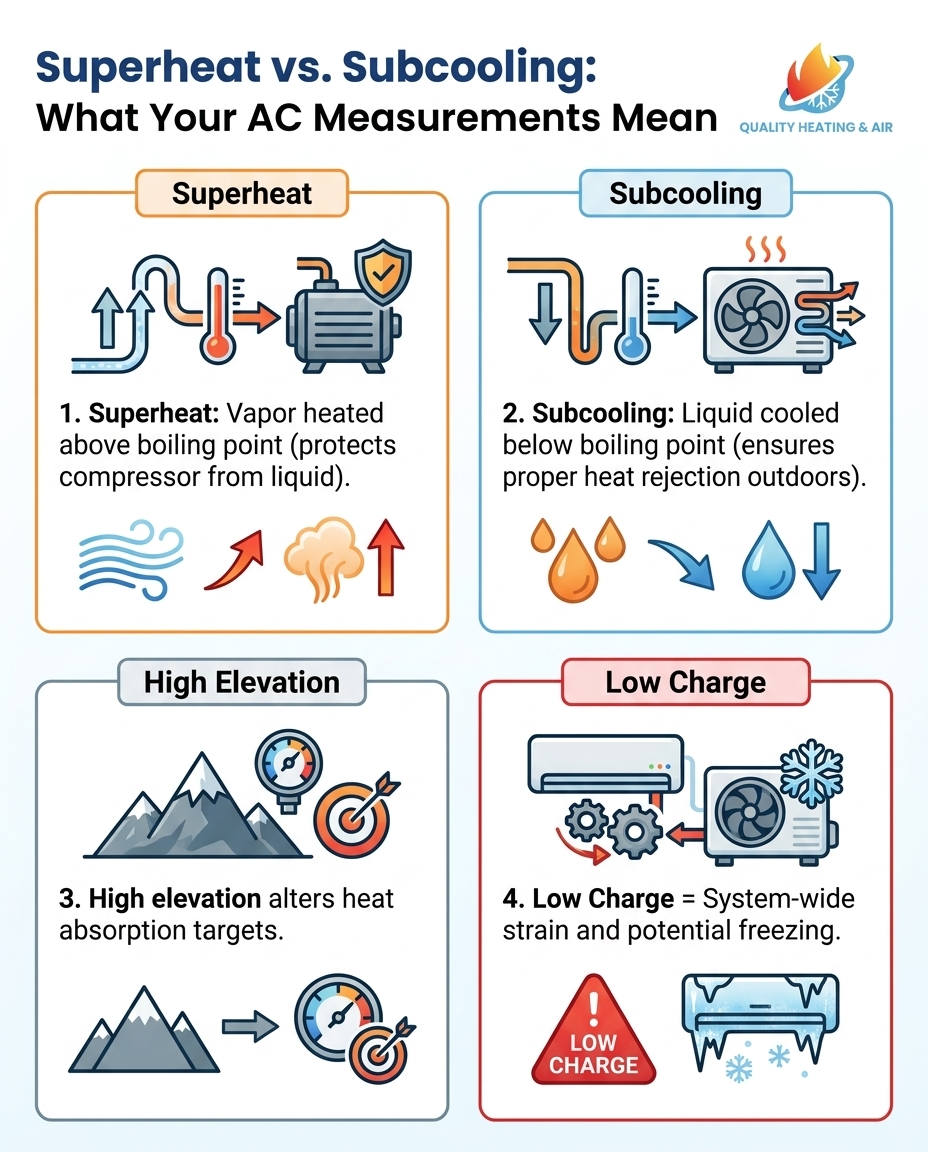
To put it simply, superheat measures how much the refrigerant vapor has heated up above its boiling point before it returns to the compressor outside. Subcooling measures how much the liquid refrigerant has cooled down below its boiling point before it travels back inside your home to start the cycle over again.
• Superheat — What It Measures: Vapor temperature above boiling point (Indoor Coil) — Why It Matters: Ensures no liquid enters the compressor, which would cause severe damage.
• Subcooling — What It Measures: Liquid temperature below boiling point (Outdoor Coil) — Why It Matters: Confirms the system is successfully rejecting heat to the outside air.
• Target Range — What It Measures: Manufacturer specified (varies by system type) — Why It Matters: Provides the baseline for a perfectly balanced cooling cycle.
Why Target Numbers Matter
These target numbers are absolutely critical for a proper diagnosis. An incorrect superheat reading can either starve the compressor of the cool vapor it needs to keep from overheating, or worse, flood the compressor with liquid refrigerant, which destroys the internal valves. An incorrect subcooling reading usually indicates issues with the outdoor condenser's ability to reject heat, which could be caused by a dirty coil, a failing fan motor, or an improper charge.
Environmental factors also play a massive role in these calculations. In our years serving local homes, we've seen firsthand how Northglenn's high elevation of over 5,300 feet means there is thinner air passing over the indoor evaporator coil. This thinner air fundamentally alters the heat absorption rates. Because of this, our team knows we cannot just rely on standard sea-level charts; we must calculate exact superheat and subcooling temperatures based on local atmospheric conditions to ensure your system is calibrated perfectly for the Colorado climate.
The Chain Reaction: Why Low Refrigerant Causes Frozen Coils
It sounds like a complete paradox: if your air conditioner is low on cooling fluid, why does it suddenly turn into a block of ice? When our technicians diagnose low refrigerant during the peak of August late-summer cooling, the most common physical symptom we actually see homeowners dealing with is a frozen indoor coil or ice building up on the copper lines outside.
Here is the step-by-step breakdown of why this happens:
1. The Pressure Drops: When refrigerant leaks out, the pressure inside the indoor evaporator coil drops significantly.
2. The Temperature Plummets: In the world of HVAC physics, lower pressure equals lower temperature. The remaining refrigerant gets far too cold, dropping well below the freezing point of water.
3. Condensation Freezes: As warm household air blows over this super-chilled coil, the natural humidity in the air condenses on the metal fins. Because the coil is below freezing, that condensation instantly turns to ice.
4. Airflow is Blocked: The ice builds up, blocking airflow entirely, which causes the system to blow warm air into the house while the internal components freeze solid.
Even in the relatively dry Colorado climate, a severely undercharged system will still freeze up during peak August heat because there is always some moisture in the indoor air. We always make sure to help our customers differentiate between refrigerant issues and airflow issues. A severely clogged air filter can also cause the system to freeze by restricting the warm air needed to keep the coil above freezing. Maintaining proper indoor air quality solutions often involves ensuring you have clean, high-quality filters installed, which protects your system against these airflow-related freezing issues.
Topping Off vs. Leak Searches: Making an Informed Decision
When faced with a low charge diagnosis, a common homeowner request we hear is to "just top it off" to get through the rest of the season. While this might seem like a quick fix, we always advise against it because it is a temporary and ultimately costly approach. Because the system is a closed loop, adding refrigerant without fixing the leak is exactly like putting air in a tire with a nail in it. The new refrigerant will simply leak out again, leaving you right back where you started.
A professional leak search is a comprehensive diagnostic procedure designed to find exactly where the closed loop has failed. Our experienced technicians in Northglenn CO use specialized tools like electronic sniffers, ultraviolet dye, and high-pressure nitrogen tests to pinpoint microscopic holes in the copper lines or coils. Once the leak is found, we can repair the metal, pressure test the system, and recharge it to the exact factory specifications.
Important regulatory facts to consider:
• EPA Mandates: Under Section 608 of the Clean Air Act, the Environmental Protection Agency mandates that only certified professionals can handle, check, or recover HVAC refrigerants.
• Environmental Impact: Venting refrigerant into the atmosphere is illegal due to its impact on the ozone layer and global warming potential.
• Safety Risks: DIY refrigerant handling is highly dangerous. The pressures involved can cause severe injury, and improper charging will destroy your expensive compressor.
Choosing a proper leak search over a temporary top-off protects your equipment, keeps you compliant with federal regulations, and ensures long-term reliability.
The Value of a Technician Who Acts as an Educator
There is a massive difference between a technician who simply hands over an invoice and one who takes the time to explain the "why" behind the repair. When you are dealing with complex superheat and subcooling temperatures, you need a partner who prioritizes transparent, plain-English communication. Positioning our technicians as educators rather than just repairmen fundamentally changes the service experience.
Understanding the actual health of your system removes the stress and intimidation from HVAC repairs. When you know exactly how a slow leak is causing your coil to freeze, the recommendation for a leak search makes perfect sense. Our team at Quality Heating & Air is deeply committed to translating complex diagnostics into clear, actionable advice.
Recently, a customer needed late-summer AC servicing and felt uneasy about the process. Our technician explained everything being done and gave end-of-season maintenance tips along the way. As a result, their system is running efficiently, and the customer received valuable advice they could actually use. This dedication to explaining every step of your HVAC repair ensures that you are never left in the dark about what is happening in your own home.
Frequently Asked Questions About Refrigerant Levels
What does an HVAC technician mean by low charge?
When a technician says your system has a "low charge," they mean there is not enough refrigerant fluid inside the closed-loop system to cool your home effectively. Because air conditioners do not consume refrigerant, a low charge always indicates that a leak has developed somewhere in the copper lines or coils. In Northglenn CO, finding and fixing this leak is essential to restore proper cooling power and prevent severe damage to the compressor.
What is the difference between superheat and subcooling?
Superheat and subcooling are temperature measurements that tell a technician how well the refrigerant is absorbing and releasing heat. Superheat measures how much the vapor has warmed up inside the indoor coil, ensuring no liquid reaches the outdoor compressor. Subcooling measures how much the liquid has cooled down in the outdoor coil, confirming the system is successfully pushing heat out of your home.
Why do AC coils freeze in the summer?
AC coils typically freeze due to either a severe lack of airflow or a low refrigerant charge. When refrigerant levels drop, the pressure inside the indoor coil drops as well, causing the temperature of the metal fins to plummet below freezing. Any natural humidity in the household air then condenses on the super-chilled metal and instantly turns to ice, eventually blocking all airflow.
How do you know if your AC needs freon?
The most common signs that your AC is low on refrigerant include blowing warm or room-temperature air, ice building up on the indoor coil or outdoor copper lines, and the system running constantly without ever reaching the temperature set on the thermostat. You might also notice a faint hissing or bubbling sound near the unit, which indicates a physical leak in the system.
Can I check my home AC refrigerant levels myself?
No, checking and handling home AC refrigerant requires specialized gauges, EPA certification, and professional training. The system operates under extreme pressure, and attaching gauges incorrectly can cause dangerous blowouts, severe frostbite, or introduce harmful moisture into the system. Federal law mandates that only certified technicians can handle, recover, or add refrigerant to an HVAC system.
Moving Forward with Confidence in Your Cooling System
Understanding terms like superheat, subcooling, and system charge empowers you as a homeowner. When you know what these measurements mean, you are no longer at the mercy of confusing industry jargon during an unexpected August late-summer cooling breakdown. A plain-English breakdown of these technical terms allows you to make confident, educated decisions regarding professional leak searches and necessary repairs.
Always seek out technicians who prioritize education and transparency over quick fixes. When your service professional takes the time to explain the science behind the symptoms, you can trust that the recommended solutions are truly in your best interest. If you want to keep your refrigerant levels stable year-round and catch microscopic leaks before they cause major breakdowns, consider looking into a proactive maintenance schedule to protect your home's comfort.

Testimonials
Neighbors trust Quality Heating & Air for honest work and fair pricing.
Service Areas