Why Is My Commercial Furnace Emitting a Burning Smell When First Turned On?
Is That Burning Smell an Emergency or Just Seasonal Dust?
Are you asking yourself, "Why is my commercial furnace emitting a burning smell when first turned on?" It is a question that immediately triggers alarm for any facility manager or building owner. You adjust the thermostat for that September first fall start-up, and within minutes, a distinct burning odor begins circulating through the vents. Your concrete problem is clear: the heating system is producing a concerning smell right out of the gate. This leaves you facing a critical decision point—determining immediately whether this is a harmless cloud of burning dust from summer buildup or a severe electrical or mechanical failure that requires an immediate system shutdown.
When you are responsible for a large commercial building, safety is always the primary concern. You cannot afford to ignore potential fire hazards, but you also do not want to evacuate a building over a completely normal seasonal process. Distinguishing between routine operation and a true emergency requires a basic understanding of how heavy-duty rooftop units behave after a long idle period. If you are ever in doubt, relying on our professional commercial heating services at Quality Heating & Air is the safest route. Here is exactly how our team evaluates that initial burning smell, what signs point to danger, and how to protect your facility this heating season.
Normal Dust Burn-Off: What to Expect in Early Fall
In many cases, the sudden odor you detect is entirely harmless. Commercial rooftop units (RTUs) sit completely idle for months during the summer cooling season. While the air conditioner runs, the heating components—specifically the heat exchangers and burners—remain inactive. Over time, these components accumulate a significant layer of fine particulate matter, dirt, and debris. When you finally initiate the heating cycle, the system rapidly reaches temperatures exceeding 400 degrees Fahrenheit, instantly incinerating that accumulated debris.
This phenomenon is especially pronounced in Northglenn CO commercial facilities. In our years of servicing rooftop units throughout Colorado's semi-arid climate, we see firsthand how dry summer winds increase the amount of fine particulate and dust that gets blown into commercial systems during the months they sit idle. When that September chill hits and you turn the heat on, the resulting burn-off can be quite noticeable.
The Impact of Idle Summer Months
The sheer scale of a commercial HVAC system means that the volume of dust burning off is much larger than what you would experience in a residential home.
1. Massive surface area: Commercial heat exchangers are large, providing ample space for dust to settle over the summer.
2. High air volume: Heavy-duty blowers push massive amounts of air, distributing the burn-off smell rapidly throughout the entire facility.
3. Immediate ignition: The burners fire up at full capacity, burning off months of accumulation in a matter of minutes.
Duration and Characteristics of Harmless Odors
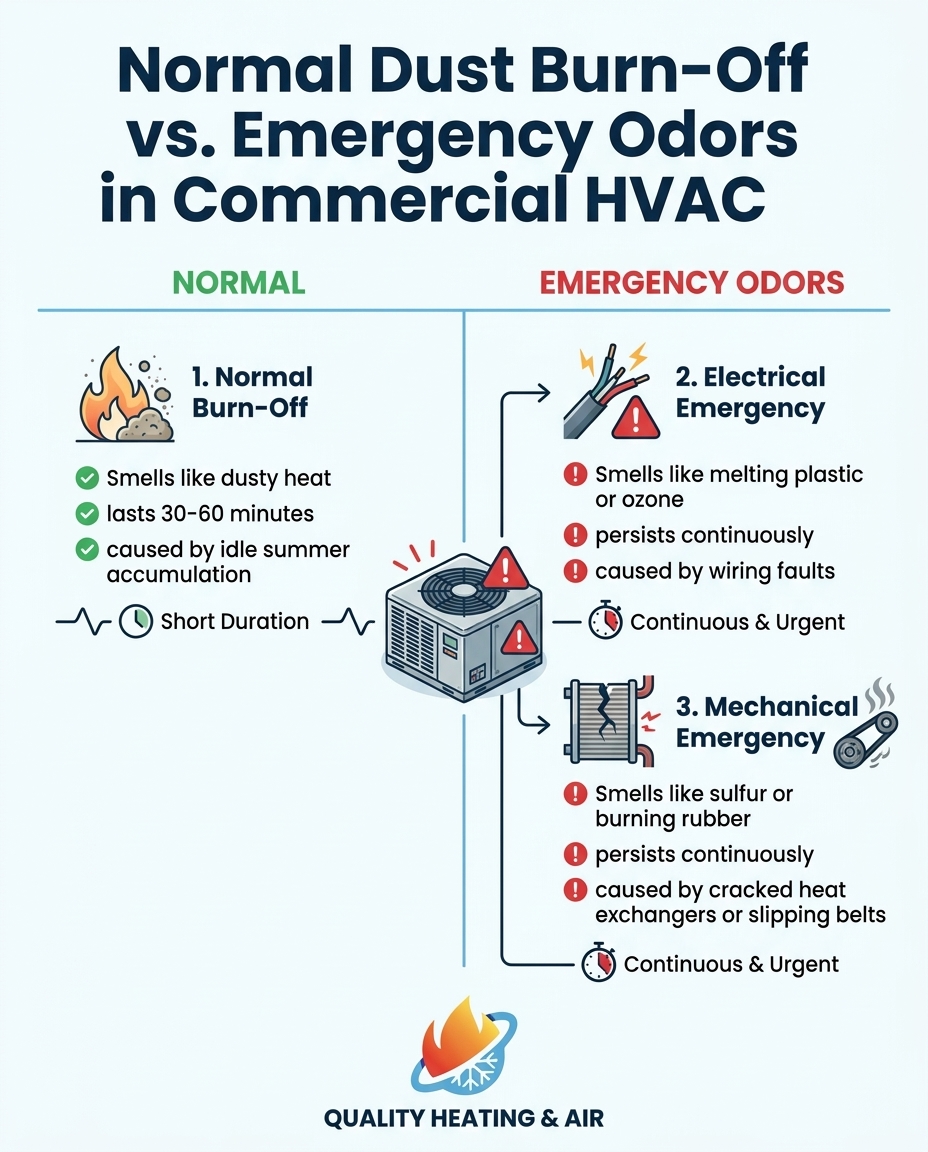
How do you know if the smell is just normal dust? A standard dust burn-off has very specific characteristics. It typically smells like a dusty, dry heat—similar to the smell of a hot clothes iron or a space heater that has just been plugged in. It should never smell like harsh chemicals, melting plastic, or sulfur.
Most importantly, this normal burn-off will typically dissipate within 30 to 60 minutes of the initial heating cycle. If the smell is faint, dry, and fades quickly, simply ensure your building has proper ventilation during this brief window. However, if the odor lingers or intensifies, it is time to contact a certified HVAC technician for an immediate inspection.
Recognizing Dangerous Odors: Electrical and Plastic Smells
While dust burn-off is normal, certain smells are immediate red flags that demand action. If the odor coming from your vents resembles melting plastic, burning wires, or an acrid, fishy scent, you are likely dealing with an electrical emergency. According to the National Fire Protection Association (NFPA), electrical failures and heating equipment issues are leading causes of fires in commercial properties.
These smells will not dissipate after 60 minutes. They indicate that something inside the unit is actively overheating, melting, or short-circuiting. For Northglenn CO commercial facilities, aging electrical components combined with heavy initial heating loads can sometimes push a compromised system past its breaking point.
Ozone and Melting Insulation
The smell of ozone: A sharp, metallic smell—often compared to the scent of a lightning storm or overheated electronics—is a strong indicator of an electrical arc or a failing motor.
Melting wire insulation: When electrical connections become loose, they generate extreme localized heat. This heat melts the protective plastic insulation around the wires, producing a harsh, toxic odor that quickly spreads through the ductwork.
Wiring Faults in Commercial Units
Commercial units rely on heavy-duty contactors, capacitors, and complex wiring harnesses to manage high voltage. If these components degrade, the risk of an electrical fire increases significantly. For example, during a recent early fall service call at a local facility, our technicians at Quality Heating & Air traced a severe electrical odor back to the fact that the furnace installation wiring had not been completed correctly by a previous contractor. Once our team properly connected all the necessary wires, the system started working safely and efficiently again. If you smell plastic or ozone, shut the system down immediately at the breaker and call for emergency service.
Mechanical Warning Signs: Heat Exchangers and Belts
Not all dangerous smells are electrical. Sometimes, the odor points to severe mechanical degradation. When heavy-duty components fail, they produce distinct smells that our team knows should never be ignored during a September first fall start-up.
The Danger of Cracked Heat Exchangers
Sulfur and exhaust odors: The heat exchanger is the metal shield that separates the breathable air in your building from the toxic combustion gases created by the burners. Over years of expanding and contracting, thermal stress can cause micro-cracks in this metal. If the heat exchanger cracks, dangerous exhaust gases—including carbon monoxide—can leak into the facility's air supply. This often presents as a smell similar to sulfur, formaldehyde, or vehicle exhaust. This is a life-safety emergency that requires immediate evacuation and professional intervention.
Failing Belts and Overheating Motors
Burning rubber: If your facility smells like burning rubber, the most likely culprit is a slipping or failing blower belt. Commercial blowers use heavy rubber belts to turn the massive fans that distribute air. If a belt becomes loose, stretched, or misaligned over the summer, the friction of the motor spinning against the slipping belt will create a strong burning rubber smell. Furthermore, the blower motor itself faces immense strain during that first heavy heating load, and an overheating motor can also produce this scent.
Because commercial units require precise calibration to operate safely under heavy loads, investing in specialized commercial furnace tuning is the best way to catch these mechanical warning signs. Our commercial HVAC specialists routinely replace worn belts during fall tune-ups before they result in a complete breakdown.
The Facility Manager's Immediate Triage Protocol
When you detect a burning smell, guessing is never an option. You need a clear, actionable protocol to evaluate the situation safely. Quality Heating & Air's commitment to transparency and safety means empowering facility managers with the exact knowledge our dispatchers use to determine when an odor warrants an emergency dispatch versus a standard check. Do not attempt DIY repairs on commercial high-voltage equipment. Instead, follow this triage checklist.
Step 1: Observation and Timing
• Log the exact time: Note the precise minute the heating system was turned on. Normal dust burn-off should clear within 30 to 60 minutes.
• Categorize the odor: Walk the affected zones. Does it smell like dry, dusty heat? Or does it smell like harsh chemicals, melting plastic, rubber, or sulfur?
• Check for visible signs: Look closely at the vents. Is there any visible smoke, haze, or soot entering the room? Visible smoke is never normal.
Step 2: When to Trigger a Shutdown
• Immediate shutdown criteria: If you detect the smell of electrical burning, melting plastic, ozone, rubber, or exhaust, go to the thermostat and turn the system to "OFF." If the smell is severe, shut off the main breaker to the HVAC unit.
• Evacuate if necessary: If chemical or exhaust smells persist, or if carbon monoxide detectors trigger, evacuate the affected zones immediately.
• Gather information for dispatch: When calling for emergency service, be prepared to tell the dispatcher the exact location of the unit (e.g., Roof Zone B), a description of the smell, and how long the system was running before shutdown.
• Dry, dusty heat — Likely Cause: Normal summer dust accumulation burning off — Required Action: Monitor for 30-60 minutes; ensure ventilation
• Melting plastic or ozone — Likely Cause: Electrical fault, melting wire insulation, failing motor — Required Action: Shut down system immediately; call for emergency repair
• Burning rubber — Likely Cause: Slipping blower belt or seized bearings — Required Action: Turn off system to prevent belt snapping; schedule service
• Sulfur or exhaust fumes — Likely Cause: Cracked heat exchanger leaking combustion gases — Required Action: Shut down instantly; evacuate zone; call for emergency repair
Proactive Solutions: Stopping Odors Before They Start
The best way to handle a burning smell is to prevent it from happening in the first place. Transitioning from reactive panic to proactive prevention protects your equipment, your staff, and your daily operations. A comprehensive pre-season inspection is the most effective tool a facility manager has.
The Importance of Pre-Season Checks
Before that September first fall start-up, a professional technician can open the RTU and thoroughly clean the heat exchanger, burners, and sensors. By removing the summer dust accumulation manually, you completely eliminate the dramatic burn-off odor. More importantly, this inspection catches frayed wires, loose electrical connections, and worn belts before they fail under load. For example, during a recent pre-season inspection at a Northglenn facility, our technicians removed significant summer dust accumulation from a struggling commercial system, explained the process to the facility manager, and provided targeted maintenance tips. As a result, the system returned to running efficiently without emitting any strange odors or requiring emergency interventions.
Air Quality Considerations for Commercial Spaces
Upgrading filtration: Commercial buildings generate a massive amount of internal dust, from foot traffic to manufacturing processes. Upgrading to higher-efficiency filters reduces the particulate load that settles on your HVAC components year-round.
Consistent servicing: Enrolling your facility in a routine HVAC maintenance plan ensures that your equipment is calibrated, cleaned, and safety-tested long before the deep cold sets in. Better air quality management protects both the costly mechanical equipment on your roof and the occupants inside your building.
Frequently Asked Questions About Commercial Furnace Odors
Before diving into the most common questions, remember that maintaining excellent commercial indoor air quality is one of the best ways to reduce dust accumulation and prevent severe start-up odors in Northglenn CO commercial facilities. If you still have concerns about strange smells, these answers can help guide your next steps.
How long should a furnace smell like burning when first turned on?
A furnace should typically smell like burning dust for only 30 to 60 minutes during its very first heating cycle of the season. Based on our extensive experience with Northglenn CO commercial facilities, this is the time it takes for the system to incinerate the harmless particulate matter that settled on the burners over the summer. If the smell persists beyond an hour, or if it returns on subsequent days, it is no longer normal burn-off and requires professional investigation.
Is it normal for a commercial heater to smell like burning?
Yes, it is entirely normal if it smells strictly like dusty heat during the first cycle of the fall season. Because commercial units process massive volumes of air, the initial burn-off can be surprisingly strong. However, it is never normal for a commercial heater to smell like burning plastic, ozone, rubber, or exhaust fumes at any point.
Can a burning smell from a furnace cause a fire?
Standard dust burn-off rarely causes fires, as the dust is incinerated safely inside the heat exchanger. However, electrical or mechanical burning smells are high-risk indicators. Smells of melting plastic or ozone mean components are actively overheating, which can absolutely lead to an electrical fire if the system is not shut down immediately.
What does a cracked heat exchanger smell like?
A cracked heat exchanger often smells like sulfur, formaldehyde, or harsh vehicle exhaust fumes. Because the heat exchanger's job is to vent toxic combustion gases outside, a crack allows those dangerous gases—including carbon monoxide—to mix with your indoor air. This is a severe safety hazard that requires immediate evacuation and repair.
What does an electrical fire in a commercial HVAC unit smell like?
An electrical fire or severe electrical fault produces a sharp, acrid odor similar to melting plastic, burning wire insulation, or ozone. Some people describe it as a harsh, metallic scent or even a fishy smell. If you detect this odor, cut power to the unit immediately, as electrical failures will not resolve on their own.
When should I shut down my commercial furnace for a burning smell?
You should shut down your commercial furnace immediately if you detect chemical, electrical, or rubber odors, or if you see any visible smoke entering the building. Additionally, if a standard dusty burning smell persists beyond an hour without fading, it is safest to turn the system off and call a certified technician to inspect the unit.
Secure Your Facility's Heating Safety Today
While early fall dust burn-off is a common and harmless occurrence, guessing is never worth the risk when managing a commercial facility. The safety of your occupants and the integrity of your building rely on heavy-duty equipment operating flawlessly. As you approach that critical September first fall start-up, pay close attention to the odors your system produces. If you are ever asking yourself, "Why is my commercial furnace emitting a burning smell when first turned on?" and the answer isn't clearly just seasonal dust, do not hesitate to act. Reach out to our certified professionals at Quality Heating & Air for a thorough evaluation to ensure your heating season begins safely, efficiently, and with total peace of mind.

Testimonials
Neighbors trust Quality Heating & Air for honest work and fair pricing.
Service Areas