Beating the Late Summer Rush for Arvada Boiler Maintenance
The Hidden Risks of Delaying End-of-Summer Heating Preparations
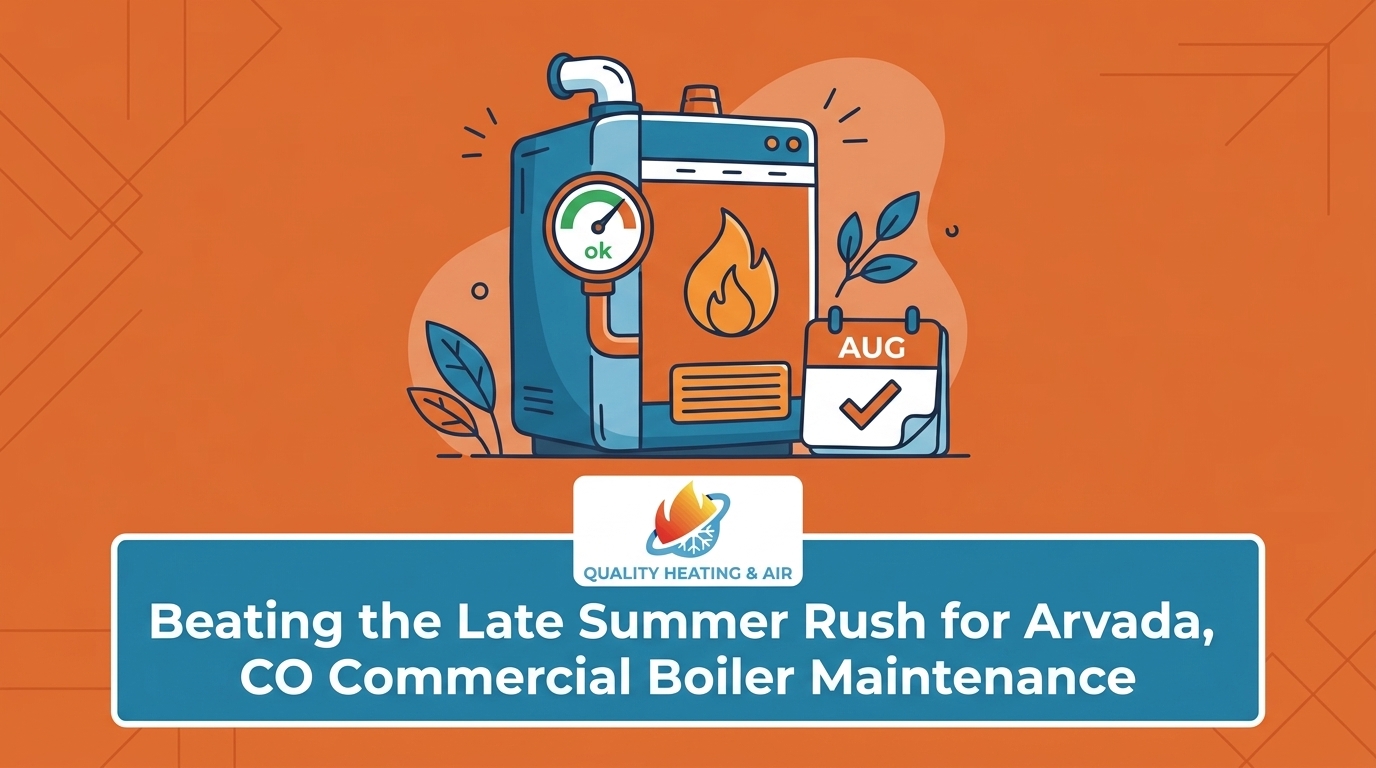
The August / late-summer transition brings cooler evenings to the Front Range, signaling a critical window for facility managers. At Quality Heating & Air, we know that Beating the Late Summer Rush for Arvada Boiler Maintenance requires proactive planning before the first unexpected freeze hits. In our experience, when commercial boiler systems sit idle for months, the sheer mechanical stress of a sudden, high-load cold start can trigger immediate component failures. For facilities that wait until the weather turns, the primary challenge is no longer just mechanical wear and tear—it is competing against hundreds of other properties for limited contractor availability.
To secure your facility's heating infrastructure before the cold sets in, establishing reliable commercial heating services is essential, and scheduling comprehensive commercial boiler service now guarantees priority attention.
Commercial heating systems are complex networks of heat exchangers, high-pressure valves, and sophisticated electronic controls. When our technicians power up these systems for the first time in autumn without prior inspection, we frequently find that minor issues developed over the summer—such as dried-out seals, minor corrosion, or seized actuators—can rapidly escalate into total system lockouts. The decision point for property managers is straightforward: schedule comprehensive maintenance during a controlled window when our dispatch boards are clear, or risk extended facility downtime during a weather emergency.
Taking action during the late summer months allows our professionals to perform thorough combustion analyses and system calibrations without the pressure of a looming winter storm. It provides the necessary lead time to identify, order, and install worn components before they fail under load. Ultimately, proactive scheduling shifts facility management from a reactive, crisis-driven model to a predictable, cost-effective operational strategy.
How Sudden Temperature Drops Overwhelm Local HVAC Dispatch Boards
The Colorado Front Range is notorious for its early fall cold snaps, where temperatures can plummet by 30 degrees or more in a matter of hours. Because Arvada and Northglenn commercial districts sit in close proximity to the foothills, our team frequently sees how susceptible these zones are to sudden, rapid freezes. This unique regional climate reality creates an immediate ripple effect across the local HVAC industry.
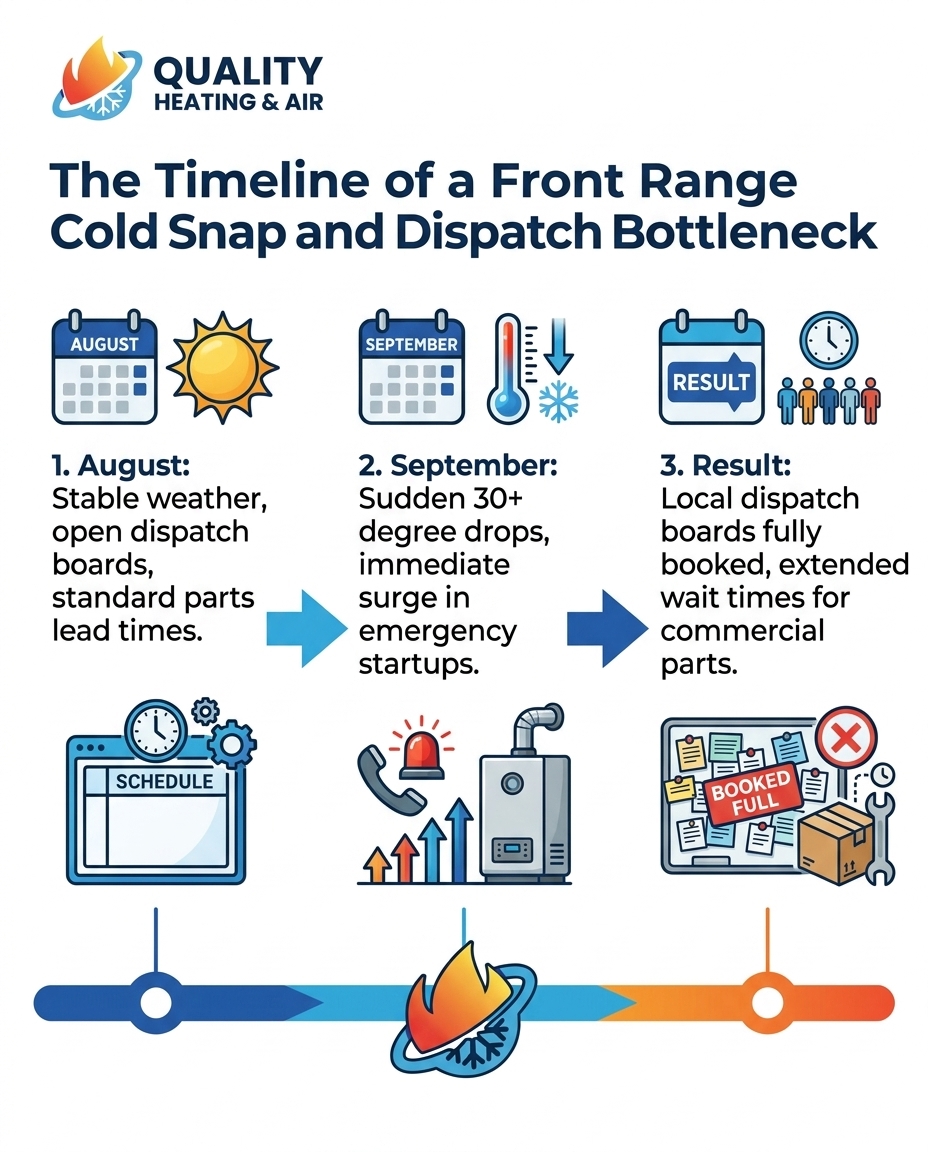
When a sudden cold front arrives, the resulting "dispatch bottleneck" follows a highly predictable timeline that we witness year after year:
1. The Initial Drop (Hours 1-12): A significant cold front moves over the foothills, dropping ambient temperatures rapidly. Facility management systems automatically trigger boiler startups across hundreds of local commercial properties simultaneously.
2. The Surge in Failures (Hours 12-24): Systems that bypassed August maintenance begin to fail under the sudden thermal load. Ignition modules fault out, seized pumps trip breakers, and un-serviced heat exchangers cause safety lockouts.
3. The Dispatch Bottleneck (Hours 24-48): Local HVAC companies receive a massive influx of emergency service requests. Dispatch boards become instantly booked out for days or even weeks. Wait times skyrocket, and routine maintenance requests are pushed aside to triage critical emergencies.
4. Extended Downtime (Days 3+): Facilities that waited for the weather to change are now stuck at the back of the service queue, facing days of lost heating, tenant complaints, and potential operational shutdowns.
Waiting for the first freeze guarantees a disadvantageous position. By the time the temperature drops, the opportunity for a controlled, preventative inspection has already passed.
Navigating Supply Chain Realities for Commercial Boiler Components
The logistics of commercial parts: Unlike residential furnaces, commercial boiler systems utilize highly specialized components that are rarely stocked on standard service vehicles. Navigating the current industry supply chain requires a deep understanding of manufacturing lead times and freight logistics. Finding a worn component during the August / late-summer transition means our team can order, ship, and install the part well before peak heating season begins.
Extended lead times: Commercial HVAC components—such as specialized burner assemblies, high-capacity circulation pumps, and proprietary building management control boards—often require significant lead times. Depending on manufacturer availability, sourcing a specific commercial heat exchanger or gas valve can take anywhere from a few days to several weeks. When an unexpected failure occurs in the middle of a November freeze, that waiting period translates directly into prolonged facility downtime.
Efficiency and compliance: The Department of Energy (DOE) guidelines emphasize that maintaining optimal commercial HVAC efficiency relies heavily on the timely replacement of degrading components. A boiler operating with a failing draft inducer or a compromised fuel valve will consume significantly more energy to produce the same BTU output. Early identification of these issues allows our technicians to restore the system to factory efficiency standards.
Proactive sourcing: By evaluating the system early, facility managers gain complete control over the procurement process. If a part is backordered, the facility can continue operating safely on its summer schedule while the component is routed to our local suppliers. This strategic approach completely eliminates the panic of expedited shipping delays during mid-winter breakdowns.
The True Cost of Reactive Maintenance and Facility Downtime
Operating a commercial facility on a "run-to-fail" strategy is an inherently high-risk approach. We constantly remind our clients of the stark contrast between the controlled environment of scheduled preventative maintenance and the chaotic, disruptive nature of an emergency breakdown. When a commercial boiler fails unexpectedly, the financial and operational consequences cascade rapidly through the entire building.
The operational impacts of lost heating are severe. In office spaces, plunging indoor temperatures lead to immediate tenant complaints and halted productivity. In industrial or warehouse settings, the loss of climate control can damage temperature-sensitive inventory or disrupt manufacturing processes. Furthermore, a prolonged outage during a hard freeze introduces the critical risk of frozen and burst pipes, which can cause catastrophic water damage to the property.
Deferring maintenance also frequently leads to failed municipal inspections. Adhering to Arvada commercial boiler regulations requires verifiable upkeep of safety relief valves, proper combustion venting, and secure gas lines. An ignored system is highly likely to fail a surprise inspection, resulting in mandatory shutdowns and compliance fines.
Ultimately, being forced to call for 24 hour emergency boiler repair arvada is a costly last resort that facility managers should aim to avoid at all costs. Emergency deployments inherently carry higher logistical burdens, and when combined with the costs of halted operations, the financial impact of reactive maintenance dwarfs the investment of a proactive tune-up.
• Proactive August Servicing — Scheduling Flexibility: High (Pick your exact date/time) — Downtime Risk: Minimal (Issues fixed before cold hits) — Parts Availability: Excellent (Time to order specialized parts)
• Reactive Winter Repair — Scheduling Flexibility: None (Dictated by emergency dispatch) — Downtime Risk: Severe (Days to weeks without heat) — Parts Availability: Poor (Subject to supply chain delays)
Securing Priority Service Before the Seasonal Rush
The logistical advantage: Scheduling service while our dispatch boards are relatively clear provides facility managers with maximum flexibility. Appointments can be coordinated around the building's operational hours to minimize disruption to tenants or workflow. More importantly, it secures your facility's place on our maintenance roster before the inevitable autumn rush begins.
Proactive, punctual dispatch: Utilizing a service provider that operates on a proactive, punctual dispatch model prevents extended facility downtime. Deep local Colorado HVAC expertise is critical here; Quality Heating & Air technicians understand the specific demands of high-altitude, rapid-freeze environments and know exactly how to tune a commercial boiler for optimal combustion in thinner air. This regional knowledge ensures that the system is not just operational, but specifically calibrated for the Front Range climate.
The value of ongoing partnerships: Establishing an ongoing routine HVAC maintenance plan with us is one of the most effective ways to guarantee priority response year-round. Facilities with active service agreements are generally placed at the front of the line during extreme weather events. These agreements transform the relationship from a transactional emergency call into a strategic partnership focused on maximizing the lifespan of the commercial heating equipment.
Predictable budgeting: Beyond priority dispatch, securing service early allows property managers to finalize their seasonal maintenance budgets without the looming threat of unexpected capital expenditures. Knowing that the heating infrastructure has been vetted by our local experts provides true operational peace of mind as the seasons change.
Essential Late-Summer Boiler Checklist for Facility Managers
While our licensed professionals must handle the mechanical tuning and combustion analysis, facility managers play a crucial role in preparing the boiler room for the upcoming heating season. A proactive approach during the August / late-summer transition streamlines our professional inspection process and ensures a safer environment.
• Reviewing historical data: Check system logs and energy usage from the previous winter. Spikes in energy consumption or frequent short-cycling anomalies often point to underlying inefficiencies that our technicians need to address.
• Clearing the mechanical room: Ensure the boiler room is entirely clear of summer storage, cleaning supplies, and debris. Commercial boilers require massive amounts of unobstructed makeup air for safe combustion.
• Verifying communication: Check that all thermostats, zone sensors, and building management systems are powered on and communicating correctly with the main control panels.
• Scheduling the inspection: Book a licensed professional to inspect heat exchangers, test burners, and verify the operation of all safety pressure relief valves.
Visual Inspections and Site Preparation
Before our technician arrives, perform a thorough visual walk-through of the mechanical space. Ensure the area around the commercial boiler has at least three feet of clearance on all sides. Look closely at the base of the unit and the surrounding piping for any visible signs of corrosion, rust, or minor water leaks that may have developed over the summer months. Catching these small visual cues early helps our team pinpoint potential seal failures before they rupture under pressure.
Professional Diagnostics
Certain tasks must strictly remain in the hands of licensed professionals. Combustion analysis, for example, requires specialized digital tools to measure carbon monoxide output, oxygen levels, and flue gas temperatures. Our licensed technicians also perform critical safety control testing, simulating flame failures and pressure spikes to ensure the system's fail-safes trigger correctly. This level of professional diagnostics is non-negotiable for extending equipment lifespan and ensuring the safety of the facility's occupants.
Accessing Reliable Support When the Unexpected Happens
Preparing for the unpredictable: Even with meticulous preparation and thorough late-summer maintenance, extreme weather events can sometimes cause unexpected system faults. Massive power grid fluctuations, external gas pressure drops, or unprecedented cold snaps can stress a system beyond its operational limits. Acknowledging that emergencies still occur is part of comprehensive facility management.
Reliable communication during a crisis: When a failure happens, having a reliable contractor on speed dial is paramount. Our team at Quality Heating & Air recently helped an Arvada commercial facility that required service on very short notice during a sudden freeze. The response demanded not just a rapid physical deployment, but a step-by-step professional explanation of the diagnostic process to the facility director, ensuring they understood exactly how the system would be brought back online safely. Clear communication is just as critical as technical expertise during a crisis.
Rapid deployment: When you need 24 hour boiler service arvada, the speed of the diagnostic process determines the length of the downtime. Facilities that have established maintenance histories with our HVAC team often receive much faster diagnostic turnarounds. Because we already have the system's baseline data, wiring schematics, and service history on file, our technicians can bypass hours of initial troubleshooting and immediately target the root cause of the failure.
Frequently Asked Questions About Commercial Boiler Maintenance in Colorado
Why is late summer the best time for commercial boiler maintenance?
Late summer offers a critical window of stable weather and open dispatch boards. Scheduling maintenance in August allows our technicians to thoroughly inspect and calibrate the system without the pressure of an active winter storm. It also provides ample time to order and install any specialized commercial parts that may be subject to supply chain delays, ensuring the system is fully operational before the first freeze.
How do sudden temperature drops affect commercial boilers?
Sudden 30+ degree temperature drops place immense thermal and mechanical stress on a commercial boiler, especially if it has been sitting idle all summer. The rapid demand for high-capacity heating forces cold metal components to expand quickly, which can expose weak seals, trigger ignition failures, or cause seized pumps to trip electrical breakers. This sudden load is the primary cause of early-season breakdowns that we respond to.
When should a commercial boiler be serviced?
Commercial boilers should receive comprehensive professional servicing at least once a year, ideally during the late summer or early fall before the heating season begins. Facilities with high-demand industrial processes or older equipment may require bi-annual inspections to maintain efficiency and ensure all safety controls remain fully functional.
What happens if you don't service a commercial boiler?
Neglecting commercial boiler maintenance leads to a compounding series of operational failures. Efficiency drops significantly, resulting in much higher energy costs to heat the same square footage. More importantly, un-serviced boilers are prone to safety lockouts, cracked heat exchangers, and failed pressure relief valves, which can cause total system shutdowns, compliance violations, and extensive facility downtime.
How often should commercial boilers be inspected in Colorado?
In Colorado, most commercial boilers are subject to strict municipal and state regulations that mandate annual safety inspections. Beyond legal compliance, the extreme high-altitude environment and rapid temperature fluctuations of the Front Range make annual preventative maintenance essential for safe, reliable combustion and optimal system longevity.
How do parts supply chain delays impact commercial heating repairs?
Commercial HVAC components are highly specialized and rarely kept in standard local inventory. If a critical part like a specialized gas valve or control module fails mid-winter, supply chain delays can leave a facility without heat for weeks while the part is manufactured and shipped. Identifying worn parts during our proactive late-summer maintenance completely bypasses these winter supply chain bottlenecks.
Lock in Your Facility's Heating Reliability This August
Taking action during the August / late-summer transition is the single most effective way to minimize facility downtime and avoid the chaotic emergency scheduling rush that hits the Front Range every autumn. By addressing mechanical wear and tear now, you ensure that your commercial heating infrastructure is prepared for the sudden, high-load demands of the upcoming winter.
Proactive maintenance delivers the operational peace of mind that comes from knowing all necessary commercial parts are sourced, installed, and tested by Quality Heating & Air long before the first cold snap arrives. Don't wait for the dispatch boards to fill up and the supply chains to slow down. Consult with our local experts today to evaluate your facility's heating infrastructure and schedule your comprehensive commercial boiler service before the seasonal rush begins.

Testimonials
Neighbors trust Quality Heating & Air for honest work and fair pricing.
Service Areas