Why Your Home Takes Hours to Heat Up: Signs of a Failing Furnace Blower Motor

When Your Home Takes Hours to Heat Up During Early Cold Snaps
Your furnace is running nonstop, but the house still feels stubbornly cold, which is one of the most common signs of a failing furnace blower motor. In our years of keeping homes warm throughout Northglenn and the surrounding Denver metro area, our team at Quality Heating & Air regularly sees this frustrating problem catch homeowners off guard during November pre-winter cold snaps. You hear the system kick on, you see the thermostat indicating that the heating cycle is active, yet the indoor temperature refuses to climb. After an hour of continuous running, you might only feel a faint, lukewarm trickle of air coming from your living room vents.
Many homeowners immediately assume their furnace is completely broken or that the burners have failed. However, a pattern we see often is that this specific behavior points to a heat distribution issue rather than a heat generation problem. The system is successfully creating heat, but it lacks the mechanical strength to push that warmth through your ductwork and into your living spaces. Recognizing these early warning signs is critical. Identifying a struggling motor now allows us to address the underlying issue before the component seizes entirely, leaving you without heat right as the harsh winter weather arrives.
If you need help evaluating your system's performance, explore our professional HVAC services to keep your home comfortable all season long.
Heat Generation vs. Heat Distribution: Understanding the Difference
Our technicians frequently explain to clients that to understand why your furnace runs without actually warming your home, it helps to look at how your heating system operates in two distinct phases: heat generation and heat distribution. These two functions rely on completely different sets of components, and knowing the difference can save you time and stress when troubleshooting.
The Heat Generation Phase
When your thermostat detects that the room temperature has dropped below your set point, it sends a signal to the furnace control board. This initiates the heat generation phase. The draft inducer motor starts up to clear residual gases, the igniter glows hot, and the gas valve opens. The burners ignite, creating a steady flame that rapidly heats up the metal heat exchanger inside the furnace cabinet. At this point, your furnace has successfully generated heat. If this phase fails, your furnace will blow cold air, or it will refuse to turn on at all.
The Heat Distribution Phase
Once the heat exchanger reaches a specific temperature, the heat distribution phase begins. The furnace control board signals the blower motor to turn on. The blower motor spins a large fan (often called a squirrel cage), which pulls cold air from your home through the return ducts, pushes it over the hot metal heat exchanger to warm it up, and then forces that newly heated air out through your supply vents.
If the blower motor is failing, the heat generation phase still happens perfectly, but the distribution phase falls apart. The heat is trapped inside the furnace cabinet. If you suspect your system is struggling with this second phase, reaching out for professional heating repair and service is the safest way to accurately diagnose the root cause.
• Air Temperature at Vents — Likely Generation Issue (Burners/Igniter): Blowing completely cold air — Likely Distribution Issue (Blower Motor): Blowing very hot air, but weakly
• Airflow Strength — Likely Generation Issue (Burners/Igniter): Normal, strong airflow — Likely Distribution Issue (Blower Motor): Barely noticeable or nonexistent airflow
• System Behavior — Likely Generation Issue (Burners/Igniter): Fails to ignite or locks out immediately — Likely Distribution Issue (Blower Motor): Runs continuously or short-cycles rapidly
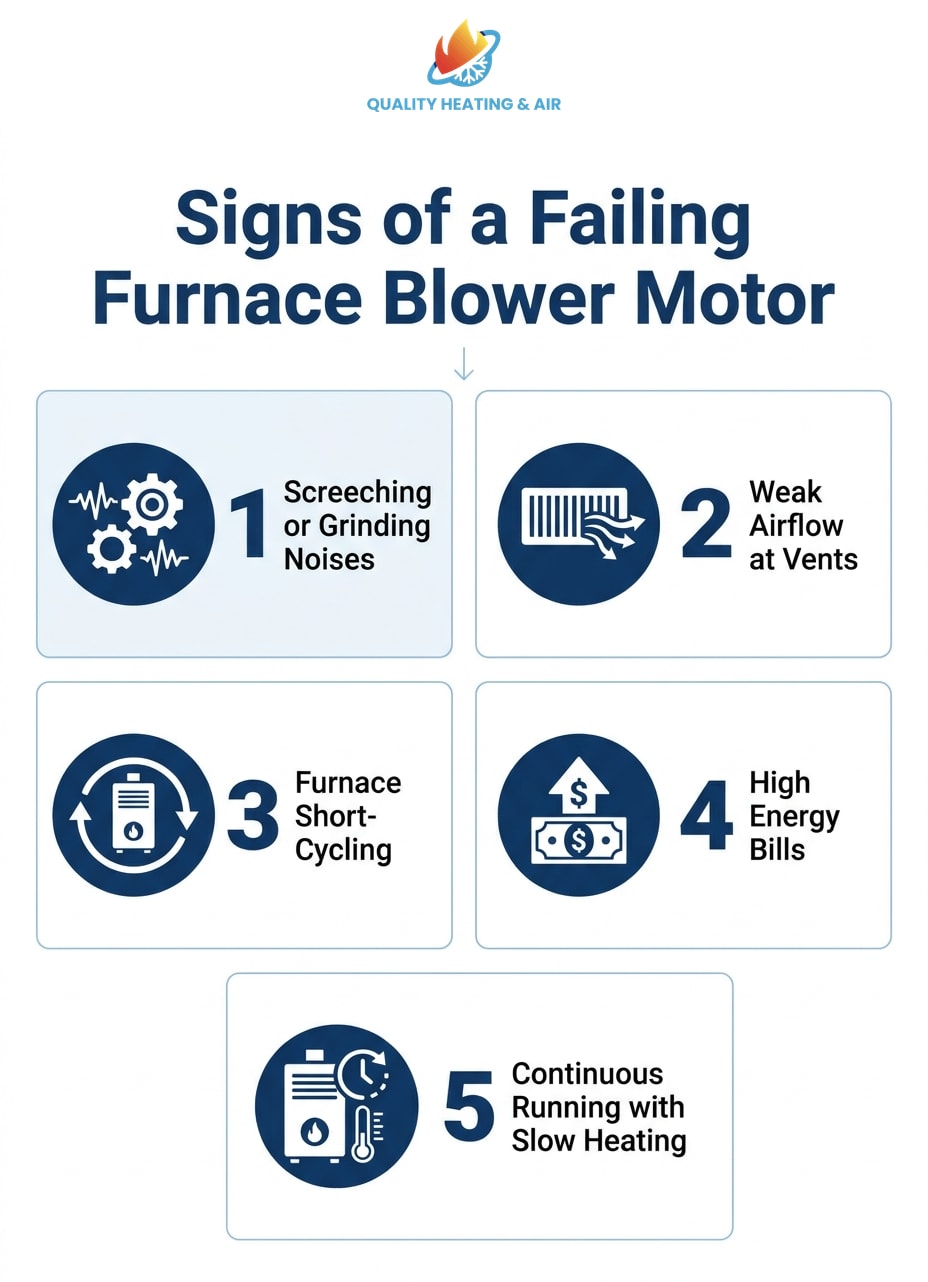
• Unusual Sounds — Likely Generation Issue (Burners/Igniter): Clicking or popping noises — Likely Distribution Issue (Blower Motor): Screeching, grinding, or loud humming
Auditory Warnings: What Does a Failing Blower Motor Sound Like?
Your heating system should operate with a smooth, consistent whoosh of air. When mechanical or electrical components begin to degrade, the furnace will start broadcasting clear auditory warnings. Because the blower motor is one of the hardest-working moving parts in the entire system, our dispatchers often hear clients describe very distinct, disruptive noises over the phone. Listening closely during those November pre-winter cold snaps can help you catch a failing motor before it stops spinning altogether.
The High-Pitched Screech of Worn Bearings
A loud screeching or squealing noise that sounds like metal scraping against metal is a classic indicator of worn-out motor bearings. The bearings are small metal spheres that allow the motor shaft to spin smoothly with minimal friction. Over years of use, the factory lubrication inside these bearings dries up. Without lubrication, the metal components grind against each other at high speeds, producing a piercing squeal. If caught early, our professionals can sometimes lubricate the bearings or replace them, but ignoring the screech often leads to the motor overheating and burning out.
The Heavy Grinding of a Damaged Blower Wheel
If you hear a violent, heavy grinding or clanking sound, the issue might involve the blower wheel itself. The motor is attached to a cylindrical fan that consists of dozens of small metal blades. If the motor mounts become loose, or if the fan wheel gets knocked off balance, the metal blades can start scraping against the side of the blower housing. This metal-on-metal contact creates a harsh grinding noise and can quickly tear the fan blades apart if the system is allowed to keep running.
The Electrical Buzz of a Failing Capacitor
A loud electrical humming or buzzing noise often points to a failing run capacitor rather than a mechanical breakdown of the motor itself. The capacitor acts like a battery that stores electricity, delivering a powerful jolt of energy to help the heavy blower motor start spinning. If the capacitor loses its charge, the motor tries to start but lacks the necessary torque. It will sit in place, drawing a massive amount of electricity, and emit a loud, vibrating hum. This is known as drawing "locked rotor amps," and it will quickly fry the motor windings if the system is not shut down.
Why High Altitude Accelerates Blower Motor Wear
At Quality Heating & Air, we know firsthand that HVAC systems operate differently depending on their geographic location, and the specific climate of Northglenn and the surrounding Denver metro area plays a massive role in how long your furnace components last. Sitting at an elevation of over 5,300 feet, our region presents unique atmospheric challenges that put extra strain on mechanical systems.
The impact of thinner air: At high altitudes, the air is significantly thinner, meaning it has a lower density than air at sea level. Because there are fewer air molecules per cubic foot, the air cannot absorb and carry heat as efficiently. To compensate for this reduced heat transfer capacity, your furnace blower motor has to work much harder. It must move a significantly higher volume of air through the ductwork just to deliver the same amount of warmth to your living room as a furnace operating at sea level.
Longer run times and dry climate: This need to push more air means the blower motor has to run longer during every heating cycle. Those extended run times add up to hundreds of extra hours of wear and tear over a single winter. Additionally, the exceptionally dry climate of the high desert can cause the lubricants inside the motor bearings to degrade and dry out much faster than they would in a humid environment.
Because of these regional factors, a motor that might last twenty years on the coast may start showing signs of fatigue much sooner here. Understanding how high altitude impacts your HVAC system is an important part of knowing when to schedule proactive maintenance and inspections.
Weak Airflow, Short-Cycling, and Overheating
When our technicians inspect a struggling furnace, we find that the symptoms of a failing blower motor extend far beyond strange noises. The physical operation of the furnace will change drastically, creating a chain reaction of safety hazards and inefficiencies. Here is exactly what happens inside your system when the motor struggles to push air.
1. Weak or Non-Existent Airflow: The most immediate physical symptom is a severe drop in air pressure at your vents. You may hold your hand over a supply register and feel almost nothing, even though you can hear the furnace running in the basement or utility closet. This weak airflow means the warm air is failing to reach the outer rooms of your home, leaving your bedrooms freezing while the hallway near the furnace stays warm. (Upgrading your indoor air quality solutions can also be hindered if the motor cannot circulate air through your whole-home purifiers or humidifiers).
2. Heat Trapped in the Exchanger: Because the weak motor is not moving enough air over the heat exchanger, the heat has nowhere to go. The metal heat exchanger continues to absorb energy from the gas burners, causing its internal temperature to skyrocket well beyond safe operational limits.
3. Tripping the High-Limit Switch: Modern furnaces are equipped with a safety device called a high-limit switch. This sensor monitors the temperature of the heat exchanger. When it detects that the system is overheating due to a lack of airflow, it immediately shuts off the gas burners to prevent a fire hazard or a cracked heat exchanger.
4. The Short-Cycling Loop: Once the high-limit switch cuts the burners, the furnace shuts down prematurely before your home reaches the target temperature. After the metal cools off, the furnace tries to start again, only to overheat and shut down a few minutes later. This rapid on-and-off behavior is called short-cycling, and it places immense electrical strain on the system while leaving your home completely unheated.
The Role of Air Filters in Blower Motor Lifespan
Before assuming that your blower motor is completely dead and needs an expensive replacement, there is one crucial, non-technical troubleshooting step we recommend every homeowner take: checking the air filter. A pattern we see often on our service calls is that one of the leading causes of premature blower motor failure is simply a dirty, neglected air filter.
Understanding static pressure: Your HVAC system is designed to operate within a specific range of static pressure. You can think of static pressure like blood pressure for your ductwork—it is the resistance to airflow. When you leave an air filter in place for too long, it becomes clogged with dust, pet dander, and debris. This creates a solid wall that restricts the amount of air the system can pull in through the return vents.
The strain on the motor: When the blower motor tries to pull air through a clogged filter, it has to work exponentially harder to overcome that severe restriction. This forces the motor to draw more electrical current, run hotter, and endure far more physical stress. Over time, this constant strain will burn out the motor windings or destroy the capacitor.
If you notice weak airflow during those November pre-winter cold snaps, pull your filter out and inspect it. If it is caked in gray dust, replace it immediately with a fresh one. If normal airflow resumes, you may have solved the problem. To prevent this issue from recurring, consider enrolling in a routine HVAC maintenance plan, which ensures your filters, motors, and electrical components are regularly inspected and optimized.
The Importance of Transparent Diagnostics Before Replacement
When a furnace stops blowing warm air, the anxiety of a major breakdown can quickly set in. However, we always remind our clients that not every airflow issue or strange noise means the entire blower motor must be replaced. The actual failure could be isolated to a much smaller, easily correctable component.
For example, if the motor is just humming, the fix might simply be swapping out a failed capacitor—a quick and straightforward repair. If the system is older and uses a belt-driven motor, a slipping or snapped belt could be the culprit, leaving the motor itself perfectly intact. Even a faulty relay on the control board can prevent the motor from receiving the signal to turn on.
This is where our team's commitment at Quality Heating & Air to transparent diagnostics makes a profound difference. We believe in taking the time to explain the mechanical "why" behind your airflow issues. Instead of rushing to suggest a full motor replacement at the first sign of trouble, our thorough professional diagnostic process identifies the exact root cause of the failure.
Proper diagnostics protect you in two ways. First, it prevents you from paying for a major component replacement when a minor adjustment would suffice. Second, if the motor does need to be replaced, identifying the root cause—such as highly restrictive ductwork or chronic static pressure issues—ensures that the brand-new motor won't suffer the exact same premature death as the old one.
Frequently Asked Questions About Furnace Blower Motors
What does a failing furnace blower motor sound like?
In our experience, a failing furnace blower motor typically produces loud screeching, metal-on-metal grinding, or heavy electrical humming. Screeching usually points to dried-out or worn bearings, grinding indicates a damaged blower wheel scraping the housing, and a loud hum suggests an electrical failure like a dead capacitor.
Can a furnace run with a bad blower motor?
It may run briefly, but it will quickly overheat and shut down to prevent a fire hazard. Without the blower motor moving air over the heat exchanger, the internal temperature spikes rapidly, causing the high-limit safety switch to trip and trigger a short-cycle.
Why is my furnace running but not blowing hot air?
The burner is successfully generating heat, but the blower motor is failing to push that warm air through the ductwork. The heat remains trapped inside the furnace cabinet, resulting in very weak or non-existent airflow at your living room vents.
How long do furnace blower motors last?
Our team typically sees furnace blower motors last 10 to 20 years, depending heavily on routine maintenance, regular filter changes, and local climate strain. In areas like Northglenn and the surrounding Denver metro area, high altitude and dry air can force the motor to work harder, potentially shortening its lifespan if not properly maintained.
Is it safe to run my furnace if the blower motor is screeching?
No, continuing to run the system can cause the motor to seize completely or cause severe damage to the heat exchanger. We recommend shutting the furnace off at the thermostat and calling a professional to prevent further mechanical damage or electrical burnout.
Address Weak Airflow Before Winter Arrives
Dealing with a furnace that runs constantly but leaves you shivering is frustrating, but those early warning signs are actually an opportunity. Weak airflow, screeching bearings, and short-cycling are clear indicators that your system needs professional attention. By scheduling a thorough diagnostic inspection with Quality Heating & Air during the November pre-winter cold snaps, you can resolve these heat distribution issues early, ensuring your home remains warm, safe, and reliably comfortable all winter long.

Testimonials
Neighbors trust Quality Heating & Air for honest work and fair pricing.
Service Areas