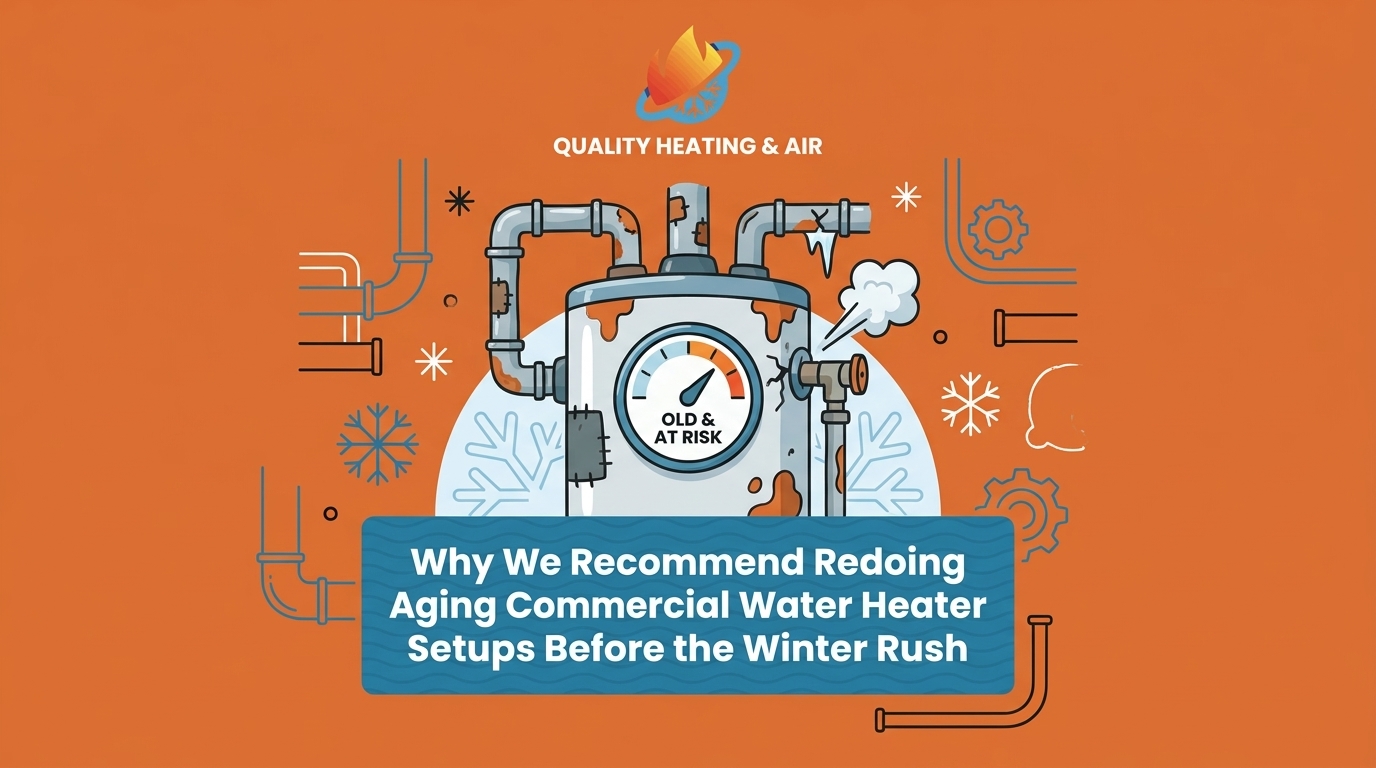
Why We Recommend Redoing Aging Commercial Water Heater Setups Before the Winter Rush
The Approaching Winter Threat to Aging Commercial Water Systems
With the September pre-winter heating rush just weeks away, facility managers are already bracing for the seasonal shift, making this the critical window to evaluate building infrastructure. Why we recommend redoing aging commercial water heater setups before the winter rush comes down to a simple reality: cold weather exposes every hidden flaw in a facility's plumbing configuration. When temperatures drop, aging systems that have been operating inefficiently for months suddenly face maximum thermal demand, turning minor performance hiccups into total operational failures. The core problem often isn't just the water heater tank itself, but the original piping configuration that forces the equipment to work significantly harder than necessary.
For facilities looking to secure their infrastructure, upgrading your commercial heating services and optimizing your commercial water heater setups should be at the top of the fall maintenance checklist.
When a commercial water heater begins to fail, property managers face a critical decision point: perform a basic one-to-one tank replacement or completely re-pipe and re-configure the setup for maximum system efficiency. A standard swap might seem like the quickest path to restoring hot water, but it often leaves the fundamental layout flaws untouched. Aging commercial systems frequently suffer from poor original manifold designs that throttle flow, create uneven thermal distribution, and force newly installed equipment to operate under the exact same stressful conditions that killed the old unit. By addressing these structural issues now, before the harsh winter weather arrives, facilities can prevent catastrophic breakdowns, eliminate chronic standby heat loss, and significantly reduce long-term operational costs.
Why Original Piping Layouts Often Sabotage New Equipment
Many property owners assume that if a building has had hot water for decades, the plumbing layout must be correct. The reality is that many original commercial piping layouts were fundamentally flawed from the start. Whether due to outdated building codes, rushed construction timelines, or a lack of specialized commercial plumbing knowledge at the time of installation, these original configurations frequently sabotage new equipment. In many Northglenn CO commercial facilities, we see brand-new, high-efficiency tanks failing years before their expected lifespan simply because the surrounding pipework restricts their performance.
To understand why this happens, we have to look at the mechanics of commercial manifolds. When multiple water heaters are banked together, they require a perfectly balanced manifold to ensure water flows equally through each unit. Here are the most common ways original layouts fail:
• Improperly sized headers: When the main supply pipe is too narrow, it creates a bottleneck, reducing flow velocity and starving the tanks furthest down the line.
• First-in, first-out piping: This outdated layout forces the first tank in the bank to handle the majority of the heating load, while the subsequent tanks sit nearly idle.
• Lack of balancing valves: Without proper flow control, water takes the path of least resistance, leading to massive temperature fluctuations across the system.
• Dead legs and unnecessary elbows: Excessive turbulence and stagnant water zones increase standby heat loss and drop the overall delivery temperature.
The Mechanics of Uneven Draw: When a manifold is improperly configured, it causes uneven draw from the multiple tanks. The unit closest to the cold water inlet ends up doing 80% of the heavy lifting. This single tank cycles on and off constantly, its burners firing continuously to keep up with the building's demand, while the other tanks barely operate. This imbalance leads to premature failure of the overworked unit. Even if you install a state-of-the-art replacement, keeping an old piping configuration incurs heavy long-term operational penalties. The new tank will suffer the exact same uneven thermal stress, rapidly degrading its internal components and voiding the efficiency gains you expected from the upgrade.
Basic Tank Swaps vs. Comprehensive Manifold Re-Piping
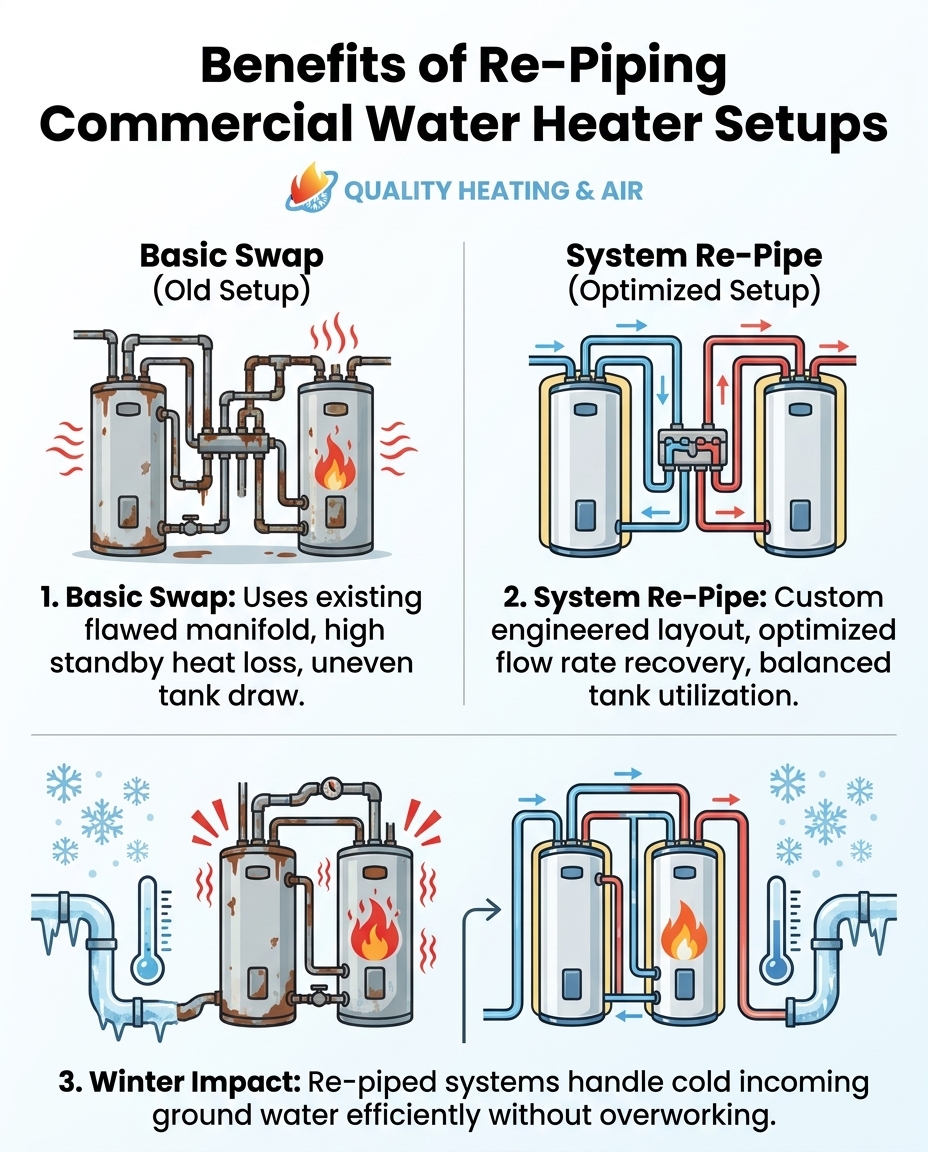
Drawing a clear technical distinction between simply replacing a water heater and re-engineering the entire setup is vital for long-term facility management. A basic one-to-one equipment swap entails disconnecting the old tank, sliding a new one into the exact same footprint, and reconnecting it to the existing manifold. While this approach minimizes immediate labor hours, its limitations are severe. It acts as a temporary band-aid, forcing the new equipment to adapt to an old, inefficient environment.
Comprehensive manifold re-piping, on the other hand, corrects original layout flaws by treating the replacement process as an opportunity for complete system re-engineering. This involves removing the restrictive headers, redesigning the flow path—often utilizing a reverse-return configuration to guarantee equal flow distance for every tank—and installing properly sized balancing valves.
• Flow Distribution — Basic 1-to-1 Tank Swap: Relies on existing layout; often heavily unbalanced. — Comprehensive Manifold Re-Pipe: Engineered for equal draw across all banked units.
• Equipment Lifespan — Basic 1-to-1 Tank Swap: Shortened due to uneven wear and tear on specific tanks. — Comprehensive Manifold Re-Pipe: Maximized, as the workload is distributed evenly.
• Energy Efficiency — Basic 1-to-1 Tank Swap: Limited by old, restrictive pipe sizing and standby loss. — Comprehensive Manifold Re-Pipe: Optimized through proper sizing and modern insulation.
• Recovery Rate — Basic 1-to-1 Tank Swap: Struggles during peak demand if headers are undersized. — Comprehensive Manifold Re-Pipe: Rapid recovery, utilizing the full BTU capacity of the bank.
• Long-Term Costs — Basic 1-to-1 Tank Swap: Higher operational overhead and premature replacement needs. — Comprehensive Manifold Re-Pipe: Lower utility expenditures and reduced maintenance frequency.
By redoing the setup holistically, the overall performance improves beyond the system's original capabilities. A comprehensive re-pipe ensures that when the building demands hundreds of gallons of hot water during a morning rush, every single tank in the bank fires simultaneously and contributes equally. This balanced approach not only protects the structural integrity of the new tanks but also delivers a much more consistent water temperature to the end user, eliminating the frustrating hot-and-cold fluctuations that generate tenant complaints.
How Freezing Temperatures Expose Weak Flow Configurations
Winter places highly specific environmental stressors on commercial water heating systems, and the physics of these changes cannot be ignored. During the summer, municipal ground water enters the facility at a relatively mild temperature, requiring less energy to heat up to the standard 120°F to 140°F setpoint. But as the season shifts, the incoming parameters change drastically.
The Thermal Load Spike
With Northglenn's harsh freezing winters dropping average lows into the teens, incoming city water temperatures fall significantly. Water that entered the building at 60°F in July might enter at 40°F in December. This massive temperature drop creates a severe increase in the thermal load for the heating system. The equipment suddenly has to bridge a much wider temperature gap—often working 30% to 40% harder just to achieve the exact same output temperature. This is the precise moment when poorly configured piping begins to fail the facility.
Recovery Rate Collapse
Recovery rate is the speed at which a water heater can heat a specific volume of water after the stored hot water has been depleted. When a system is burdened by restricted flow from a bad manifold layout, it simply cannot move water through the heat exchanger fast enough. Under extreme seasonal conditions, this sluggish flow combined with freezing incoming water causes the recovery rate to collapse. The system falls behind the building's demand, resulting in lukewarm water at the fixtures and burners that never shut off.
Adjacent System Stress
The need for robust heating infrastructure extends beyond just domestic hot water. In many commercial and industrial facilities, the water heating setup is intrinsically linked to other high-demand facility systems. If the primary water heating bank is struggling, it can cause cascading pressure drops or thermal irregularities that impact commercial boiler systems and hydronic heating loops. Upgrading the manifold ensures that the entire mechanical room operates with the correct flow dynamics, protecting all interconnected equipment from winter-induced strain.
Custom Engineering Solutions for Maximum Flow Efficiency
Solving complex commercial water heating inefficiencies requires more than just unboxing a new heater; it requires a calculated, engineered approach. Quality Heating & Air provides custom engineering solutions by evaluating the whole manifold for strategic re-piping to maximize efficiency, rather than just performing basic equipment swap-outs. This meticulous process ensures the new system is built to handle peak winter demands effortlessly.
1. Comprehensive System Evaluation: The process begins by analyzing the entire manifold and piping layout as a cohesive unit. We measure existing pipe diameters, assess flow velocities, and identify the exact points where the original design creates bottlenecks or uneven thermal draw.
2. Strategic Re-Routing and Sizing: Based on the evaluation, the new manifold is designed using the reverse-return piping method. This guarantees that the water traveling to and from each tank covers the exact same distance, naturally balancing the hydraulic pressure. Properly sized headers are installed to accommodate the maximum flow rate required during peak usage without causing turbulent friction.
3. Reducing Standby Heat Loss: Optimized piping configurations drastically reduce standby heat loss. By eliminating dead legs (sections of pipe where water sits stagnant and cools down) and utilizing modern, high-grade insulation on all new copper or PEX commercial lines, the system retains thermal energy much longer, reducing the number of times the burners must cycle on during off-hours.
4. Improving Flow Rate Recovery: With the hydraulic resistance minimized, water moves smoothly through the heat exchangers. This strategic re-configuring improves flow rate recovery, ensuring that even when incoming winter ground water is ice-cold, the system can rapidly heat and distribute it to meet peak heating season demands.
5. Integrating Advanced Technologies: A full re-pipe is the perfect time to explore advanced options that can be integrated to further modernize the facility's energy profile. This includes adding smart recirculation pumps, installing digital mixing valves for precise temperature control, or transitioning to energy-efficient water heater options like commercial heat pump technology or high-efficiency condensing units that pair perfectly with an optimized manifold.
Securing Operational Reliability Ahead of the Fall Deadline
Commercial facilities consume a massive portion of their total energy budget on water heating, making efficiency not just a matter of comfort, but a critical component of operational overhead. As we approach the September pre-winter heating rush, the urgency to complete these technical upgrades cannot be overstated. Waiting until the first hard freeze to discover that your aging system cannot handle the thermal load puts your entire operation at risk.
The risks of business downtime if a flawed system fails during peak winter demand are severe. For a restaurant, hotel, or multi-family complex, a total loss of hot water is an operational emergency that halts business, frustrates tenants, and demands immediate, often highly stressed, emergency service. By acting now, facility managers can schedule comprehensive evaluations and upgrades during the early fall window, avoiding the frantic winter service rush when parts and commercial specialists are in peak demand.
Furthermore, an upgraded system requires ongoing oversight to keep re-engineered systems running at peak performance. Even a perfectly balanced manifold benefits from routine flushing, anode rod inspections, and burner tuning. Enrolling the newly upgraded system in a comprehensive preventative maintenance plan ensures that the custom engineering work continues to deliver maximum efficiency and reliability year after year, protecting the facility's investment long after the winter season passes.
Frequently Asked Questions About Commercial Water Heater Upgrades
What is the difference between a water heater swap and a system re-pipe?
A basic water heater swap involves disconnecting the old tank and installing a new one using the existing plumbing connections. A system re-pipe involves redesigning and replacing the entire manifold and surrounding pipework to correct original design flaws. Re-piping ensures equal flow distribution and maximizes the efficiency of the new equipment, whereas a simple swap often forces the new tank to operate in a restrictive, inefficient environment.
Why is my commercial water heater losing efficiency?
Commercial water heaters lose efficiency due to sediment buildup, failing internal components, and restrictive piping layouts that force the unit to overwork. If the manifold is improperly configured, the unit may be constantly cycling to compensate for uneven draw across the system. Upgrading the piping configuration and performing regular descaling can restore the system's ability to transfer heat effectively.
How do incoming winter water temperatures affect commercial heaters?
During the winter, municipal ground water temperatures drop significantly, creating a much larger temperature gap for the heater to overcome. This massive increase in thermal load forces the system to run longer and work harder to deliver the same volume of hot water. Poorly configured systems with undersized manifolds struggle to maintain their recovery rates under this extreme seasonal stress.
How long do commercial water heaters last?
A typical commercial water heater lasts significantly less time than a residential unit due to the heavy, continuous demand placed upon it. When installed correctly with a balanced manifold and maintained regularly, a high-quality commercial tank can operate reliably for many years. However, if the unit is subjected to uneven draw from a flawed piping layout, its lifespan can be drastically reduced due to premature component fatigue.
When should a commercial water heater be replaced?
A commercial water heater should be replaced when you notice chronic signs of failure, such as rusty water, persistent leaks, a severe drop in recovery rate, or unusual rumbling noises from heavy sediment calcification. Facility managers should proactively schedule replacements before the winter rush if the system is aging and struggling to keep up with daily demand, rather than waiting for a total breakdown.
Protect Your Facility's Hot Water Supply Before the Freeze
Redoing an aging commercial water heater setup is about much more than just putting a new tank in the mechanical room. Comprehensive re-piping provides clear technical reasoning for better efficiency, balanced flow dynamics, and long-term operational reliability. By correcting the structural flaws of the original manifold, you ensure that your new equipment operates exactly as engineered, without the burden of uneven thermal stress.
We strongly encourage facility managers to take proactive steps now, evaluating their mechanical rooms before the harsh winter weather exposes weak flow configurations. Don't wait for a catastrophic breakdown to force your hand during the busiest time of the year. Reach out to consult with our commercial plumbing experts today to engineer a custom solution that protects your facility's hot water supply and keeps your operations running smoothly all winter long.

Testimonials
Neighbors trust Quality Heating & Air for honest work and fair pricing.
Service Areas