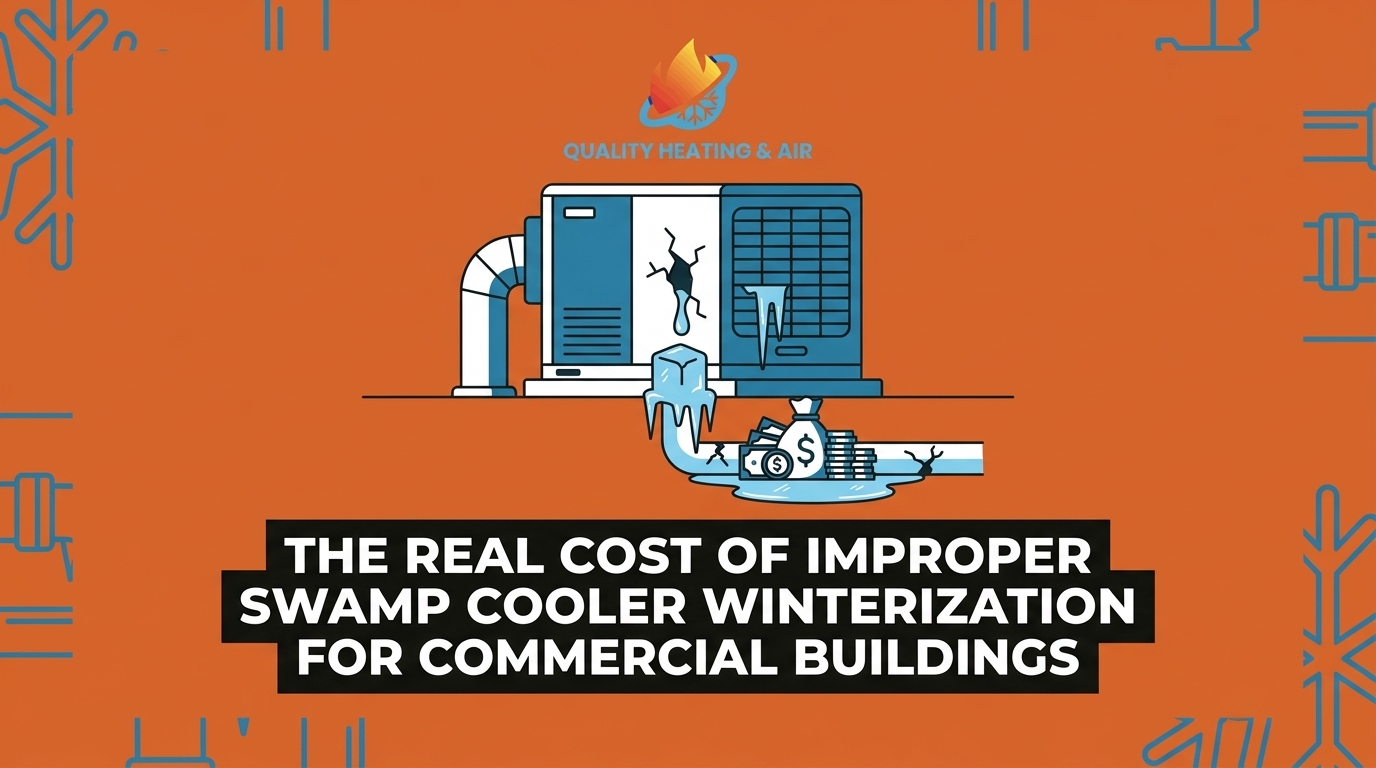
The Real Cost of Improper Swamp Cooler Winterization for Commercial Buildings
The Hidden Impact of Skipped Fall Shutdowns on Commercial Rooftop Units
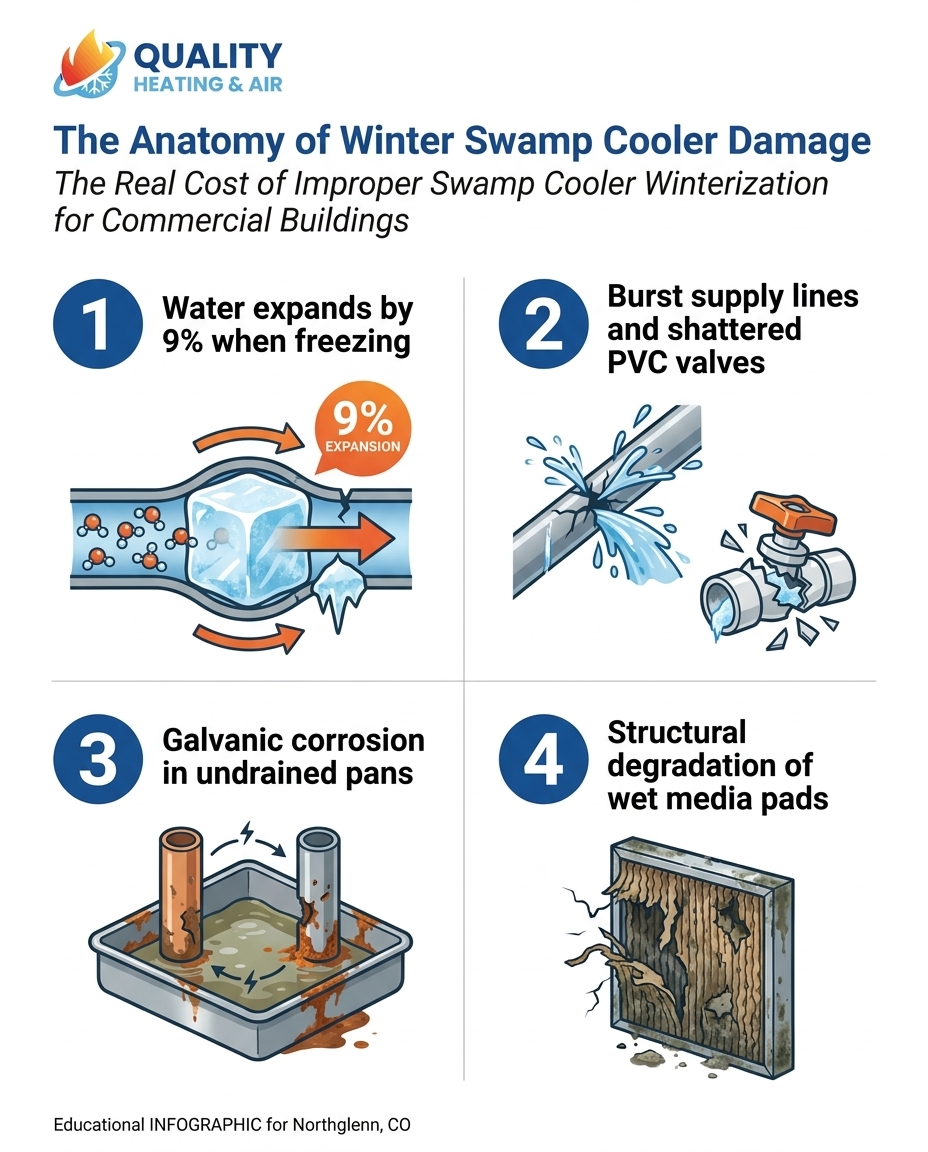
Water expands by approximately 9% when it freezes, a physical reality that perfectly illustrates a harsh truth: the real cost of improper swamp cooler winterization for commercial buildings. When facility managers skip proactive seasonal shutdowns, that small amount of residual moisture turns into a destructive force inside mechanical systems. Instead of a smooth transition into the heating season, our Quality Heating & Air technicians frequently see property directors met with a concrete problem: discovering burst supply lines, warped exterior housings, and deeply rusted drain pans during spring start-ups. These catastrophic failures occur simply because proper draining and covering were neglected during the September pre-freeze fall transition.
To protect your rooftop assets, learn more about our commercial cooling systems and consider securing a commercial HVAC maintenance plan before temperatures drop.
The true scope of the problem:
• Hidden deterioration: Ice expansion happens silently over the winter months, completely out of sight on commercial rooftops.
• Compounding failures: A single cracked valve can lead to extensive water damage once the system is re-pressurized in the spring.
• Budget disruption: Reactive spring repairs consume facility budgets that should be allocated for routine operational improvements.
The critical decision point for any facility director is scheduling a professional shutdown before the first hard freeze hits. Commercial evaporative coolers are massive, complex pieces of equipment that require specialized decommissioning. Framing this discussion around risk management and protecting commercial assets is necessary because, in our experience, basic DIY maintenance falls severely short of what a large-scale rooftop unit requires to survive dormant winter months.
How Freezing Temperatures Destroy Commercial Water Supply Lines
The mechanical physics of freeze damage on water supply lines and valves in commercial evaporative coolers are unforgiving. When undrained water freezes solid inside an enclosed space, it exerts immense outward pressure on the surrounding materials. In our years servicing Northglenn commercial properties, our team has seen how sudden, early October hard freezes frequently catch facility managers off guard if their rooftop systems aren't drained in time. The resulting ice expansion causes catastrophic damage that remains hidden until the cooling season returns.
The Physics of Ice Expansion in HVAC Components
Understanding how water behaves at sub-zero temperatures explains why standard pipe insulation is insufficient without proper system draining. When the ambient temperature drops below freezing, the water inside copper, brass, and PVC fittings begins to crystallize. This crystallization process forces the water molecules into a hexagonal structure, which takes up significantly more volume than liquid water.
Common component failures we encounter include:
• Shattered PVC fittings: Rigid plastics cannot flex to accommodate the 9% volume increase, resulting in immediate shattering.
• Split copper supply lines: While copper has slight malleability, the immense pressure of a solid ice block easily splits the seam of the pipe.
• Ruptured brass float valves: The intricate internal mechanisms of float valves are easily crushed by internal ice formation, rendering them useless.
These catastrophic ice expansions lead to microscopic cracks that widen over repeated freeze-thaw cycles throughout the winter. When the system is re-pressurized in the spring, these compromised components fail instantly, spraying pressurized water across the roof.
• Water Volume — Residential Window Units: Minimal capacity, quick to drain passively. — Commercial Rooftop Units: Massive reservoirs and extended supply lines requiring forced purging.
• Component Scale — Residential Window Units: Small, easily accessible plastic tubing. — Commercial Rooftop Units: Heavy-duty copper, brass, and industrial PVC exposed to high winds.
• Freeze Risk — Residential Window Units: Often removed and stored indoors during winter. — Commercial Rooftop Units: Permanently mounted on the roof, enduring direct exposure to deep freezes.
• Failure Consequence — Residential Window Units: Minor dripping near a window frame. — Commercial Rooftop Units: High-pressure water flooding commercial flat roofs and penetrating the building envelope.
Galvanic Corrosion: The Silent Threat of Standing Water in Drain Pans
Leaving standing water in commercial cooler pans over the winter causes severe long-term structural degradation. This process is driven by galvanic corrosion, an electrochemical reaction that occurs when dissimilar metals are exposed to an electrolyte—in this case, stagnant water filled with accumulated dissolved minerals. During the September pre-freeze fall transition, failing to completely dry the basin sets the stage for months of silent decay.
The mechanics of metal degradation:
• Mineral concentration: As water slowly evaporates and freezes, the concentration of calcium and magnesium increases, creating a highly corrosive sludge.
• Electrochemical attack: The stagnant, mineral-heavy water acts as a catalyst, accelerating the transfer of electrons between the metal components of the unit, leading to rapid oxidation.
• Base pan rust-out: Continuous exposure to this moisture over the winter months deeply rusts out commercial drain pans, eating through the protective galvanized coatings.
Beyond the chemical breakdown, there is a severe physical threat. When standing water freezes in the base pan, the expanding ice pushes outward against the walls of the unit. This structural warping of the cooler housing bends the metal out of alignment. Once the housing is warped, the louvered side panels will no longer fit correctly, allowing untreated outside air and pests to bypass the cooling media. This degradation happens silently over months, completely hidden from property managers until our technicians open the unit in the spring.
Media Pad Degradation and Spring Air Quality Risks
Improper winterization directly connects to the physical breakdown of media pads and subsequent indoor air quality issues. Commercial evaporative coolers rely on thick, highly absorbent media pads to facilitate the cooling process. If these pads are left saturated with water during freezing temperatures, the internal cellular structure of the material is destroyed. The freezing water acts like microscopic blades, shredding the fibers of the pad.
The biological consequences of wet pads:
1. Structural collapse: The degraded pads sag and lose their rigid shape, creating large gaps where unconditioned air bypasses the cooling process entirely.
2. Moisture trapping: Undrained, partially frozen pads hold moisture deep within their layers, preventing proper airflow and drying.
3. Microbial growth: This trapped moisture creates an ideal breeding ground for mold spores and bacteria during dormant months.
The consequence of this neglect is severe for Northglenn commercial properties. When our crews perform spring start-ups, we often see massive blower motors pulling air through these compromised, mold-infested pads, circulating contaminated air throughout the entire commercial building. Facility directors must recognize that poorly maintained swamp coolers can cause indoor air quality issues that directly impact employee health and productivity. Highlighting the necessity of removing or properly drying and covering pads during the shutdown process is a core component of professional winterization.
Structural Damage and Roof Leak Liabilities
The secondary liabilities of improper winterization extend far beyond the HVAC equipment itself, posing a direct threat to the commercial building's structural integrity. When burst rooftop commercial cooler supply lines thaw in the spring, or when an unsuspecting maintenance worker turns the water supply back on, the results are immediate and destructive. Hundreds of gallons of water can escape from a ruptured one-inch supply line in a matter of hours.
The cascading effects of water damage:
• Flat roof pooling: Commercial buildings typically feature flat or low-slope roofs. High-pressure water from a burst cooler line quickly overwhelms local roof drains, leading to massive pooling.
• Membrane degradation: Continuous exposure to pressurized water can lift seams in TPO or EPDM roof membranes, forcing water into the insulation layers below.
• Interior flooding: Compromised cooler bases and breached roof membranes allow water to pour directly into the building, damaging ceiling tiles, inventory, and electrical systems.
For Northglenn commercial properties, we constantly warn clients that this scenario represents a major liability for real estate investors and property managers. The fallout extends beyond just an HVAC repair bill; it involves roofing contractors, water mitigation specialists, and potential business interruption for the tenants below. Reinforcing preventative fall maintenance is the most effective strategy available. The effort required to properly decommission a unit is a fraction of the labor and resources required to mitigate severe commercial water damage.
Risk Management: Why Commercial Decommissioning is Not a Maintenance Shortcut
Commercial winterization involves complex steps that demand the expertise of licensed professionals. This is not a residential window unit that can simply be unplugged and covered with a tarp. A comprehensive commercial shutdown requires disconnecting high-voltage power supplies, isolating and purging industrial water lines, and installing specialized, heavy-duty winter covers that can withstand severe winter winds.
Step-by-step DIY approaches are inappropriate and dangerous for commercial facility managers. Attempting to isolate high-voltage systems or navigate wet commercial roofs without proper safety training introduces severe liability and safety risks. Instead, transitioning the focus to proactive partnerships yields far better results for facility operations.
During a recent early fall visit for a pre-heating-season tune-up, one property manager requested a thorough assessment of their facility's rooftop units. Our Quality Heating & Air technician performed the necessary evaluations and took the time to explain the system functions, detailing potential weather-related scenarios if maintenance was delayed. The customer received the needed information to make informed decisions about their seasonal transition timeline.
This approach highlights a key operational difference: partnering proactively with local property managers. By explaining every step of the winterization process, facility directors understand exactly how this proactive maintenance prevents massive spring repair bills. A comprehensive system assessment during the September pre-freeze fall transition ensures that the equipment is safely decommissioned while simultaneously identifying any components that will need replacement before the next cooling season. This proactive maintenance partnership helps facility directors plan budgets accurately without facing surprise spring failures, allowing them to focus confidently on their commercial heating services throughout the winter.
Schedule Your Commercial Swamp Cooler Shutdown Before the Freeze
The window for safe, effective winterization closes rapidly as temperatures begin to drop during the September pre-freeze fall transition. Once the first hard freeze arrives, the damage to undrained supply lines and saturated media pads is already done.
At Quality Heating & Air, we strongly recommend facility managers take action now to secure a comprehensive maintenance plan to protect their commercial investments and avoid budget-draining spring repairs. Proper draining, professional power isolation, and secure covering are the only proven methods to prevent catastrophic mechanical failures.
Frequently Asked Questions
What happens if a commercial swamp cooler is not winterized?
If a commercial unit is left completely active or improperly shut down, trapped water will freeze and expand. This expansion shatters PVC fittings, splits copper supply lines, and crushes brass valves. Additionally, standing water in the drain pan accelerates severe rust, and wet media pads break down structurally, leading to extensive repairs in the spring.
Why do swamp cooler lines burst in the winter?
Swamp cooler lines burst because water expands by approximately 9% when it turns into ice. In an enclosed pipe or valve, this physical expansion creates immense outward pressure that the surrounding metal or plastic cannot contain. The rigid materials inevitably crack or shatter to accommodate the increased volume of the ice.
When should I turn off my commercial swamp cooler in Colorado?
The ideal time we recommend for decommissioning a commercial evaporative cooler in Colorado is during the September pre-freeze fall transition. Waiting until October significantly increases the risk of a sudden, unexpected overnight hard freeze. Scheduling the shutdown early ensures the system is completely dry and secured before sub-zero temperatures arrive.
Can a large evaporative cooler freeze and crack?
Yes, large commercial evaporative coolers are highly susceptible to freezing and cracking. The massive base pans can hold significant amounts of standing water, which expands upon freezing and warps the heavy metal housing. This structural warping permanently damages the unit's integrity and prevents the louvered panels from sealing correctly.
Does standing water in a drain pan cause rust over the winter?
Standing water heavily accelerates rust and galvanic corrosion over the dormant winter months. As the water sits, dissolved minerals concentrate and react with the metal components of the drain pan. This continuous electrochemical reaction eats through protective galvanized coatings, eventually causing the base pan to rust completely through.
Why is professional winterization recommended over DIY for commercial units?
Commercial evaporative coolers operate on high-voltage electrical systems and feature complex, high-capacity water supply networks. Professional technicians have the training to safely isolate these dangerous energy sources and fully purge the industrial lines without risking injury. Attempting DIY maintenance on commercial rooftop equipment introduces severe safety hazards and liability risks for property managers.
Testimonials
Neighbors trust Quality Heating & Air for honest work and fair pricing.
Service Areas