
What to Look for When Buying a New AC Unit to Stay Chilled

## Why Choosing the Right AC System for Your Home Matters More Than You Think
How to choose the right ac system for your home comes down to five key steps:
1. Calculate your cooling needs - Estimate BTUs by multiplying your home's square footage by 20, then divide by 12,000 to get tonnage 2. Pick the right system type - Central air for whole-home cooling with existing ducts, ductless mini-splits for zoned or duct-free spaces, or a heat pump for combined heating and cooling 3. Check efficiency ratings - Look for a SEER2 of at least 13.4 (North) or 14.3 (South/Southwest); higher ratings mean lower utility bills 4. Account for your home's unique factors - Insulation, window size, ceiling height, sun exposure, and occupancy all affect what size and type you need 5. Get a professional Manual J load calculation - Square footage alone is not enough; a certified HVAC technician can size your system accurately and help you avoid costly mistakes
Your air conditioner is one of the biggest investments you'll make in your home. It shapes how comfortable you feel every day, how high your energy bills climb each summer, and how often you're calling for repairs. Yet many homeowners end up with a system that's the wrong size, the wrong type, or simply not matched to their home — and they pay for it for years.
An undersized unit runs constantly and never quite keeps up. An oversized one short-cycles, wearing itself out faster while leaving your home feeling humid and clammy. According to data from Consumer Reports, about 19% of central AC systems purchased between 2009 and 2024 experienced at least one problem, with 24% eventually stopping working properly. A lot of that comes down to poor selection and sizing from the start.
Whether you're replacing an aging system or cooling a home for the first time, getting this decision right matters — for your comfort, your wallet, and your peace of mind.
How to Choose the Right AC System for Your Home
When we talk to our neighbors in Thornton and Northglenn, the most common concern is longevity. Nobody wants to replace a major appliance every few years. A well-chosen system should last at least a decade, and with proper AC Maintenance and Service, it can often go much longer.
The secret to that lifespan isn't just buying an expensive brand; it’s ensuring the cooling capacity matches your home’s specific needs. If a system is too small, it works itself to death. If it's too large, the frequent starting and stopping (short-cycling) puts immense strain on the compressor. Choosing a Central Air Conditioner or a ductless system requires looking at our unique regional climate. Here in Colorado, we deal with semi-arid conditions and high-altitude air, which can actually change how equipment performs compared to sea-level locations.
Calculating Capacity: How to Choose the Right AC System for Your Home Sizing
To understand AC sizing, we have to look at BTUs (British Thermal Units) and tonnage. A BTU is a measure of how much heat a unit can remove from the air in one hour. In the HVAC world, we also use "tons." One ton of cooling equals 12,000 BTUs per hour.
While a professional assessment is always best, you can use a rough "rule of thumb" to get started. Multiply your square footage by 20 to find the base BTUs needed. For example, a 1,200-square-foot home would need roughly 24,000 BTUs, which translates to a 2-ton unit.
| Home Square Footage | Estimated BTUs Needed | Required Cooling Tons | | --- | --- | --- | | 1,000 - 1,200 | 21,000 - 24,000 | 1.5 - 2.0 Tons | | 1,500 - 1,800 | 30,000 - 36,000 | 2.5 - 3.0 Tons | | 2,100 - 2,400 | 42,000 - 48,000 | 3.5 - 4.0 Tons | | 2,700 - 3,000 | 54,000 - 60,000 | 4.5 - 5.0 Tons |
Expert Tips on How to Choose the Right AC System for Your Home Layout
Square footage is only the beginning of the story. If you have vaulted ceilings, your AC has to cool a much larger volume of air than a home with standard eight-foot ceilings. This is where a Manual J load calculation becomes vital.
When we perform our Air Conditioning Services, we look at "heat gain." This includes how much sun hits your windows, the quality of your insulation, and even how many people live in the house. A kitchen that is used daily for heavy cooking generates more heat than a formal dining room that sits empty. These nuances ensure that when you finally flip the switch, the air is crisp and the humidity is perfectly managed.
Comparing Central Air, Ductless Mini-Splits, and Heat Pumps
Choosing the right technology is just as important as the size. Most homes in Thornton were built with ductwork already in place, making a central system a natural choice. However, as we move toward more Energy Efficient HVAC solutions, many homeowners are looking at ductless options or heat pumps.
Benefits of Central Air Systems
Central air is the gold standard for whole-home comfort. It uses a single outdoor condenser and an indoor evaporator coil to cool air, which is then pushed through your ducts by a blower motor. The biggest advantage is consistency. Because the air is distributed through every vent, you don't get "hot spots" in the corners of your home. If your existing ducts are in good shape, this is often the most straightforward installation. However, we always recommend a duct inspection first; sealing leaky ducts can prevent 20-30% of energy waste from air escaping into your attic or crawlspace. If you ever run into issues with airflow, our team provides expert HVAC Repair Denver CO to get your system back in balance.
Versatility of Ductless Mini-Splits
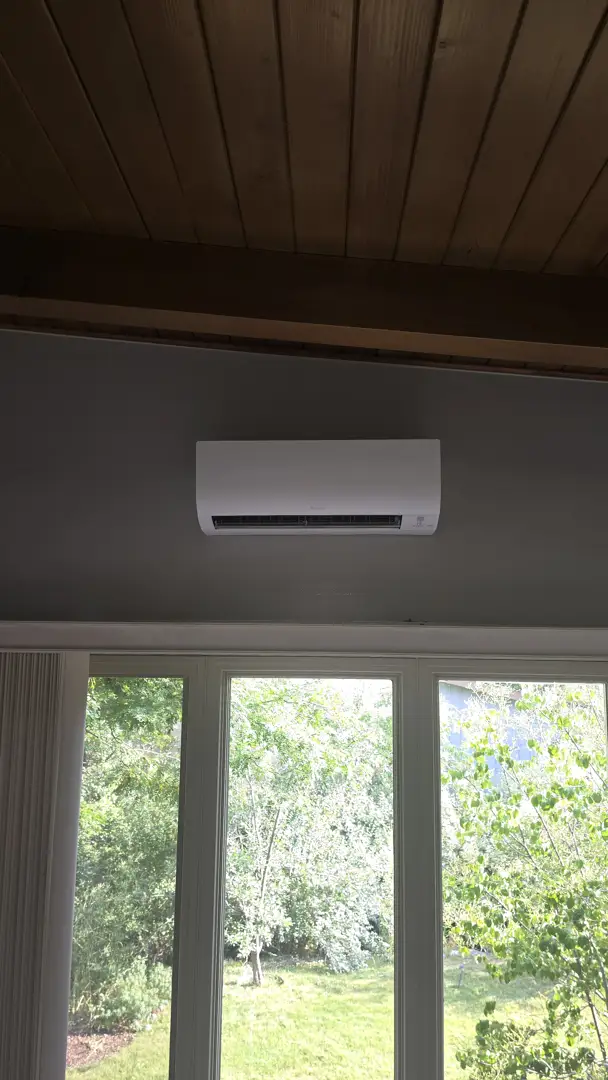
What if your home doesn't have ducts, or you’ve recently added a sunroom or a garage workshop? Ductless mini-splits are the answer. These systems consist of a small outdoor unit connected to one or more indoor air handlers mounted on the wall.
The beauty of ductless is zoned comfort. You can keep your bedroom at 68 degrees while leaving the guest room at 75, saving massive amounts of energy. They are incredibly quiet and avoid the energy losses associated with ductwork. For older homes in our area that rely on baseboard heat and lack the space for bulky ducts, mini-splits are a game-changer.
Decoding Energy Efficiency Ratings and Performance Features
In the past, you just looked for the biggest unit you could afford. Today, efficiency is king. High-efficiency systems don't just save the planet; they save you money every single month.
Understanding SEER2 and EER2
You’ve likely seen the term SEER (Seasonal Energy Efficiency Ratio). In 2023, the industry moved to SEER2, which is a more accurate testing standard that accounts for the "static pressure" of your home's ductwork. Essentially, it reflects real-world performance better than the old ratings.
In the Northern U.S. (including Colorado), the minimum SEER2 for new systems is 13.4. However, "minimum" doesn't mean "optimal." Many high-end units reach ratings of 20 or even 26. While a higher SEER2 unit costs more upfront, the utility bill reduction over its 15-year lifespan can be thousands of dollars. Additionally, the federal government offers a tax credit that covers 30% of air source heat pump costs, up to $2,000, making efficiency more affordable than ever.
Single-Stage vs. Variable-Speed Units
The "engine" of your AC is the compressor, and how it runs makes a huge difference in your comfort.
- Single-Stage: This is like a light switch. It’s either 100% on or 100% off. These are the most common but can lead to temperature swings. - Two-Stage: Think of this as having a "low" and "high" setting. It runs on low (about 70% capacity) most of the time, switching to high only on the hottest July afternoons. - Variable-Speed (Inverter): This is like a dimmer switch. It can run at any speed between 25% and 100%. By running at lower speeds for longer periods, it provides incredibly precise temperature control (within 0.5 degrees) and superior dehumidification. This constant, gentle airflow is also great for Allergy Relief HVAC because the air is constantly being filtered through your system.
Key Home Factors That Influence Your Cooling Selection
Your home is a complex system where everything is connected. Before you decide how to choose the right ac system for your home, you need to look at the envelope of the house itself. If your insulation is thin or your windows are drafty, even the best AC will struggle.
When we provide AC Repair Services, we often find that "broken" air conditioners are actually just overwhelmed by a home that leaks air. Improving your airtightness and insulation can sometimes allow you to buy a smaller, less expensive AC unit because the house holds the cold air so much better.
Impact of Thornton Climate on AC Performance
Thornton sits in a semi-arid climate zone. We have hot summers where temperatures can easily climb into the 90s, but we also have very low humidity compared to the Midwest or South. This is why "swamp coolers" (evaporative coolers) are popular here, though they struggle on the few humid days we do have.
High altitude also matters. Air is thinner here, which means fans have to work a bit differently to move the same amount of cooling "mass." We ensure your system is calibrated for the Front Range’s specific atmospheric conditions so you don't lose efficiency.
Smart Features and Advanced Controls
Modern AC systems are smarter than ever. We highly recommend pairing your new unit with a programmable or smart thermostat. A smart thermostat can reduce cooling costs by about 10% simply by adjusting the temperature when you aren't home.
Other features to consider:
- Quiet Operation: Look for units with decibel (dB) ratings under 60 if the unit is located near a bedroom window. - Humidity Control: Even in dry Colorado, indoor humidity from showers and cooking can make a home feel "stuffy." Variable-speed units are masters at pulling this moisture out. - Smart Home Integration: Many new units allow you to monitor your energy usage and system health directly from your smartphone.
Frequently Asked Questions about AC Installation
What is a Manual J load calculation?
A Manual J is the industry-standard calculation used to determine the exact amount of heat a house gains throughout the day. Unlike simple square footage estimates, it looks at your home’s orientation to the sun, the number of windows, insulation R-values, wall thickness, and even the number of occupants. It is the only way to ensure your AC is sized perfectly for your specific address.
How often should I maintain my new AC system?
We recommend professional maintenance at least once a year, ideally in the spring before the heat hits. During a visit, we clean the coils, check refrigerant levels, and ensure electrical connections are tight. On your own, you should change your air filters every 1–3 months. Keeping the system clean can prevent the 20% energy waste often caused by dirty equipment.
When is it better to replace an AC rather than repair it?
If your system is more than 10–15 years old and requires a repair that costs more than half the value of a new unit, it’s usually time to replace it. Other signs include skyrocketing utility bills, uneven cooling, or if the unit still uses R-22 refrigerant (which is phased out and very expensive to replace). Modern units are so much more efficient that the energy savings alone often help "pay back" the investment over time.
Conclusion
Choosing a new air conditioner doesn't have to be an overwhelming process. By focusing on proper sizing, high efficiency, and the right technology for your home's layout, you can ensure a cool, comfortable environment for your family for years to come.
At Quality Heating and Air, we take pride in being Thornton’s trusted HVAC partner. We treat every home like our own, offering transparent solutions and expert guidance to help you make the best choice for your unique needs. Whether you need a full system replacement or a quick tune-up, we are here to help. Contact us today for our expert Air Conditioning Services and let’s get your home ready for summer!

Testimonials
Neighbors trust Quality Heating & Air for honest work and fair pricing.
Service Areas