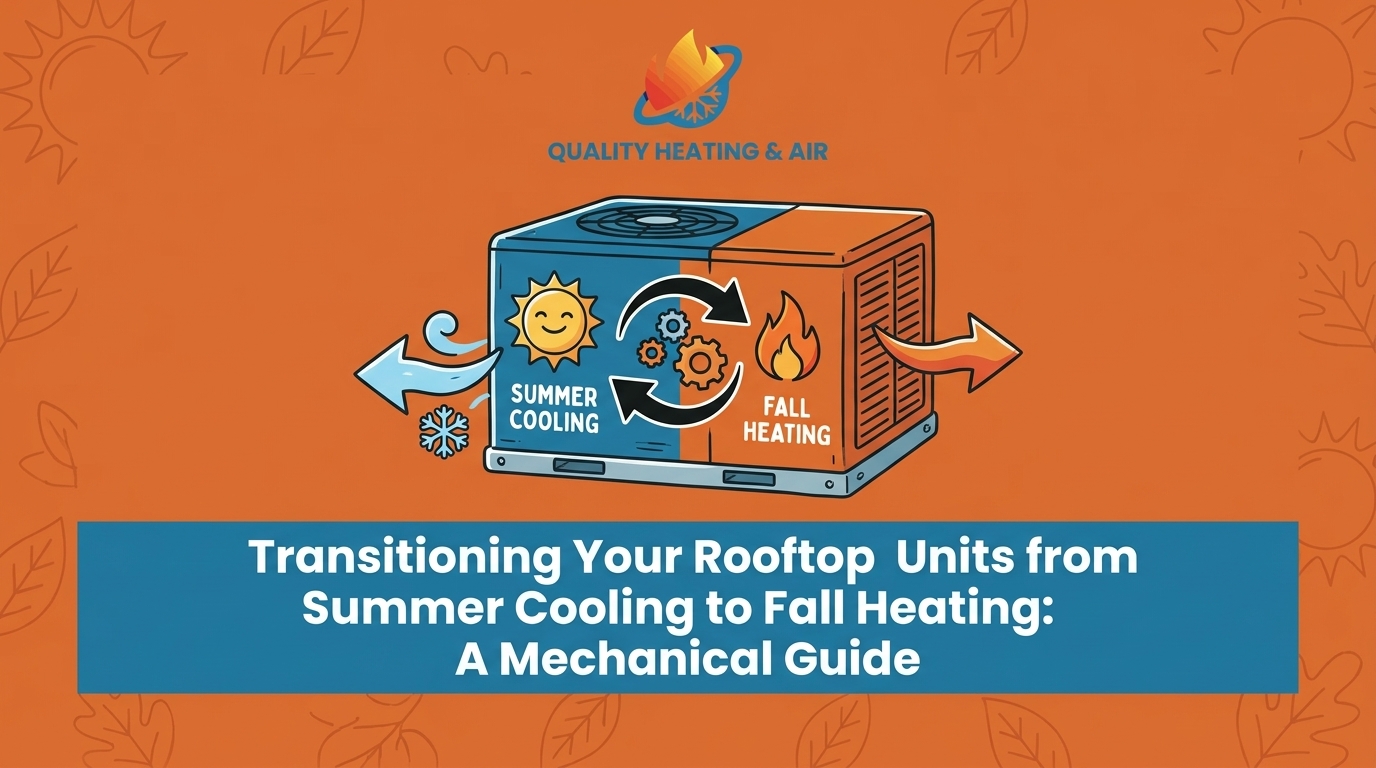
Transitioning Your Rooftop Units from Summer Cooling to Fall Heating
Bracing for the Early Freeze: Why September RTU Action is Critical
At Quality Heating & Air, we know that transitioning your rooftop units from summer cooling to fall heating is one of the most critical operational tasks a facility manager faces as September arrives. In Colorado, the shift from late summer heat to autumn chill does not happen gradually. Commercial facilities experience drastic early fall temperature swings, where an 85-degree afternoon can easily plummet into a freezing night. For large-scale buildings relying on commercial rooftop units (RTUs), these rapid environmental changes present a significant mechanical challenge.
In our experience serving local businesses, waiting for the first hard freeze to test your heating capabilities is a high-risk gamble. The sudden demand placed on dormant heating components can cause thermal shock to the system, leading to unexpected failures just when you need the equipment the most. Understanding the professional mechanical steps required for a seamless seasonal changeover is the key to preventing mid-winter breakdowns and keeping your occupants comfortable.
A proper transition requires far more than a simple thermostat adjustment. It involves precision calibration, safety testing, and proactive mechanical interventions. By scheduling professional heating services with our team during the critical September window, you ensure that your RTUs are mechanically prepared to handle the unpredictable September and October temperature swings in Colorado without missing a beat.
Beyond the Thermostat: The Mechanical Reality of Commercial Fall Changeovers
Most homeowners can simply flip their hallway thermostat from "cool" to "heat" and walk away. In the commercial sector, taking that same approach is a recipe for disaster. In our daily work throughout the Northglenn commercial districts, we see firsthand how facilities rely on complex, heavy-duty internal mechanics to maintain large-scale climate control across varied zones, multiple floors, and shifting occupancy levels.
A true fall changeover is a comprehensive mechanical reality check for your entire HVAC infrastructure. During the summer, your RTU's cooling components have endured thousands of hours of continuous vibration, thermal stress, and wear. Belts may have stretched, pulleys may have shifted, and electrical contacts may have pitted. Simply demanding that the unit switch to heating mode ignores the physical toll the summer has taken on the shared components of the system.
The Dual Focus of the Transition Window
Early fall presents a unique operational challenge: your building may still require significant cooling during the heat of the afternoon, while demanding robust heating during the early morning hours. This dual demand means your RTUs must be capable of pivoting flawlessly between modes.
• Component Inspection — The "Thermostat Switch" Approach: Assumes all parts are functional if the screen turns on. — The Professional Mechanical Changeover: Physically verifies belts, bearings, and electrical contacts.
• Safety Verification — The "Thermostat Switch" Approach: Relies on built-in fault codes that only trigger after a failure. — The Professional Mechanical Changeover: Tests ignition sequences and gas pressures before operation.
• Efficiency Optimization — The "Thermostat Switch" Approach: Uses standard, out-of-the-box settings regardless of weather. — The Professional Mechanical Changeover: Calibrates dampers and sensors to leverage ambient outdoor air.
• Risk Management — The "Thermostat Switch" Approach: High risk of sudden breakdown during the first cold snap. — The Professional Mechanical Changeover: Identifies and resolves minor wear before it causes downtime.
Because of this mechanical complexity, establishing a proactive maintenance plan is essential. Routine calibration ensures that your system can handle the daily back-and-forth between heating and cooling without stressing the blowers or tripping safety limits. When our professionals manage this transition, we secure your heating reliability while simultaneously optimizing your remaining cooling needs for those lingering warm afternoons.
Calibrating Economizers for Maximum 'Free Cooling'
Our technicians frequently find that one of the most valuable components of a commercial RTU—the economizer—is misunderstood and poorly maintained. An economizer is a mechanical assembly of dampers, sensors, and logic controllers designed to regulate the intake of outside air. When the outdoor temperature and humidity levels are favorable, the economizer opens to bring in fresh air, effectively cooling the building without running the energy-intensive mechanical compressor.
This process is known as "free cooling," and it is incredibly advantageous during the autumn months. The region's crisp, cool fall air provides an ideal environment for economizer-driven free cooling, significantly reducing your energy consumption before peak winter hits. However, to capture these savings, the economizer must be precisely calibrated.
The Mechanics of Economizer Calibration:
• Testing Dampers and Actuators: Technicians must verify that the physical louvers open and close smoothly. A damper stuck in the open position will flood your building with freezing air in December, while a damper stuck closed wastes the opportunity for free cooling in October.
• Sensor Verification: Enthalpy sensors measure both temperature and humidity. If these sensors drift out of calibration, the RTU might pull in outside air when it is actually too humid, forcing your air conditioning cooling systems to work twice as hard to dehumidify the space.
• Logic Controller Assessment: The "brain" of the economizer must be tested to ensure it is making the correct decisions based on the data it receives from the sensors.
Given the dramatic September/October temperature swings in Colorado, a properly calibrated economizer is your first line of defense against high commercial energy bills. It allows your RTUs to offset the mechanical load on the primary cooling system, resting the compressors while maintaining perfect indoor air quality and comfort.
Rigorous Burner Testing: Securing Reliability Before Peak Winter
While the economizer handles the transitional cooling, the heating components of your RTU require intense scrutiny before they are activated for the season. When our team opens up a commercial furnace section after a long spring and summer, we often find that the burners, heat exchangers, and gas valves have sat completely dormant. During this downtime, dust settles, spiders build webs in burner tubes, and moisture can cause microscopic corrosion on critical ignition components.
Firing up a commercial furnace section without prior testing is a massive safety and reliability risk. Meticulous, step-by-step mechanical adjustments—especially thorough burner testing—are the primary defense against unexpected downtime for local businesses in the Northglenn commercial districts. Our licensed professionals follow a strict protocol to secure the system.
1. Visual Burner Assembly Inspection: Technicians begin by removing panels and inspecting the burner tubes for any blockages, rust, or debris. Even a small obstruction can alter the flame pattern, causing soot buildup or localized overheating.
2. Ignition Sequence Verification: The technician forces a call for heat to observe the sequence of operations. The inducer motor must start, the pressure switches must close, the igniter must glow (or spark), and the gas valve must open at exactly the right millisecond. Any hesitation in this sequence indicates a failing component that will likely leave you without heat during a freeze.
3. Gas Pressure Calibration: Using specialized manometers, professionals measure the gas pressure entering the valve and the manifold pressure exiting it. If the pressure is too high, the unit will overheat and cycle on its high-limit safety switch. If it is too low, the system will struggle to heat the massive volume of air moving through the commercial ductwork.
4. Heat Exchanger Integrity Checks: The heat exchanger is the metal barrier that separates the breathable indoor air from the toxic combustion gases. Technicians inspect this critical component for cracks, rust, or stress fractures caused by years of expansion and contraction. A compromised heat exchanger is an immediate safety hazard that must be addressed before winter operations begin.
By rigorously testing these dormant components, we ensure that your RTU is prepared to deliver safe, consistent, and heavy-duty heating the moment the first blizzard arrives.
Navigating Altitude and Dry Air in Commercial HVAC Performance
Commercial HVAC systems are typically engineered and factory-set for operation at sea level. Because we operate locally, our team knows that when these units are installed in high-elevation environments like the Northglenn commercial districts, standard, out-of-the-box settings are entirely insufficient for regional commercial demands. Understanding the local atmospheric physics is a mandatory part of a successful fall transition.
The Impact of High Elevation on Combustion
At higher altitudes, the air is significantly thinner, meaning there is less oxygen available per cubic foot of air. Gas-fired RTUs require a very specific ratio of oxygen to natural gas to achieve clean, safe combustion. If a unit operates at altitude with factory sea-level settings, the fuel mixture will be "rich"—meaning there is too much gas and not enough oxygen. This leads to incomplete combustion, excessive soot production, reduced heating capacity, and a drastically shortened lifespan for the heat exchanger.
During a professional fall changeover, our technicians perform specific fuel-to-air ratio adjustments, often derating the gas manifold pressure or changing the burner orifices to match the specific elevation of your facility. This ensures optimal heat output and safe operation.
The Challenge of Extremely Dry Air
In addition to altitude, the region is known for incredibly low humidity, which plummets even further as winter approaches. Extremely dry air affects heat transfer within the building. Dry air feels colder to the human skin than humid air at the exact same temperature, which often leads occupants to constantly push the thermostat higher, wasting energy.
Furthermore, dry air holds less thermal energy, meaning your RTU's blowers have to work harder to distribute warmth throughout a large commercial space. We account for these variables during the fall transition, adjusting blower speeds and checking fan belts to ensure the system can move the necessary volume of air. For a deeper dive into these regional challenges, facility managers should explore how dry air and altitude affect HVAC performance to better understand the unique demands placed on their equipment.
The Professional Fall RTU Transition Checklist
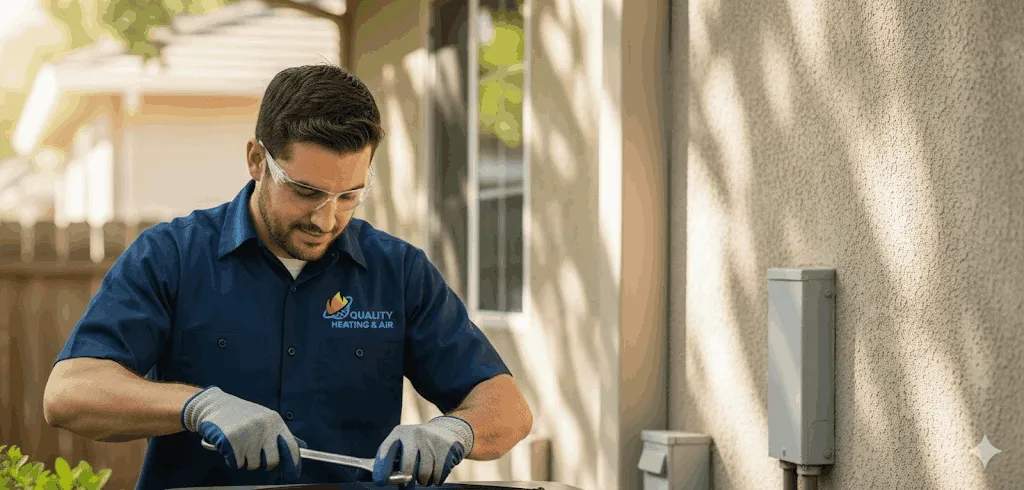
To fully grasp the scope of a commercial changeover, it helps to see the specific mechanical steps involved. A professional fall RTU transition is a systematic process designed to touch every critical component of the system. Just this past spring, a Northglenn commercial client asked our team to perform routine checks. Our attending technician performed all necessary diagnostics, carefully explained the operational scenarios, and provided educational information on how the system was performing. This level of thorough, communicative service is exactly what facility managers can expect from Quality Heating & Air during a fall RTU transition.
Here is the snippet-optimized breakdown of what our professional mechanical transition entails to prepare for the September/October temperature swings in Colorado:
• Economizer Calibration: Testing dampers, enthalpy sensors, and logic controllers to ensure the system can successfully capture free cooling without pulling in freezing air.
• Burner Assembly Testing: Cleaning the burner tubes and verifying proper ignition sequences to guarantee the furnace fires safely on the first attempt.
• Gas Pressure Verification: Utilizing manometers to ensure optimal fuel delivery for safe, efficient combustion at high altitudes.
• Heat Exchanger Inspection: Conducting a thorough visual and diagnostic check for structural integrity, cracks, or rust after months of dormancy.
• Airflow and Belt Assessment: Inspecting blower wheels, adjusting pulley alignment, and checking belt tension to handle the denser, heated air required for winter comfort.
• Electrical Contact Tightening: Securing all high-voltage connections that may have vibrated loose during the heavy summer cooling season.

The True Cost of Skipping Mechanical Calibration
Over the years, we have seen how neglecting proper RTU transitions becomes a costly oversight that impacts the bottom line of businesses in the Northglenn commercial districts. Facility managers who view the fall changeover as an optional expense rather than a required investment often face severe financial and logistical consequences mid-winter.
Rampant Energy Waste
Running an uncalibrated commercial HVAC system is incredibly inefficient. Industry data consistently indicates that routine commercial maintenance and mechanical calibration can reduce energy costs by up to 20%. When economizers are stuck open, or gas pressures are incorrectly set for the altitude, the system consumes vastly more fuel and electricity to achieve the same indoor temperature. Over the course of a long Colorado winter, that 20% inefficiency translates to a massive drain on operational budgets.
Cascading Mechanical Failures
Commercial RTUs operate as highly interconnected systems. A minor mechanical imbalance in the fall can easily snowball into a catastrophic failure in January. For example, a slightly loose blower belt might seem insignificant in September. However, as it slips, it reduces airflow over the heat exchanger. This lack of airflow causes the heat exchanger to overheat, which forces the system to constantly trip its high-limit safety switch. Eventually, the rapid expansion and contraction from overheating will crack the heat exchanger entirely, turning a simple belt adjustment into a massive, system-halting repair.
Logistical Nightmares and Downtime
The most significant cost of skipping mechanical calibration is the disruption to your facility. Emergency commercial HVAC failures create a logistical nightmare. Tenants complain, productivity plummets, and specialized inventory can be ruined by freezing temperatures. Furthermore, emergency service calls during the peak of winter are inherently more stressful to manage. Framing professional transition services as a critical investment in facility continuity is the only way to protect your building, your budget, and your peace of mind.
Frequently Asked Questions About Commercial RTU Transitions
What does a professional fall RTU transition include?
A comprehensive transition includes economizer calibration, burner testing, gas pressure checks, and heat exchanger inspections. Licensed professionals also evaluate blower belts, electrical contacts, and safety limits. This ensures every mechanical component is prepared for heavy winter usage.
Why is economizer calibration important for commercial HVAC?
Calibration allows the system to use cool outside air for 'free cooling', significantly reducing mechanical energy consumption. By ensuring the dampers and sensors respond accurately to outdoor conditions, the RTU can rest its compressors while maintaining indoor comfort during unpredictable September/October temperature swings in Colorado.
How do professionals test RTU burners for winter?
Technicians test burners by verifying fuel-to-air ratios, checking gas pressure, and ensuring safe, consistent ignition sequences. They also visually inspect the burner tubes for debris and monitor the flame pattern to confirm clean, efficient combustion.
How do you prepare a commercial HVAC system for winter?
You prepare a commercial system through comprehensive mechanical calibration by a licensed professional prior to the first freeze. This includes transitioning the unit from cooling-dominant operations to heating readiness while adjusting settings for local altitude and dry air conditions.
Why is my commercial heater blowing cold air?
This is often due to uncalibrated economizers stuck in the open position, pulling in freezing outside air. It can also be caused by ignition failures, tripped safety limits, or improper thermostat changeovers that prevent the burner assembly from firing.
How often should commercial rooftop units be serviced?
Commercial RTUs should be serviced at least biannually, with critical mechanical transitions scheduled for the spring and early fall. Facilities with high operational demands or specialized indoor air quality requirements may need quarterly professional assessments.
Secure Your Facility's Comfort Before the Freeze
Understanding the mechanical reality behind your commercial HVAC system is the key to preventing mid-winter breakdowns. When you recognize that a fall changeover involves precise economizer calibration, rigorous burner testing, and altitude-specific adjustments, it becomes clear why this is not a task to delay. The rapid temperature drops experienced in the Northglenn commercial districts demand that your RTUs are fully prepared to handle the shift from cooling to heating seamlessly.
Do not wait until a sudden freeze leaves your occupants shivering and your facility scrambling for emergency repairs. Prioritize your fall transition schedule immediately. Consult with our local mechanical professionals at Quality Heating & Air to execute these critical calibrations, ensuring your commercial rooftop units deliver safe, efficient, and reliable comfort all winter long.

Testimonials
Neighbors trust Quality Heating & Air for honest work and fair pricing.
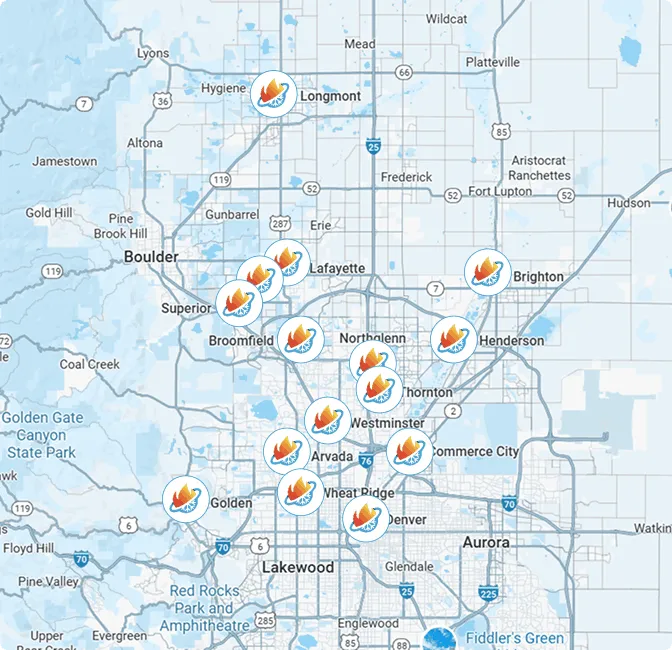
Service Areas