Evaluating Boiler Replacement Options for Aging Arvada Multi-Family Properties

Is Your Multi-Family Property Ready for Another Arvada Winter?
Is your aging heating system truly prepared to handle another brutal Colorado winter without leaving tenants in the cold? For property managers and real estate investors, entering the freezing months with a questionable heating infrastructure is a massive liability. At Quality Heating & Air, we know that Evaluating Boiler Replacement Options for Aging Arvada Multi-Family Properties is a concrete problem that requires immediate attention before the first freeze hits. The primary decision point usually comes down to a choice between the familiar, heavy-duty operation of traditional cast-iron models and the modern, risk-mitigating advantages of high-efficiency modular systems.
Making the right choice requires looking past the initial mechanical swap and viewing the upgrade as a strategic asset management decision. If you are ready to secure your building's winter reliability, exploring commercial heating services is the first step toward planning a professional boiler replacement.
The High Stakes of Commercial Heating in Colorado
Managing shared-wall buildings in the Front Range means dealing with unpredictable, severe weather patterns. Arvada's severe winter freezes require reliable, high-capacity heating to maintain habitability standards and protect multi-family plumbing infrastructure. When a residential home loses heat, it is an inconvenience for one family. When a multi-family property loses heat, the stakes multiply exponentially.
A total-building freeze-out is one of the most stressful scenarios a property manager can face. Our team has seen firsthand the devastation that occurs when an aging boiler fails during a January cold snap. The immediate drop in indoor temperatures puts the entire building's plumbing at risk. Burst pipes inside shared walls lead to catastrophic water damage, displaced tenants, massive liability claims, and significant structural repairs. Furthermore, local habitability laws require landlords to maintain specific indoor temperatures; failing to do so can result in withheld rent and legal action.
This is why upgrading your heating system is not just a routine maintenance task—it is a critical component of strategic asset management. Arvada multi-family properties cannot rely on a "run it until it breaks" philosophy. Proactive replacement allows ownership to control the timeline, secure the best equipment for the building's specific thermal load, and avoid the chaotic, rushed decisions that accompany emergency mid-winter failures.
The Hidden Costs of Inaction:
• Emergency premiums: Sourcing commercial-grade equipment on short notice during peak winter season limits your options and complicates logistics.
• Tenant turnover: Unreliable heating is a primary driver of tenant dissatisfaction, leading to lower retention rates and higher marketing costs to fill vacant units.
• Ancillary damage: Tenants using auxiliary space heaters to compensate for a failing boiler frequently overload older electrical panels, creating fire hazards and power outages.
Traditional Cast-Iron Boilers: The Familiar Workhorse
For decades, the standard approach to commercial heating was straightforward: install a massive, heavy-duty cast-iron boiler. These systems operate by burning fuel to heat water inside a large cast-iron heat exchanger, which then circulates steam or hot water throughout the building's radiators or baseboards. When comparing high-efficiency modular vs. traditional cast-iron systems, our commercial HVAC technicians often point out why cast-iron has remained a staple in the industry for so long.
Advantages of Cast-Iron Systems
Familiarity for maintenance crews: One of the biggest selling points of a traditional system is its simplicity. Most commercial HVAC technicians and on-site maintenance staff have spent their entire careers working around cast-iron units. The controls are generally straightforward, the mechanical principles are basic, and troubleshooting is a well-documented process.
Heavy-duty durability: Cast-iron boilers are built like tanks. The thick metal heat exchangers are highly resistant to the stresses of constant expansion and contraction. Our technicians regularly find these units operating in older Arvada apartment building basements thirty or forty years after their initial installation, provided they have received consistent maintenance.
Simpler installation when replacing an identical older unit: If your mechanical room was originally designed around a specific cast-iron footprint, swapping an old unit for a new one of the same style can sometimes be logistically simpler. The existing piping, flue venting, and concrete pads are already configured for that exact setup. For property managers looking for a streamlined transition, reviewing a guide to affordable boiler replacement can help clarify what a like-for-like swap entails.
Operational Limitations
Lower energy efficiency (AFUE): The primary drawback of traditional cast-iron design is how it handles exhaust. These are non-condensing systems, meaning a significant amount of heat energy escapes up the chimney along with the combustion gases. Consequently, their Annual Fuel Utilization Efficiency (AFUE) ratings generally hover at lower percentages, meaning more of your utility budget is wasted simply venting exhaust outdoors.
Lack of system redundancy: A traditional cast-iron setup usually relies on a single, massive unit to heat the entire building. This creates a single point of failure. If the burner malfunctions, a valve sticks, or the control board shorts out, the entire building loses heat until the repair is completed.
Higher long-term energy consumption: Because these units operate at a lower efficiency and often run at full capacity regardless of the actual immediate heating demand, they consume significantly more natural gas over their operational lifespan. While the upfront installation might seem straightforward, the month-over-month utility overhead eats into the property's net operating income.
High-Efficiency Modular Boilers: Built-In Redundancy
As building codes tighten and utility costs fluctuate, the commercial HVAC industry has shifted toward smarter, more adaptable technology. High-efficiency modular boiler systems represent a fundamental change in how multi-family properties approach winter heating. Instead of relying on one massive unit, a modular system utilizes multiple smaller, highly efficient units (modules) connected in a cascade configuration. They work together intelligently, firing up only as many modules as necessary to meet the building's real-time thermal demand.
Maximizing Energy Efficiency
Condensing technology overview: The secret to the incredible efficiency of modern modular boilers lies in condensing technology. Unlike traditional models that vent hot exhaust gases directly outside, condensing boilers route that exhaust through a secondary heat exchanger. This process extracts the latent heat from the water vapor in the exhaust, using it to pre-heat the returning boiler water. By capturing heat that would otherwise be wasted, these systems achieve exceptionally high AFUE ratings.
Lowering long-term operational utility usage: Because they extract more heat from the same amount of fuel, modular condensing systems drastically reduce the volume of natural gas required to keep a multi-family building warm. Furthermore, their ability to "modulate"—meaning they can run at lower capacities rather than just blasting on and off at 100%—prevents the massive energy spikes associated with traditional boiler cycling.
Potential eligibility for generic energy incentives: Because high-efficiency modular systems significantly reduce energy consumption and carbon emissions, they frequently qualify for various generic energy rebates, utility incentive programs, and tax credits. While property managers should always consult with a tax professional or their local utility provider to verify current programs, taking advantage of these incentives alongside flexible financing options can make upgrading highly accessible.
The Power of Redundancy
Preventing total building freeze-outs: When evaluating high-efficiency modular vs. traditional cast-iron setups, we consistently find that redundancy is the deciding factor for our risk-averse commercial clients. A modular system is designed with "N+1 redundancy." If the building requires a certain amount of heat, the system is designed with multiple modules that share the load. If one module goes offline due to a mechanical issue, the remaining modules automatically ramp up to compensate. The tenants never feel a drop in temperature, and the building remains safe from freezing.
Servicing individual units without tenant disruption: Because the modules operate independently within the cascade system, a commercial HVAC technician can isolate, shut down, and repair a single module while the rest of the system continues to heat the building. This eliminates the frantic, middle-of-the-night emergency calls from freezing tenants while a repair is underway.
Adapting heat output to exact real-time building demand: A traditional boiler turns on full-blast until the thermostat is satisfied, then shuts off. A modular system measures the outdoor temperature and the indoor return water temperature, calculating exactly how much heat is needed. On a mildly chilly October evening, only one or two modules might run at a low percentage. During a severe January blizzard, all modules will engage. This precise load-matching ensures consistent comfort without wasting fuel.
Side-by-Side Comparison: Which System Fits Your Building?
Choosing the right path for your property requires weighing installation logistics against long-term operational goals. The high-efficiency modular vs. traditional cast-iron debate ultimately depends on your building's mechanical room constraints, your risk tolerance regarding winter breakdowns, and your long-term utility strategy.
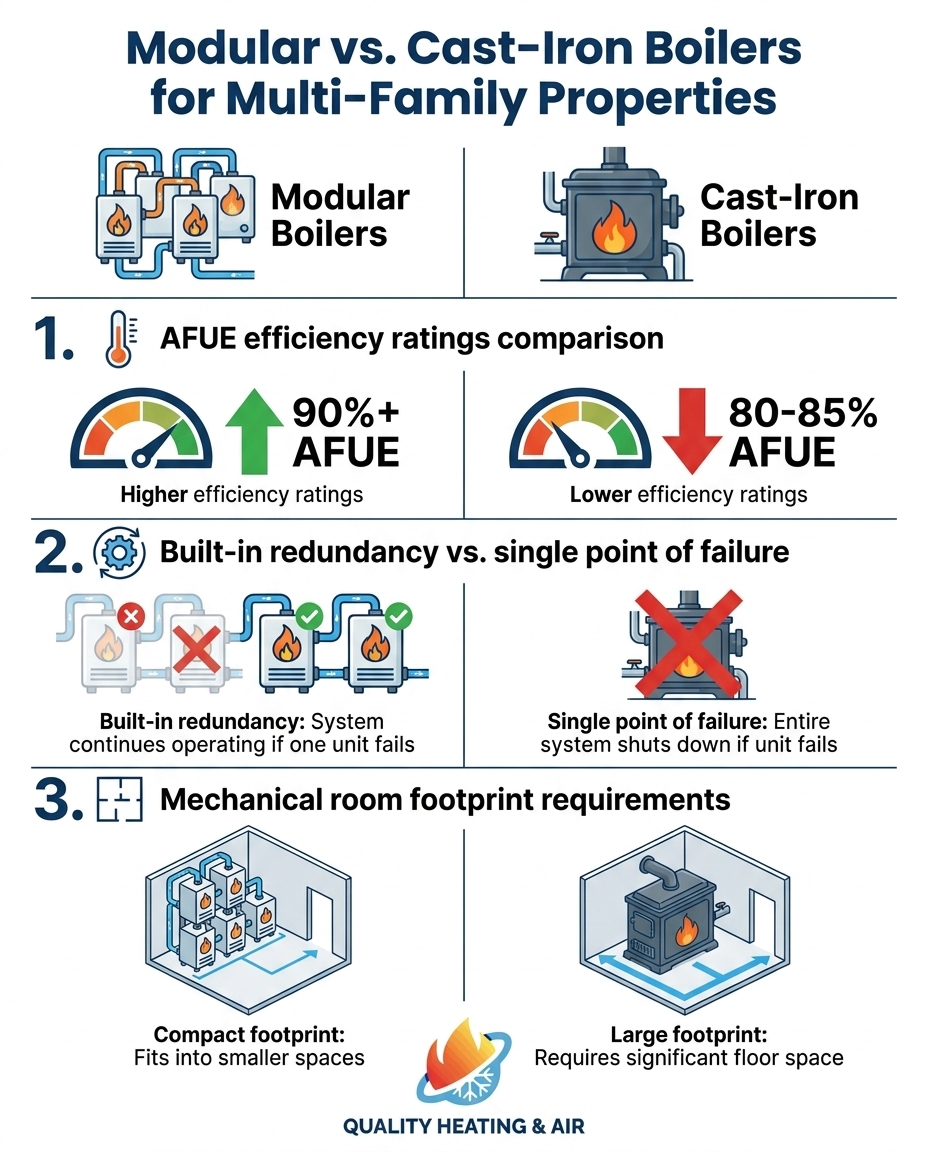
• Energy Efficiency (AFUE) — Traditional Cast-Iron Boiler: Standard efficiency; exhausts wasted heat up the flue. — High-Efficiency Modular System: Ultra-high efficiency; utilizes condensing technology to capture exhaust heat.
• System Redundancy — Traditional Cast-Iron Boiler: Single point of failure. If the unit breaks, the building loses heat. — High-Efficiency Modular System: Built-in redundancy. Multiple units share the load; if one fails, others take over.
• Mechanical Room Footprint — Traditional Cast-Iron Boiler: Requires a large, heavy footprint. Often difficult to maneuver into older basements. — High-Efficiency Modular System: Compact, stackable, or wall-hung racks. Easily fits through standard commercial doorways.
• Installation Complexity — Traditional Cast-Iron Boiler: Straightforward if replacing an identical older unit, but heavy lifting required. — High-Efficiency Modular System: Requires new PVC venting for condensation and precise cascade piping setup.
• Operational Lifespan — Traditional Cast-Iron Boiler: Highly durable, massive metal heat exchangers can last decades. — High-Efficiency Modular System: Excellent longevity when properly maintained, though complex sensors require regular tuning.
• Load Matching — Traditional Cast-Iron Boiler: On/Off operation. Runs at full capacity regardless of mild or severe weather. — High-Efficiency Modular System: Modulates output precisely to match the real-time heating demand of the building.
The quick fix vs. the strategic upgrade: Replacing a failed cast-iron boiler with another cast-iron boiler is often viewed as the path of least resistance. However, in our years of performing commercial retrofits across the Front Range, we've seen that the compact footprint of a modular system solves major logistical headaches. Because modular units are smaller and lighter, they can be wheeled through standard doorways and into tight mechanical rooms without the need for structural modifications or heavy rigging equipment. While the initial piping and PVC venting setup for a condensing system requires specialized commercial expertise, the long-term payoff in utility savings and tenant reliability makes it a superior choice for forward-thinking investors.
Strategic Asset Planning: Timing Your Boiler Upgrade
One of the biggest patterns we see is property managers waiting until the equipment forces their hand. In our experience, the September pre-heating season is the critical transition window for complex multi-family installations in Colorado. Once the hard freezes arrive in October, commercial HVAC contractors are overwhelmed with emergency no-heat calls, making it difficult to schedule a massive, multi-day boiler retrofit.
Executing a boiler upgrade in September allows for a controlled, systematic transition. It provides ample time for proper load calculations, equipment procurement, permitting, and the careful installation of the cascade piping required for modular systems. Furthermore, it ensures the system is fully commissioned, tested, and optimized before the tenants actually need it.
Quality Heating & Air brings deep expertise in local commercial HVAC upgrades, offering a transparent, long-term ROI approach for property managers. We understand that multi-family investors need reliable data to make decisions that impact their net operating income. By evaluating your building's current thermal envelope and historical utility usage, we provide a clear path forward that prioritizes both tenant comfort and operational efficiency.
Beyond the installation itself, proactive asset management requires ongoing care. Modern high-efficiency systems rely on precise sensor calibration, clean heat exchangers, and proper water chemistry to maintain their impressive AFUE ratings. Enrolling your new system in a comprehensive preventative maintenance plan ensures that the equipment operates at peak performance year after year, extending its lifespan and protecting your investment from premature wear and tear.
Frequently Asked Questions About Multi-Family Boilers
What is the most efficient boiler for an apartment building?
High-efficiency modular condensing boilers generally offer the best efficiency for multi-family properties. By extracting latent heat from exhaust gases that traditional boilers waste, they achieve exceptionally high AFUE ratings. Additionally, their ability to modulate output ensures they only use the exact amount of fuel necessary to meet the building's real-time demand.
How long do commercial cast iron boilers last?
Commercial cast-iron boilers are highly durable and can last decades if they receive regular, professional maintenance. Their thick metal heat exchangers withstand constant use very well. However, while their physical lifespan is long, their efficiency remains stagnant, meaning property owners continue to pay higher utility costs compared to modern technology.
What are the benefits of modular boilers for apartment buildings?
The primary benefits include built-in redundancy, space-saving design, and significant operational energy savings. Because multiple smaller units share the heating load, a single mechanical failure will not result in a total building freeze-out. They also fit easily into tight mechanical rooms and dramatically lower month-over-month utility consumption.
Should I replace my commercial boiler before it fails?
Yes, proactive replacement is strongly recommended for shared-wall properties. Replacing an aging system before it fails prevents emergency freeze-outs, catastrophic pipe damage, and tenant displacement. It also allows property managers to carefully select the right equipment and schedule the installation during the off-season without paying emergency premiums.
How do I choose a replacement boiler for a multi-family property?
Choosing the right replacement requires weighing installation complexity against long-term operational efficiency, maintenance needs, and system redundancy. Property managers should evaluate their mechanical room space, assess their tolerance for winter heating risks, and consult with a commercial HVAC expert to determine the exact thermal load requirements of the building.
Partner with Local Commercial Heating Experts
Managing Arvada multi-family properties requires foresight, especially when it comes to critical infrastructure. Establishing a clear, non-financial decision framework comparing modular and cast-iron boilers based on longevity, tenant reliability, and energy efficiency ensures you make the best choice for your portfolio. The September pre-heating season is the ideal time to act, giving you the runway needed to execute a seamless transition before the severe weather arrives.
Do not wait for an aging system to dictate your schedule during a winter emergency. Take control of your building's comfort and operational overhead today. Reach out to schedule a thorough consultation, and let our team help you secure a reliable, high-efficiency heating strategy that keeps your tenants happy and your property protected all winter long.

Testimonials
Neighbors trust Quality Heating & Air for honest work and fair pricing.
Service Areas