Swamp Cooler vs. Central AC for Older Commercial Buildings in Wheat Ridge

Navigating Cooling Challenges in Wheat Ridge's Historic Spaces
If you are struggling to maintain comfortable temperatures during the peak July heat load, evaluating a Swamp Cooler vs. Central AC for Older Commercial Buildings in Wheat Ridge is a critical first step. When you manage an older property, upgrading your cooling system is rarely as simple as swapping out a single unit. The primary decision point usually comes down to replacing an aging rooftop evaporative cooler with a similar unit, or taking the leap to retrofit the structure for traditional central air conditioning. At Quality Heating & Air, our team frequently helps property managers navigate this debate, balancing tenant comfort, operating efficiency, and the unique structural integrity of historical architecture.
If you are exploring commercial HVAC services for your property, understanding your building's inherent limitations is essential.
The Climate Shift Factor: Historically, the dry, high-altitude climate of Wheat Ridge heavily favored evaporative cooling. Swamp coolers thrive in low-humidity environments, utilizing the natural evaporation of water to drop indoor temperatures efficiently. However, environmental shifts, increasingly intense summer heatwaves, and changing air quality standards are rapidly changing the math for commercial property owners. Older buildings present unique structural limitations—from shallow ceiling cavities to aging roof joists—that make modernizing your cooling infrastructure far more complex than a standard commercial upgrade. As we have seen in our years of retrofitting historic properties, making the right choice means looking beyond the equipment itself and evaluating how the system interacts with the building envelope.
The Impact of Wildfire Smoke on Commercial Indoor Air Quality
When comparing cooling systems, you must examine the critical difference in how each handles external air quality threats. This is especially urgent during late-summer environmental events.
The Problem: Evaporative coolers operate on a total-loss ventilation principle. They continuously draw 100% outside air directly into the building, pass it through wet pads, and push it through the interior spaces before exhausting it outside. While this provides fresh air on clear days, it becomes a severe liability during poor air quality events. With the reality of late summer wildfire season in Colorado, drawing unconditioned outside air into your facility exposes employees, customers, and inventory to hazardous conditions.
The Cause: PM2.5 particles from wildfire smoke are microscopic—small enough to easily bypass basic swamp cooler pads. Because an evaporative cooler pressurizes the building with outdoor air, these harmful particulates infiltrate commercial spaces rapidly. Furthermore, the inherent design of a swamp cooler adds significant moisture to the air. In a commercial setting, this excess humidity can warp older woodwork, damage sensitive electronics, and create uncomfortable, muggy conditions for occupants.
The Solution: Upgrading your infrastructure to a sealed cooling system drastically alters this dynamic. Central air conditioning systems recirculate indoor air rather than constantly pulling from the outside. By integrating MERV 13 or higher filters, central AC acts as a barrier, significantly reducing indoor particulate matter. If you are focused on protecting your occupants and inventory, exploring dedicated indoor air quality solutions alongside a sealed central AC system is the most effective way to safeguard Wheat Ridge older commercial districts from seasonal smoke.
Evaporative Cooling: Pros and Limitations for Aging Structures
To make an informed decision, it is important to take an objective look at swamp coolers, acknowledging their historical use while pointing out modern operational flaws under extreme conditions.
Energy Consumption and Operational Costs: There is no denying the energy consumption benefits of evaporative cooling in dry climates. Because they rely on a simple water pump and a blower motor rather than a heavy-duty compressor, swamp coolers draw significantly less electricity than traditional air conditioners. For a sprawling commercial space with high ceilings, this can translate to lower monthly utility bills during mild weather.
Water Usage and Resource Demands: However, the trade-off for low electricity usage is high water consumption. During prolonged heatwaves, a commercial evaporative cooler requires a continuous, heavy supply of water to keep the media pads saturated. As water conservation becomes a larger priority, the utility costs associated with this constant water draw must be factored into your operational budget.
Maintenance and Comfort Limitations: The maintenance demands of commercial swamp coolers are persistent. Facility managers must schedule regular pad replacements, clean out scale buildup from hard water, maintain the water distribution lines, and perform thorough end-of-season shutdowns to prevent frozen pipes. More importantly, evaporative cooling struggles with precise temperature control. During a peak July heat load, when outdoor temperatures spike, a swamp cooler can only lower the air temperature by a set differential. If the ambient air is exceptionally hot or if a summer thunderstorm spikes the humidity, the system will simply blow warm, damp air into your commercial space, leading to severe indoor comfort issues.
Central Air Conditioning: Superior Filtration Meets Structural Hurdles
Evaluating central air conditioning reveals it as the premium cooling solution for modern comfort standards, though it brings heavy structural hurdles for older buildings that must be carefully managed.
Unmatched Comfort and Dehumidification: Central air conditioning provides superior temperature consistency. Unlike evaporative systems, AC units utilize a refrigeration cycle that actively removes heat and moisture from the indoor air. This dual action—cooling and dehumidifying—creates a crisp, precisely controlled environment regardless of how hot or humid it gets outside. For retail spaces, restaurants, or offices in Wheat Ridge older commercial districts, this level of reliability is often non-negotiable for customer retention and employee productivity.
Air Quality and Sealing the Envelope: The air quality benefits of a sealed system are unmatched. Because central AC recirculates the air through high-efficiency pleated filters, it continuously scrubs the indoor environment of dust, allergens, and smoke. This is crucial for maintaining health and safety standards in commercial environments.
The Retrofit Challenge: The primary challenge is installing complex ductwork in buildings that were never designed to house it. Historic commercial properties often feature solid masonry walls, minimal ceiling clearance, and rigid architectural features. Retrofitting these spaces for a central AC installation requires extensive planning to route supply and return ducts without destroying the building's aesthetic. Additionally, older structures frequently require significant electrical upgrades. Modern commercial compressors demand robust electrical panels—often requiring three-phase power—that aging buildings simply do not possess without a comprehensive electrical overhaul.
Overcoming Roof Load and Retrofit Challenges in Historic Buildings
When dealing with Wheat Ridge older commercial districts, the specific engineering and structural preservation challenges require a specialized approach. You cannot simply drop a modern HVAC unit onto a sixty-year-old roof without doing the math.
Older commercial roofs often require structural reinforcement to safely support the heavy weight of modern packaged central AC units. An evaporative cooler is essentially a hollow metal box containing a fan and wet cardboard pads; it is relatively lightweight. A packaged central AC unit contains heavy copper coils, dense compressors, and large blower assemblies. Placing this massive weight on an aging roof without proper reinforcement can lead to structural sagging or catastrophic failure.
To navigate these retrofit challenges safely, a systematic assessment is required:
1. Load-Bearing Assessment: Structural engineers must evaluate the existing roof joists and support columns to determine if they can handle the dead weight of a new packaged unit, plus the dynamic load of wind and vibration.
2. Penetration Mapping: Swamp coolers typically require a single, large drop-duct penetration through the roof. Central AC systems require complex supply and return plenums. Mapping these penetrations is vital to ensure structural integrity is maintained and water leaks are prevented.
3. Ventilation Pathway Analysis: Technicians must identify existing chases, abandoned chimney flues, or dropped ceilings that can be repurposed to route new ductwork without tearing down historic plaster or masonry.
4. Electrical Capacity Review: The building's main electrical service must be audited to ensure it can safely handle the high startup amperage of commercial AC compressors.
Working with professionals who understand how to navigate older electrical systems and structural quirks without causing damage is paramount. Our team at Quality Heating & Air brings specific expertise in retrofitting older and historic Colorado commercial buildings safely and effectively, ensuring that modern comfort doesn't come at the cost of architectural integrity. In a recent project we completed involving an older property, a complete AC replacement was required to handle the escalating summer temperatures. Our structural assessment allowed our technicians to safely remove the outdated equipment and integrate the new system without compromising the building's historical integrity, resulting in a highly successful upgrade.
Side-by-Side Comparison: Evaluating Performance and Preservation
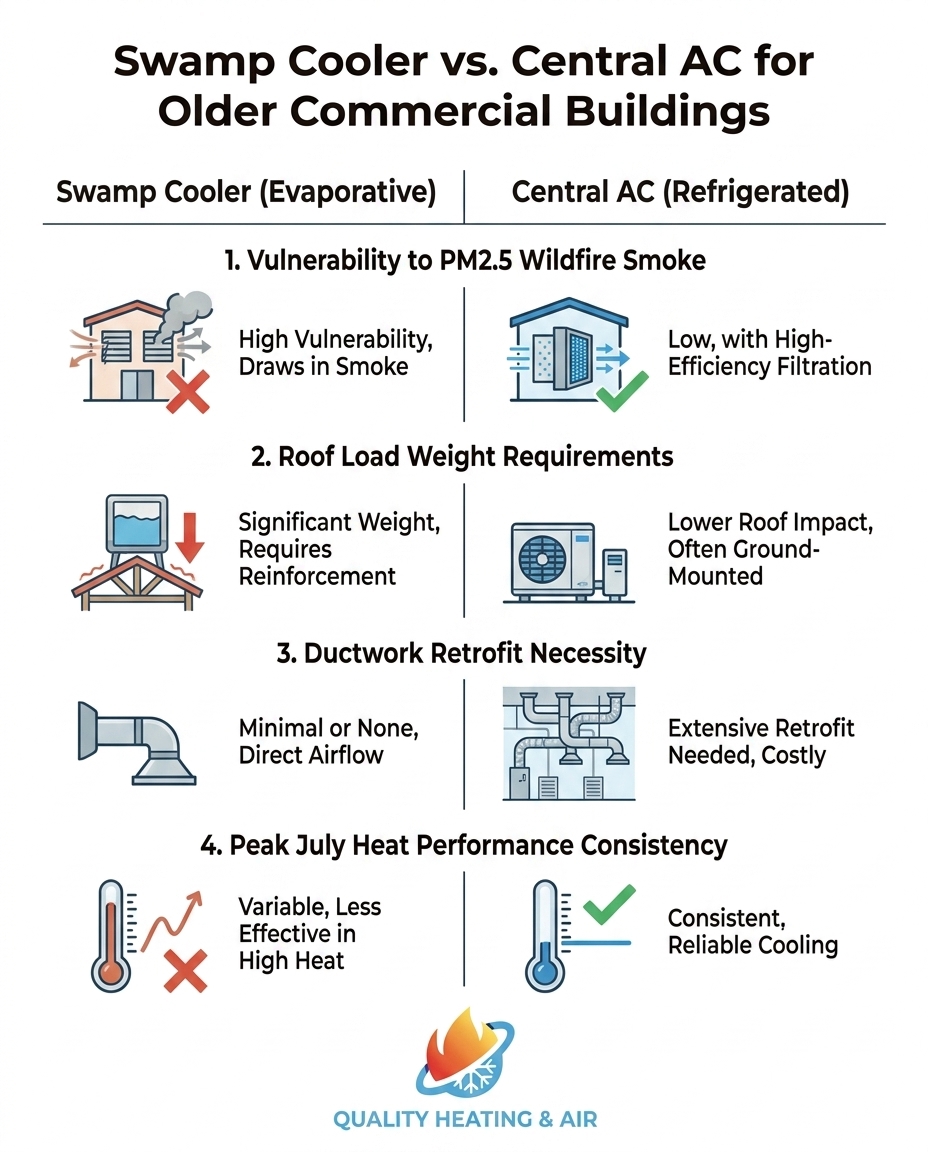
To help decision-makers synthesize these factors, evaluating the pros and cons requires looking at both immediate retrofit hurdles and long-term operational realities. When preparing for the peak July heat load, the right system must balance performance with building preservation.
• Air Quality & Filtration — Evaporative (Swamp) Cooler: Vulnerable to wildfire smoke and outdoor allergens; adds humidity. — Traditional Central AC: Superior protection; sealed system with high-MERV filtration capabilities.
• Upfront Retrofit Complexity — Evaporative (Swamp) Cooler: Low to moderate; often utilizes existing roof curbs and drop ducts. — Traditional Central AC: High; requires extensive ductwork installation and electrical upgrades.
• Structural Roof Impact — Evaporative (Swamp) Cooler: Lightweight; minimal roof reinforcement needed. — Traditional Central AC: Heavy load; often requires structural engineering and reinforcement.
• Peak Heat Performance — Evaporative (Swamp) Cooler: Struggles during extreme heat or elevated outdoor humidity. — Traditional Central AC: Consistent, precise temperature control regardless of outdoor conditions.
• Operating Efficiency — Evaporative (Swamp) Cooler: Low electrical draw, but high continuous water consumption. — Traditional Central AC: Higher electrical draw, but zero water consumption.
This side-by-side view highlights the core tension: while evaporative cooling is easier on the building's structure upfront, central AC is vastly superior for long-term air quality, occupant comfort, and reliable performance during the hottest weeks of the year.
Ductless Alternatives When Traditional Retrofits Fall Short
If your historic commercial building simply cannot support heavy rooftop units or extensive ductwork, you are not out of options. Ductless mini-splits serve as the ideal hybrid solution for Wheat Ridge older commercial districts.
Bypassing the Ductwork Dilemma: Ductless technology bypasses the need for extensive ductwork retrofits entirely. Instead of pushing air through massive metal tubes hidden in ceilings, ductless systems use a sleek outdoor compressor connected to multiple indoor air-handling units via small refrigerant lines. These lines require only a three-inch hole through an exterior wall, preserving the architectural integrity of historic brick or stone facades.
Lighter Structural Footprint: Because the outdoor units are compact and can be mounted on the ground or on a reinforced exterior wall pad, they eliminate the need for massive roof reinforcements. This lighter structural footprint solves one of the biggest headaches of upgrading older commercial spaces.
Advanced Zoning Capabilities: For varied commercial spaces—such as a historic building with a retail floor downstairs and distinct office suites upstairs—multi-zone systems offer unparalleled control. Each indoor unit operates independently, allowing you to cool only the occupied zones. This is a highly efficient alternative that still provides the sealed-system air filtration necessary to combat summer wildfire smoke.
During routine cooling system checks at older properties, our team takes an educational approach. In one recent instance, we helped a local property owner who needed various scenarios and options explained clearly. By detailing how ductless systems operate differently from traditional central air, we enabled the property owner to make an informed, confident choice about their investment. If you are considering this route, exploring ductless mini split systems can open up new possibilities for preserving your building.
Cost and Efficiency Considerations for Ductless Systems
When evaluating the financial side of a ductless upgrade, energy efficiency ratings (SEER2) play a massive role. Ductless systems frequently boast higher SEER2 ratings than standard rooftop units because they eliminate the energy loss associated with leaky ductwork—which can account for up to 30% of cooling energy waste. Furthermore, upgrading to high-efficiency heat pump technology may qualify your commercial property for generic utility incentives or federal tax credits, so be sure to verify current programs with your local utility provider or a tax professional.
The long-term value proposition is compelling when compared to extensive structural modifications. While the equipment itself represents a premium investment, avoiding the costs of roof reinforcement, drop-ceiling construction, and historical preservation permits often makes ductless technology highly competitive. For a deeper dive into the financial breakdown, comparing central AC and mini split costs can help you align your facility's budget with the best technological solution.
Make an Informed Upgrade for Your Commercial Property
Upgrading the cooling infrastructure in an older commercial building is a significant undertaking that impacts your property's value, occupant health, and structural longevity. An objective, structurally aware comparison is vital for protecting both your building and your indoor air quality against the relentless peak July heat load.
Whether you lean toward retrofitting for central air or exploring advanced ductless options, professional load calculations and thorough structural assessments are absolutely required. Do not leave your facility's comfort to chance. Reach out to a qualified commercial HVAC expert to get a comprehensive, engineering-focused evaluation of your older commercial space today.
Frequently Asked Questions
Can you replace a commercial swamp cooler with central air?
Yes, it is entirely possible to replace a commercial swamp cooler with central air conditioning, but it requires careful planning. The transition involves removing the old roof unit, sealing the large drop-duct penetration, and installing new supply and return ductwork. Additionally, you will likely need a structural assessment to ensure the roof can support the heavier AC unit and an electrical audit to handle the increased power draw.
How does wildfire smoke affect swamp coolers in commercial buildings?
Wildfire smoke severely impacts indoor air quality when using a swamp cooler. Because evaporative coolers constantly draw 100% outside air into the building, microscopic PM2.5 smoke particles easily bypass the wet media pads. This results in the commercial space filling with hazardous, smoky air, making it unsafe for employees and customers during late-summer fire seasons.
What is the best cooling system for historic buildings without ductwork?
Ductless mini-split systems are generally considered the best cooling solution for historic buildings lacking existing ductwork. They require only a small wall penetration for refrigerant lines, completely bypassing the need to tear into historic plaster or masonry to install bulky metal ducts. Furthermore, they offer excellent energy efficiency and independent zoning for different areas of the building.
Is evaporative cooling still effective for commercial buildings in Colorado?
Evaporative cooling remains highly energy-efficient in Colorado's dry climate, but its overall effectiveness is increasingly challenged by environmental factors. While it uses less electricity, it struggles to maintain precise temperatures during extreme heatwaves and offers no protection against wildfire smoke. For buildings where precise climate control and clean indoor air are priorities, its effectiveness is limited.
Do older commercial roofs need reinforcement for new HVAC units?
In most cases, yes. Older commercial roofs were often engineered to support the relatively light weight of evaporative coolers or basic ventilation fans. Modern packaged central air conditioning units are significantly heavier due to dense compressors and heavy copper coils. A structural engineer must assess the roof load capacity and often design steel reinforcements before a new unit can be safely installed.
How do ductless mini-splits compare for commercial indoor air quality?
Ductless mini-splits offer excellent commercial indoor air quality because they operate as a sealed system. Instead of drawing in outside air, they recirculate the indoor air through washable, multi-stage filters that capture dust, pollen, and particulates. While they may not match the heavy-duty MERV 13 filtration of a massive central air handler, they provide vastly superior air quality protection compared to any evaporative cooling system.

Testimonials
Neighbors trust Quality Heating & Air for honest work and fair pricing.
Service Areas