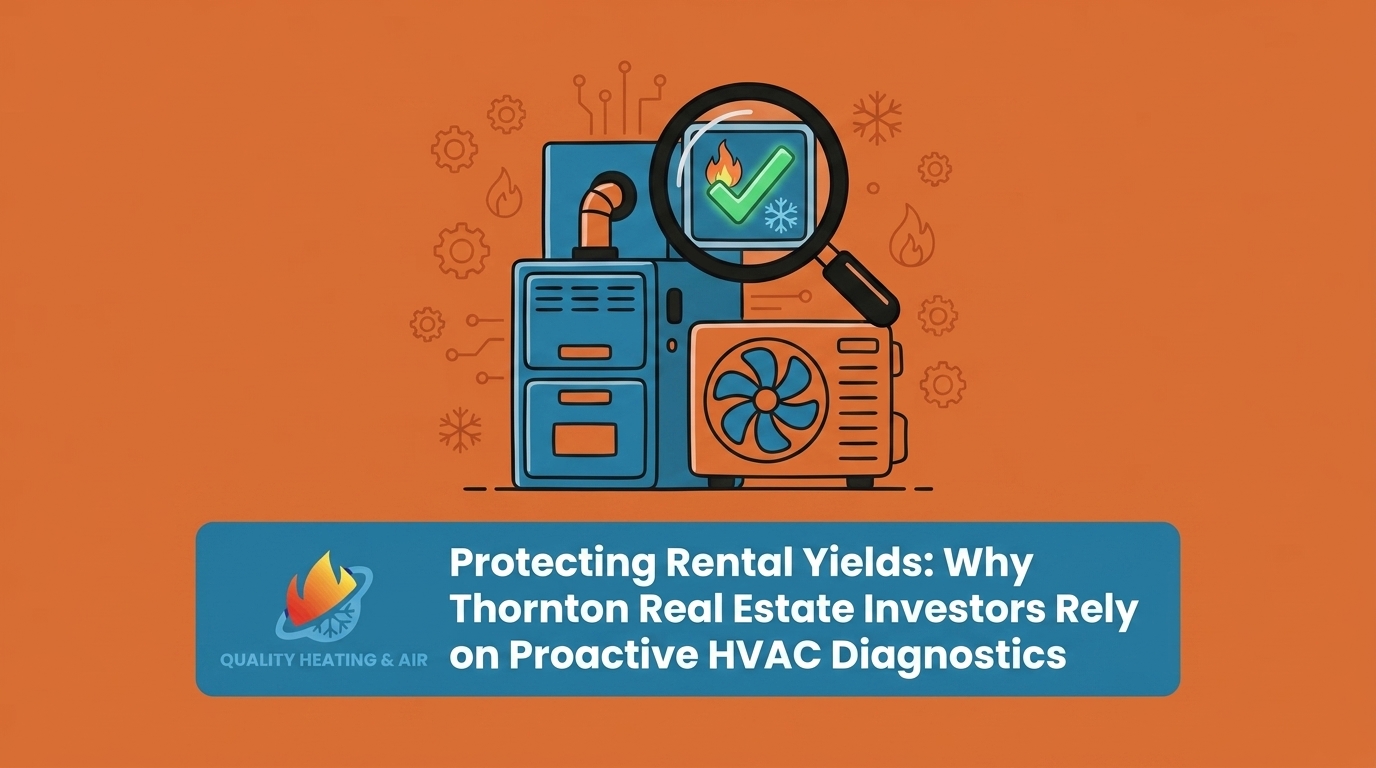
Why Thornton Real Estate Investors Rely on Proactive HVAC Diagnostics
The Hidden HVAC Risks in Late-Summer Property Acquisitions
If you are looking at a promising rental portfolio addition during the late-summer, back-to-school transition, understanding Why Thornton Real Estate Investors Rely on Proactive HVAC Diagnostics is critical to ensuring those major mechanical systems survive their first year. When acquiring properties during the peak heat of August, you inherit air conditioning units that have been running at maximum capacity for months. The critical question becomes: is that system just tired, or is it on the brink of a catastrophic failure? Prioritizing specialized evaluations over standard walk-throughs is the difference between a profitable first year and massive unexpected capital expenditures. Relying on a basic visual inspection leaves your rental yields entirely exposed to hidden mechanical wear.
To protect your investments, establishing a proactive HVAC maintenance plan and prioritizing thorough heating system diagnostics before closing is essential.
Where Standard Home Inspections Fall Short for Property Buyers
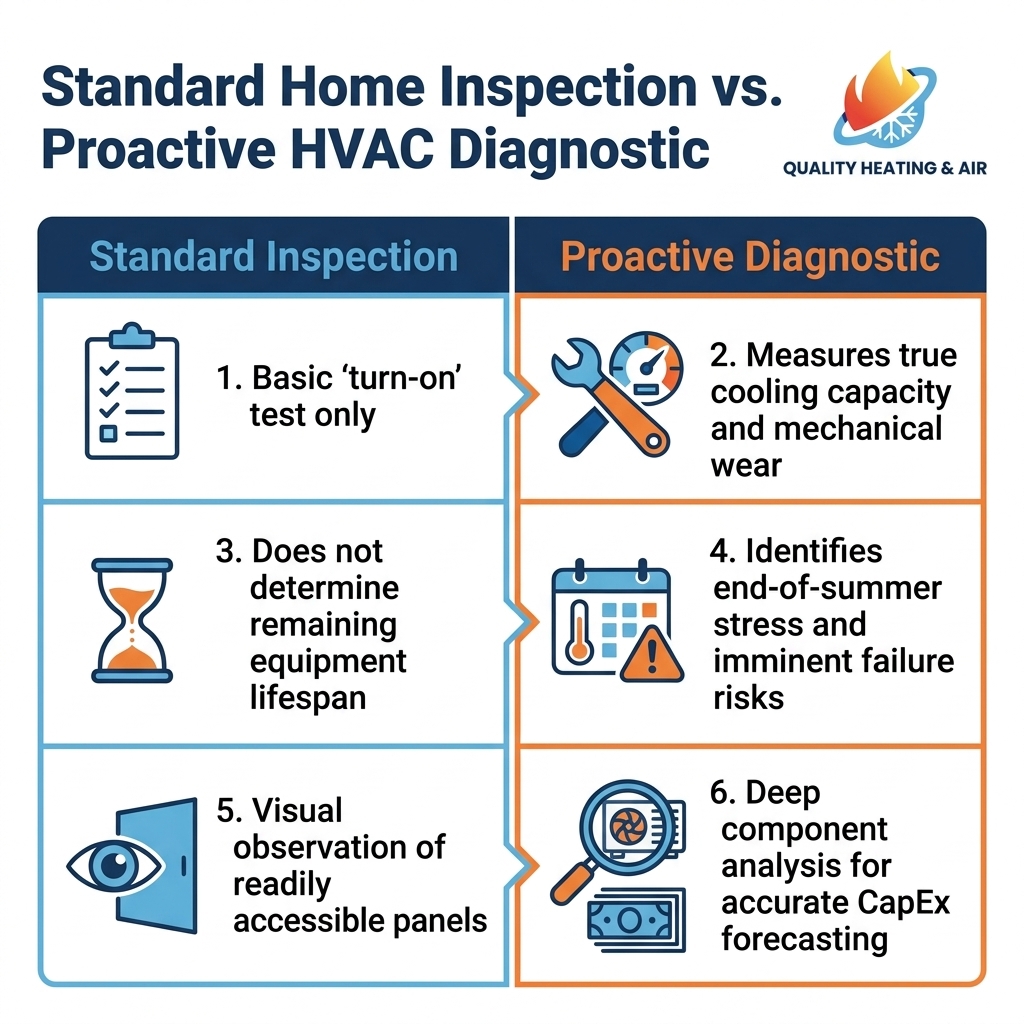
Real estate transactions move quickly, and it is tempting to rely solely on the general home inspection to verify the condition of a property. However, standard home inspections are designed to provide a broad overview of a house, not a deep mechanical assessment of its most expensive systems. According to the American Society of Home Inspectors (ASHI) Standards of Practice, general inspectors are only required to open readily accessible panels and observe central cooling equipment. They are not required to determine the remaining lifespan, verify the true cooling capacity, or measure the electrical draw of the internal components. For Thornton rental properties, this superficial check leaves a massive blind spot in your acquisition strategy.
The Limitations of the Basic 'Turn-On' Test
During a typical real estate walk-through, the inspector will adjust the thermostat, listen for the unit to kick on, and hold a hand over a vent to feel for cold air. This is widely known as the basic "turn-on" test. While it confirms the system is currently operational, it tells you absolutely nothing about the underlying health of the equipment.
The mechanical reality: A system with a failing compressor, dangerously low refrigerant levels, or a clogged evaporator coil will often still turn on and blow cool air. However, it will do so while drawing excessive electrical current and running continuously to meet the thermostat setting. A basic functional observation cannot differentiate between a robust, efficient system and one that is days away from a total breakdown.
Missing the True Cooling Capacity
Underlying wear and capacity loss go completely unnoticed during standard walk-throughs. As air conditioners age, especially in demanding climates, they lose their ability to remove heat and humidity efficiently. A proactive HVAC diagnostic measures the actual temperature drop across the evaporator coil, known as the "Delta T." If this measurement is outside the manufacturer's specifications, the system is struggling.
Acquiring a property with an HVAC system that lacks true cooling capacity introduces significant financial risk. When the system fails to cool the home, tenants will submit constant maintenance requests, and the system will eventually fail entirely under the strain. Specialized diagnostics reveal these capacity issues before you sign the closing documents, allowing you to negotiate repairs or adjust your purchase price accordingly.
Decoding August Late-Summer Cooling Wear
Timing plays a massive role in real estate acquisitions. When you purchase a property in late summer, you are acquiring a mechanical system at its most vulnerable point. By August, air conditioners in rental properties have been battling extreme heat for months. Our team at Quality Heating & Air frequently sees how this continuous operation places incredible mechanical stress on the moving parts, electrical components, and refrigerant lines. Decoding this August late-summer cooling wear requires specialized tools and expertise that go far beyond a visual check.
Cumulative Stress from Peak Summer Months
The mechanical toll of continuous cooling cycles cannot be overstated. Throughout June and July, the compressor works tirelessly to pressurize refrigerant, while the condenser fan motor runs constantly to exhaust heat. This cumulative stress degrades electrical capacitors, wears down motor bearings, and causes contactors to become pitted and burned. Furthermore, tenant usage patterns often exacerbate this fatigue. Renters frequently leave thermostats set to very low temperatures or neglect to change air filters, forcing the system to work twice as hard to pull air through a restricted barrier.
Common components degraded by late-summer stress:
• Run Capacitors: Swollen or leaking capacitors are a leading cause of late-summer motor failure.
• Contactor Relays: Burned electrical contacts can cause the system to short-cycle or fail to start.
• Condenser Coils: Months of accumulating dust, pollen, and debris severely restrict airflow and heat transfer.
• Blower Motors: Restricted airflow from dirty filters causes the indoor blower motor to overheat and degrade.
Masking Imminent Breakdowns Before Winter
One of the most dangerous aspects of late-summer cooling wear is how easily it masks imminent breakdowns. A system that appears to function fine on a warm August afternoon may completely fail when the weather begins to shift. Worse, because the air conditioner and furnace share the same indoor blower motor, a motor that has been pushed to the brink during the summer will often fail the moment it is called upon to distribute heat in the winter.
Assessing the system's health before the high-demand heating season begins is critical. A proactive diagnostic will uncover the hidden fatigue in these shared components, ensuring that the transition from cooling to heating does not trigger an emergency service call during the first cold snap.
Preventing Unexpected Capital Expenditures to Protect Yields
For real estate investors, the primary goal is protecting the yield of the asset. National Association of Realtors (NAR) insights consistently highlight that HVAC replacements are among the top unexpected capital expenditures for new property investors. When an air conditioner or furnace fails entirely within the first year of ownership, it can completely wipe out the projected cash flow for that property. Proactive diagnostics serve as a direct financial shield against these surprises.
The True Cost of Surprise HVAC Failures
The financial damage of a surprise HVAC failure extends far beyond the cost of the equipment itself. Emergency replacements command premium pricing, destroying your first-year return on investment. Furthermore, there are secondary costs associated with tenant turnover. Prolonged heating or cooling outages lead to frustrated tenants, withheld rent, and broken leases. When a tenant leaves because the property is uninhabitable, you face vacancy costs, marketing expenses, and leasing fees—all of which could have been avoided by diagnosing the system prior to closing.
Diagnosing Root Causes Over Unnecessary Replacements
A thorough diagnostic doesn't just find problems; it finds solutions. Often, a system that might be condemned by a less thorough inspector or a hasty contractor can be saved if the root cause of the issue is correctly identified. Specialized knowledge preserves existing equipment lifespans safely.
One local scenario our technicians at Quality Heating & Air recently handled highlights this perfectly. An investor acquired an older home needing a full cooling system evaluation. Because they relied on our specialized diagnostics rather than a basic inspection, they received a confident, honest assessment of the equipment. We identified the root cause of a recurring issue—including an underlying electrical hiccup that was quickly resolved post-install—saving the investor from prolonged vacancy and unnecessary full-system replacement costs. Identifying repairable issues rather than defaulting to new installations is how savvy investors preserve their capital, and it is a standard practice for our team.
Navigating Thornton's Extreme Seasonal Temperature Swings
The local climate dictates the level of stress placed on mechanical systems, and Colorado presents a unique set of challenges. Thornton's semi-arid climate and high elevation result in significant seasonal temperature extremes. The rapid shift from intense August heat to freezing winter conditions places a unique dual-stress on HVAC units that properties in milder climates simply do not experience. Understanding how to navigate these swings is a critical component of managing property in the Thornton HVAC service area, as well as our primary service area of Northglenn.
Dual-Stress from Summer Heat to Winter Freezes
HVAC systems in Thornton experience mechanical whiplash. In a matter of weeks, a system can go from running 14 hours a day to combat 95-degree heat, to sitting idle, to suddenly firing up to fight off sub-freezing overnight temperatures. This rapid transition demands that both the cooling and heating systems are verified simultaneously before closing on a property. Even if you are acquiring a property in late August, the furnace must be thoroughly inspected. A cracked heat exchanger or a failing ignition sequence might not be apparent during the summer, but it will become an immediate crisis when the first snow falls.
Mitigating Severe Property Damage Risks
The cascading effects of winter heating failures on plumbing and property infrastructure are severe. If a furnace fails unexpectedly after a grueling summer, the internal temperature of the rental property can plummet rapidly. This leads to frozen pipes, burst water lines, and catastrophic water damage. Pre-purchase diagnostics act as an insurance policy against this winter damage. By ensuring the heating system is robust and the shared blower components have survived the summer cooling season, you mitigate the risk of a failure that could result in massive costs for water remediation and structural repairs.
Gaining Budget Predictability Through Transparent Reporting
Real estate investors require exact predictability to manage property maintenance budgets effectively. You cannot scale a portfolio if you are constantly reacting to mechanical emergencies. This is where the commitment to transparent diagnostics becomes a powerful differentiator. By providing clear, detailed explanations of system health and every step of the repair process, investors gain the exact predictability they need to forecast future capital expenditures.
Clear Explanations of System Health
A high-quality diagnostic report breaks down complex HVAC jargon into actionable investor insights. Instead of simply stating that a system is "old" or "needs repair," a transparent diagnostic provides specific data points. It details the amp draw of the compressor, the condition of the evaporator coil, the integrity of the ductwork, and the safety of the furnace's heat exchanger. This level of detail provides a clear timeline for expected repairs versus immediate, critical needs.
Consider a recent situation involving a mini-split cooling system in a local rental unit. Because the property manager relied on a transparent diagnostic report from Quality Heating & Air, our technician quickly pinpointed the exact component failure causing the cooling issue. We were able to execute a targeted, rapid repair rather than jumping to a costly system overhaul, perfectly demonstrating how accurate data drives cost-effective decisions.
Accurate Forecasting for Maintenance Budgets
Using these detailed diagnostic reports, landlords can build a multi-year property maintenance budget. If a diagnostic reveals that the air conditioner in a newly acquired property has approximately two years of life remaining, you can begin allocating funds for that capital expenditure immediately. This eliminates the guesswork from property management financial planning. You shift from a reactive stance—scrambling to fund an emergency replacement—to a proactive stance, where the replacement is already budgeted and scheduled during a shoulder season to minimize tenant disruption.
Integrating Diagnostics into a Long-Term Property Strategy
The pre-purchase diagnostic is just the beginning. To truly protect your rental yields, the initial evaluation must seamlessly transition into a long-term property strategy. The data gathered during the acquisition phase establishes a critical baseline, setting the stage for ongoing preventative care that keeps the property profitable year after year.
Establishing a Mechanical Baseline
Documenting the system's condition at acquisition allows you to track future degradation accurately. When you have a comprehensive record of the refrigerant levels, electrical readings, and static pressure from day one, future air conditioning inspections become much more valuable. Technicians can compare current readings against the baseline to identify slow leaks, gradual capacity loss, or creeping electrical issues before they result in a total system failure. This sets up a reliable, documented service history for the property, which is also highly valuable if you ever decide to sell the asset.
Routine Upkeep for Sustained Rental Yields
Ongoing maintenance prevents the recurrence of August late-summer cooling wear issues. By transitioning from the initial diagnostic into a schedule of routine AC maintenance and service, you ensure that coils remain clean, electrical connections remain tight, and moving parts remain lubricated.
The benefits of routine upkeep include:
• Reduced Tenant Complaints: Proactive care keeps the system running smoothly, virtually eliminating late-night calls about a hot house.
• Lower Utility Bills: Efficient systems cost less to operate, which is a strong selling point if tenants pay their own utilities, or a direct margin increase if utilities are included in the rent.
• Extended Equipment Lifespan: Regular cleaning and tuning can add years to the functional life of an HVAC system, delaying massive capital expenditures.
• Lease Renewals: Tenants who are consistently comfortable and feel their maintenance needs are prioritized are far more likely to renew their leases, reducing costly turnover.
Protect Your Rental Yields with Professional HVAC Insights
Relying on a standard home inspection is a major risk for Thornton real estate acquisitions, especially when buying properties during the peak stress of late summer. A general inspector's basic functional check simply cannot reveal the hidden mechanical wear, capacity loss, or imminent failure risks lurking inside an aging air conditioner or furnace. Understanding the true, data-backed condition of an HVAC system is absolutely essential for protecting your investment capital and accurately forecasting your maintenance budgets.
Do not let unexpected capital expenditures destroy your first-year return on investment. Encourage your acquisition team to prioritize specialized, proactive diagnostics before the inspection objection deadline passes. By securing professional HVAC insights, you ensure your rental properties remain comfortable, your tenants remain satisfied, and your long-term yields remain thoroughly protected.
Frequently Asked Questions
Does a general home inspection cover HVAC?
A general home inspection only covers a basic visual and functional observation of the HVAC system. Inspectors typically perform a "turn-on" test to ensure the unit operates and check readily accessible panels, but they do not measure refrigerant levels, electrical draw, or true cooling capacity. This limited scope often misses significant underlying mechanical wear.
What is included in a proactive HVAC diagnostic?
A proactive HVAC diagnostic involves a deep mechanical and electrical assessment of the entire system. Technicians measure the temperature drop across coils, test the microfarad readings of capacitors, inspect the heat exchanger for micro-fractures, and evaluate the static pressure of the ductwork. This comprehensive approach identifies hidden stress and accurately forecasts the remaining lifespan of the equipment.
How do HVAC issues affect rental property ROI?
HVAC issues can severely damage rental property ROI through unexpected capital expenditures and increased tenant turnover. An emergency system replacement can wipe out a year's worth of projected cash flow, while prolonged outages lead to frustrated tenants, withheld rent, and costly vacancies. Proactive maintenance mitigates these risks by shifting surprise costs into planned, budgeted expenses.
Should I get a separate HVAC inspection before buying a house in Thornton?
Yes, securing a separate, specialized HVAC diagnostic is highly recommended before purchasing a home in Thornton. The region's extreme seasonal temperature swings place immense dual-stress on both heating and cooling systems. A dedicated evaluation ensures the equipment can handle the rapid transition from intense August heat to freezing winter conditions without catastrophic failure.
Why is late-summer AC maintenance critical for new rental properties?
Late-summer AC maintenance is critical because systems have been running at peak capacity for months, accumulating significant mechanical stress. By August, components like capacitors, contactors, and blower motors are heavily fatigued, and dirty coils restrict airflow. Evaluating and servicing the system at this stage prevents these stressed components from failing right as the heating season begins.
How do transparent diagnostics help forecast property maintenance budgets?
Transparent diagnostics provide detailed, data-backed reports on the exact health of every HVAC component, eliminating guesswork. By clearly explaining which parts are failing and estimating the remaining lifespan of the system, property managers can accurately predict when a replacement will be necessary. This allows investors to allocate funds over time rather than scrambling to cover an emergency capital expenditure.

Testimonials
Neighbors trust Quality Heating & Air for honest work and fair pricing.
Service Areas