Navigating Westminster's Commercial Building Codes for New Furnace Installations

Overcoming Commercial Heating Compliance Hurdles Before Winter
In our years of serving Northglenn and the surrounding areas, the team at Quality Heating & Air has seen firsthand how up to 75% of commercial building project delays stem directly from incomplete permit applications and subsequent failed inspections. Because of this, navigating Westminster's Commercial Building Codes for New Furnace Installations must be a top priority for facility managers and property owners long before the first freeze hits. Upgrading an aging commercial heating system is never as simple as swapping out a unit; it involves strict local permitting, detailed plan reviews, and stringent inspection requirements mandated by the city.
The primary concrete problem facility managers face is ensuring a commercial furnace replacement complies with these local codes to avoid costly failed inspections. When paperwork is rejected or an installation is flagged by an inspector, the resulting delays can leave your building without heat just as the weather turns. Handling this red tape correctly from day one prevents delayed heating operation as early fall weather arrives. If you need assistance managing these complex requirements, securing professional commercial heating services ensures your facility remains safe, compliant, and comfortable.
The urgency of early preparation: Bureaucratic processes do not speed up just because the temperature drops. Initiating your equipment upgrades during the pre-heating-season September window provides the necessary buffer for plan reviews, load calculation approvals, and multi-stage municipal inspections.
Understanding Westminster's Adoption of IBC and IMC Standards
To successfully manage a commercial heating upgrade, you must first understand the foundational regulations governing your building. The City of Westminster utilizes the International Building Code (IBC) and the International Mechanical Code (IMC) as the baseline for all commercial construction and mechanical upgrades. These comprehensive documents dictate everything from the structural support required for rooftop units to the precise volume of fresh air intake necessary for indoor air quality.
Local Municipal Amendments
While the IBC and IMC provide a global standard, Westminster applies specific municipal amendments to modify these international rules for regional safety, altitude, and efficiency. These local tweaks often address the unique atmospheric conditions of the Front Range, ensuring that combustion equipment operates safely at higher elevations. Commercial properties are held to a significantly higher standard of code enforcement than residential buildings because they impact public safety, employee health, and large-scale energy consumption across Westminster commercial districts.
The Role of Load Calculations and Energy Codes
One of the most heavily scrutinized elements during the initial planning phase is energy code compliance. The city requires comprehensive load calculations to prove that the proposed heating equipment is perfectly sized for the facility's square footage, occupancy limits, and thermal envelope. Oversized units waste energy and fail to dehumidify properly, while undersized units run continuously, leading to premature failure. Providing accurate documentation upfront is non-negotiable. Securing reliable furnace installation and heating solutions requires partnering with professionals who can generate these precise engineering calculations and seamlessly integrate them into your permit application.
Key Differences Between Commercial and Residential HVAC Code Enforcement
A common misconception among property owners is that a commercial furnace replacement is just a larger version of a home heater swap. In reality, commercial HVAC code enforcement differs drastically in scale, strictness, and scope. Commercial systems involve complex interconnected infrastructures that trigger multiple layers of municipal oversight.
When operating within Westminster commercial districts, the zoning laws, noise ordinances, and structural requirements are heavily scrutinized. To clarify these distinctions, the following table outlines the major regulatory differences between residential and commercial heating projects.
• Equipment Scale & Structural Load — Residential Code Enforcement: Standard sizing; minimal structural verification needed for basement or closet installs. — Commercial Code Enforcement: Requires engineering approval for rooftop structural loads, seismic bracing, and heavy-duty rigging.
• Ventilation & Exhaust — Residential Code Enforcement: Basic PVC or metal flue venting through the roof or sidewall. — Commercial Code Enforcement: Complex makeup air requirements, dedicated exhaust systems, and strict proximity rules to property lines.
• Electrical Requirements — Residential Code Enforcement: Standard 120V or 240V single-phase power connections. — Commercial Code Enforcement: Three-phase power requirements, dedicated lockable disconnects, and advanced phase-monitoring relays.
• Occupancy Classifications — Residential Code Enforcement: Uniform safety standards for single-family or multi-family dwellings. — Commercial Code Enforcement: Varying safety features required based on building use (e.g., retail, industrial, medical, or assembly).
Because commercial systems often require specialized ventilation and exhaust compliance under local codes, the approval process is significantly more rigorous. Furthermore, building occupancy classifications directly impact the required safety features, such as integrated smoke detectors in the ductwork that automatically shut down the blower during a fire event. Navigating these requirements across Westminster and surrounding service areas demands a thorough understanding of commercial code application.
Navigating the Mechanical Plan Review and Permitting Process
Securing a commercial mechanical permit is a multi-step bureaucratic process that requires precision and patience. Unlike residential permits, which can sometimes be pulled over the counter on the same day, commercial permits require a formal plan review by the City of Westminster Building Division.
The Standard Permitting Workflow
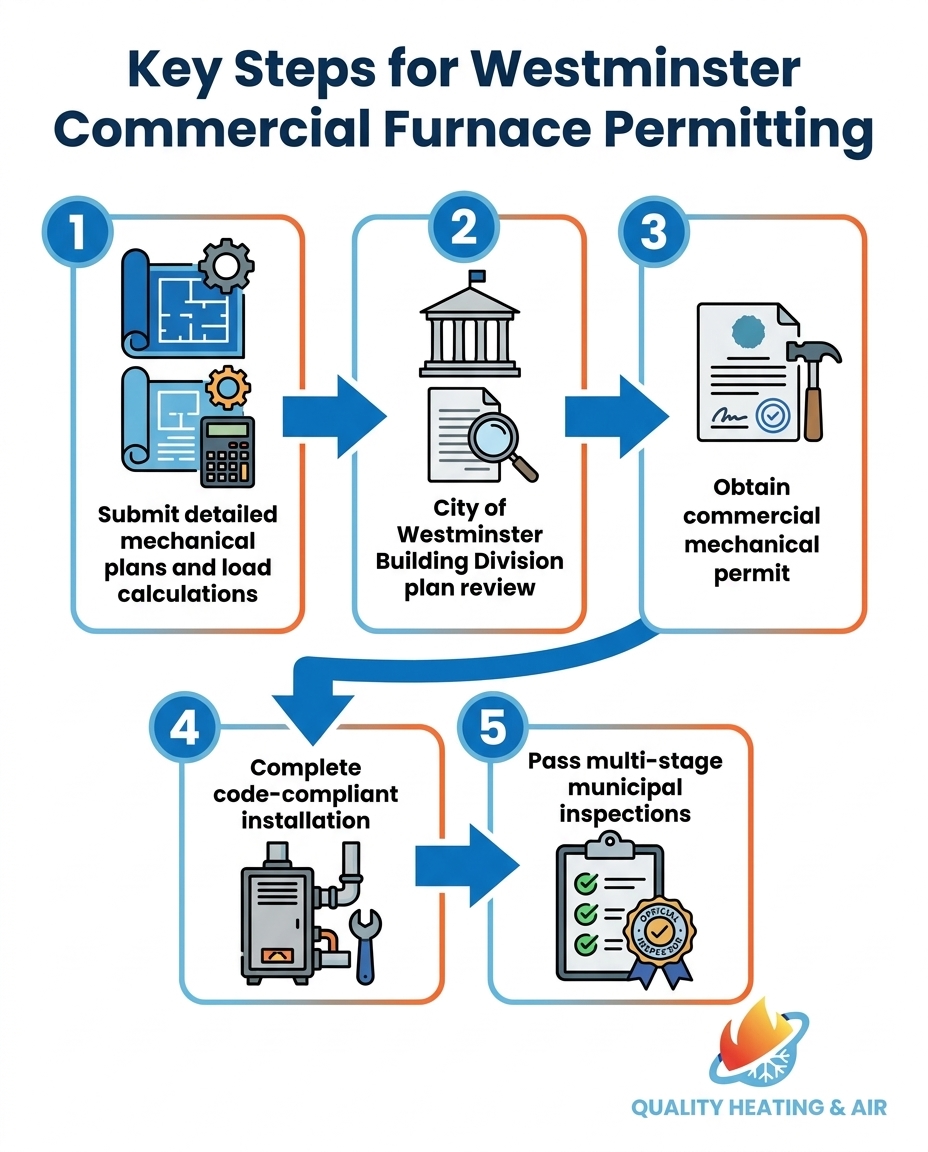
1. Document Preparation: The process begins by compiling detailed mechanical plans, manufacturer specification sheets, and certified load calculations. Every piece of equipment being installed or modified must be documented.
2. Application Submission: These plans are submitted to the Building Division for the formal mechanical plan review. The city engineers will evaluate the plans against the current IBC, IMC, and local energy codes.
3. Addressing Revisions: If the city identifies any discrepancies or missing information, they will issue plan check comments. The licensed contractor must revise and resubmit the documents, which can add weeks to the timeline.
4. Permit Issuance: Once all criteria are met, the commercial mechanical permit is issued, and physical installation work can legally commence.
The typical timeline for commercial plan reviews can range from two to six weeks, depending on the city's backlog. In our daily operations at Quality Heating & Air, we find that incomplete documentation is the leading cause of delays. For instance, when updating older mechanical infrastructures, a pattern we see often involves retrofitting start-assist mechanisms for integrated cooling while installing the new furnace—modifications that require precise electrical documentation on the initial plan submission to avoid rejection.
Because of this complexity, having a licensed professional manage the paperwork is an absolute necessity to ensure accuracy. Additionally, exploring commercial HVAC financing options early in the planning phase can keep the project budget aligned with the regulatory timeline, preventing financial bottlenecks once the permit is finally approved.
Preparing for Multi-Stage Commercial Furnace Inspections
Obtaining the permit is only the first hurdle; proving the installation matches the approved plans is the next. Commercial mechanical inspections in Westminster are typically conducted in multiple stages to ensure no critical safety components are hidden behind walls or ceilings before verification.
Rough-In vs. Final Inspections
The multi-stage nature of these inspections usually involves a "rough-in" inspection and a "final" inspection. During the rough-in phase, municipal inspectors examine the ductwork sizing, gas piping pressure tests, and electrical conduit routing before the ceiling grid is closed or walls are finished. Once the equipment is fully operational, the final inspection verifies that the system fires safely, vents correctly, and meets all energy code requirements.
Based on our experience, common reasons commercial furnace installations fail initial municipal inspections include:
• Inadequate clearances: Failing to maintain the manufacturer's specified clearance to combustible materials around the furnace casing or flue pipe.
• Improper gas line sizing: Using undersized gas piping that cannot deliver the required BTUs for high-capacity commercial burners.
• Unsealed ductwork: Failing to properly seal duct seams with approved mastic, leading to air leakage that violates energy codes.
• Missing service disconnects: Forgetting to install the required electrical disconnect switches within line-of-sight of the equipment.
The role of your HVAC contractor is vital here. At Quality Heating & Air, our team coordinates the inspection schedules directly with city officials across Westminster commercial districts, ensuring that one of our representatives is on-site to walk the inspector through the specific safety, electrical, and gas line verifications. This proactive approach drastically increases the likelihood of a first-time pass.
The Critical Timeline for Pre-Winter Code Compliance
The intersection of municipal bureaucracy and seasonal weather changes creates a strict timeline for facility managers. Bureaucratic delays in commercial permitting can leave facilities highly vulnerable to sudden temperature drops, which can lead to frozen pipes, damaged inventory, and unsafe working conditions for employees.
With Colorado's harsh, freezing winters, rapid temperature drops in early fall demand fully operational, code-compliant commercial heating systems. The necessity of initiating upgrades and securing permits before the end of the pre-heating-season September window cannot be overstated. By the time October arrives, the city's building division often sees a massive influx of emergency permit requests, further slowing down the review process.
Managing Urgent Replacements
Waiting until October freezes hit introduces the severe risk of emergency replacement scenarios. When a commercial heater fails urgently during a bitter winter freeze, rapid dispatch is critical so occupants are not left in the cold. However, even these expedited emergency replacements require strict adherence to municipal safety guidelines. While some municipalities allow emergency work to commence with the permit application following on the next business day, the installation must still flawlessly meet all IBC and IMC standards to pass the subsequent inspection. For guidance on handling urgent replacements while remaining compliant with municipal codes, reviewing tips for 24-hour furnace installation in Westminster can help you prepare your facility for worst-case scenarios.
Streamlining Approvals with Local Regulatory Expertise
Facility managers and property owners should never have to navigate complex municipal codes alone. The sheer volume of documentation, engineering calculations, and procedural steps required by the City of Westminster can easily overwhelm a team whose primary focus is running a business, not deciphering building codes.
This is where the value of partnering with an HVAC provider who understands local Westminster amendments intimately becomes apparent. Leveraging our deep Northglenn and Westminster area expertise allows our team at Quality Heating & Air to absorb the burden of red tape, helping commercial property owners seamlessly navigate local regulations and pass inspections on the first try. A seasoned local provider already knows exactly what the Westminster Building Division looks for regarding commercial exhaust proximity, rooftop structural loads, and high-altitude combustion adjustments.
Proactive communication with city building divisions ensures that any potential code conflicts are resolved during the plan review stage, rather than discovered halfway through the installation. Comprehensive, knowledgeable explanations of code requirements build confidence in the installation process, ensuring that every safety mechanism, from duct smoke detectors to phase monitors, is installed correctly the first time across Westminster commercial districts.
Ensure Your Facility's Heating Compliance Today
Early preparation is the most effective strategy for managing commercial furnace upgrades. By initiating the permitting and plan review process during the pre-heating-season September timeframe, you protect your facility from bureaucratic delays and sudden weather shifts. Local regulatory experts are ready to handle the complex permitting, load calculations, and multi-stage inspection processes on your behalf. Schedule a consultation today to review your commercial heating needs, and ensure your building is equipped with a code-compliant, reliable heating system before the winter cold sets in.
Frequently Asked Questions
Do I need a permit to replace a commercial furnace in Colorado?
Yes, replacing a commercial furnace in Colorado strictly requires a mechanical permit. Commercial installations involve complex gas, electrical, and structural systems that municipal inspectors must verify for public safety. Attempting to replace a commercial unit without a permit can result in severe fines and mandated removal of the equipment.
What is required for a commercial mechanical permit in Westminster?
A commercial mechanical permit in Westminster typically requires the submission of detailed mechanical plans, manufacturer specifications, and certified load calculations. The city's Building Division must review these documents to ensure they meet the International Building Code (IBC), International Mechanical Code (IMC), and local energy standards. Incomplete documentation is the most common reason for permit rejection.
How do I schedule a commercial mechanical inspection in Westminster?
Commercial mechanical inspections in Westminster are scheduled through the city's Building Division portal or via their automated phone system. Typically, your licensed HVAC contractor will handle this coordination, ensuring inspections are booked for the rough-in and final stages of the project. It is highly recommended to schedule several days in advance due to high seasonal demand.
What building codes apply to commercial HVAC in Westminster?
Commercial HVAC installations in Westminster are governed primarily by the International Building Code (IBC) and the International Mechanical Code (IMC). Additionally, the city enforces specific municipal amendments that account for local climate conditions, high altitude, and regional energy efficiency standards. Compliance with the International Energy Conservation Code (IECC) is also heavily scrutinized during the plan review.
How long does a commercial mechanical plan review take in Westminster?
A standard commercial mechanical plan review in Westminster generally takes between two to six weeks, depending on the current backlog at the Building Division. If the submitted plans require revisions or additional engineering calculations, this timeline can be extended. Initiating the review process well before the heating season is highly advised to avoid operational delays.
Can a commercial property fail a furnace inspection due to outdated energy codes?
Yes, a commercial installation can fail inspection if the new equipment or ductwork does not comply with the currently adopted energy codes. Even if the previous system was compliant at the time of its installation, any new replacement must meet modern standards for efficiency, sealing, and load sizing. This is why certified load calculations are required upfront to prove the new system meets current municipal expectations.

Testimonials
Neighbors trust Quality Heating & Air for honest work and fair pricing.
Service Areas