Managing High-Rise Commercial Cooling During Colorado's Intense July Heatwaves


When Upper Floors Bake and Lower Floors Freeze in the Summer Heat
Summer in Colorado brings aggressive, sustained temperatures, and if you operate a multi-story facility, you already know the drill. In our years of providing commercial HVAC solutions across the local area, our team has seen firsthand how Managing High-Rise Commercial Cooling During Colorado's Intense July Heatwaves becomes a daily battle of extremes. The ground-floor lobby feels like a meat locker, while tenants on the top floor are setting up desk fans just to survive the afternoon. This classic seasonal complaint leaves facility managers facing a difficult decision: keep pushing aging equipment past its limits, or invest in strategic airflow balancing to actually solve the root cause.
To restore comfort and protect your equipment before the heat peaks, we highly recommend optimizing your commercial air conditioning systems and securing a proactive commercial HVAC maintenance plan as the most effective path forward.
The instinct is usually to drop the thermostat lower, hoping the cold air will eventually reach the upper levels. However, in multi-story buildings, temperature imbalances are rarely a problem of raw cooling power. They are a problem of air distribution, physics, and environmental stress. When July heatwaves hit, Commercial Rooftop Units (RTUs) are already working overtime against the intense solar load on the roof. Forcing them to run continuously without addressing the underlying airflow restrictions only accelerates wear and tear, driving up utility costs while leaving upper-floor tenants completely unsatisfied.
How High Altitude Impacts Air Density and Cooling Capacity
Cooling a commercial building in Colorado is fundamentally different than cooling one in a coastal city. The physical environment directly alters how HVAC equipment operates, and the biggest unseen factor our technicians account for is elevation. Standard Commercial Rooftop Units (RTUs) are engineered and rated based on sea-level conditions. When you place those same units a mile above sea level, the physics of heat transfer change dramatically.
The 17% Density Drop
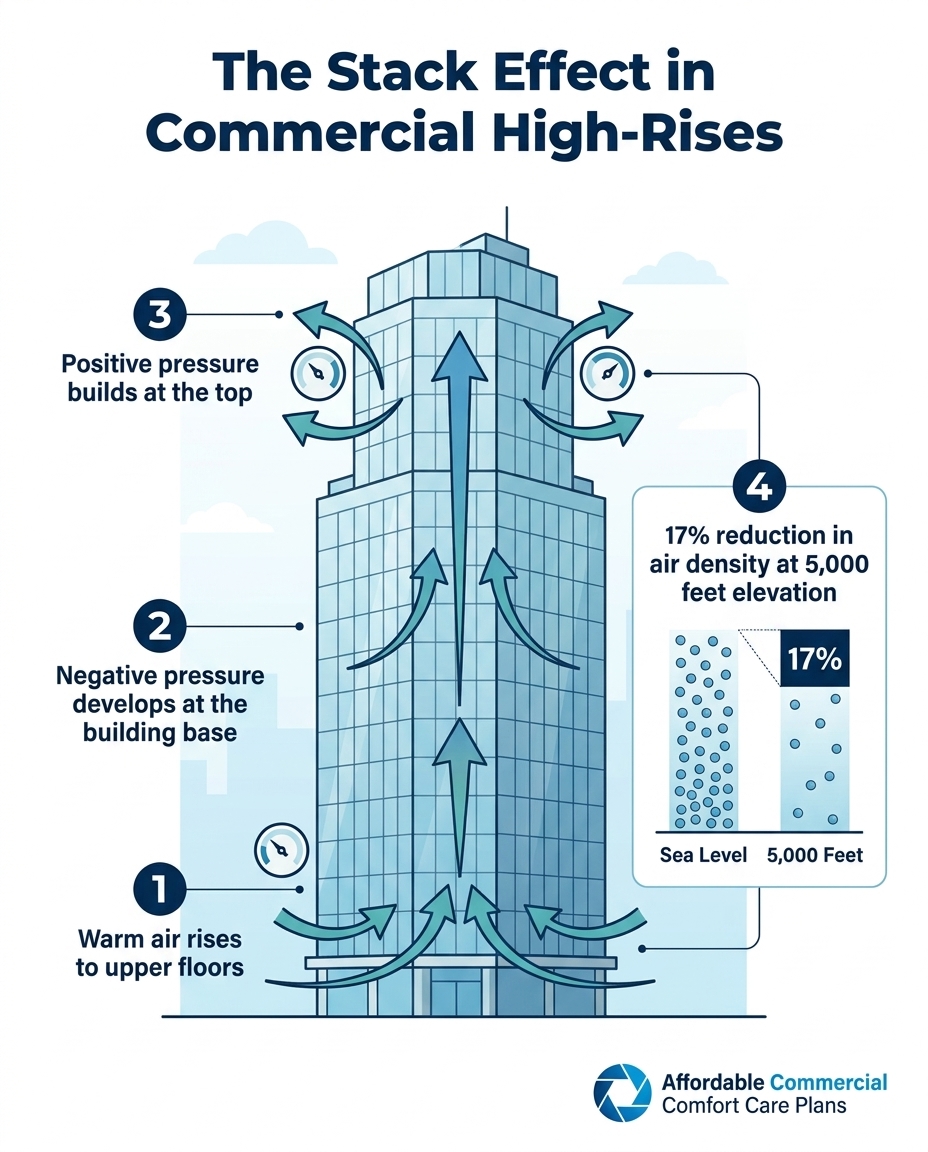
At 5,000 feet of elevation, the air density is roughly 17% less than it is at sea level. Because the air is thinner, it carries less mass per cubic foot. HVAC systems rely on the mass flow rate of air to absorb heat from the indoor environment and reject it outside. When the air is 17% thinner, the system has 17% less physical material to carry that heat away. This physical reality directly reduces the overall cooling capacity of standard equipment, meaning the system has to move significantly more air just to achieve the same temperature drop. Understanding how Colorado's altitude affects AC performance is the first step our team takes in properly calibrating a high-rise system.
Increased Fan Stress
Because the air is thinner, the blower motors and fans inside your RTUs must work harder and spin faster to move the required volume of air. This increased demand leads to longer run times and higher mechanical stress.
• Air Density — Sea Level Baseline: 100% (Standard) — Colorado Elevation (5,000+ ft): Approximately 83%
• Mass Flow Rate — Sea Level Baseline: Optimal heat transfer — Colorado Elevation (5,000+ ft): Reduced; requires higher air volume
• Blower Motor Stress — Sea Level Baseline: Normal operating RPM — Colorado Elevation (5,000+ ft): Increased RPM and run times
• Cooling Capacity — Sea Level Baseline: Meets factory rating — Colorado Elevation (5,000+ ft): Derated by 10-15% without adjustment
During peak summer operation, this continuous fan stress accelerates wear on belts, bearings, and motors. If the system is not specifically adjusted for high-altitude operation, the equipment will eventually fail under the strain of moving thin air during the hottest part of the year.
The Stack Effect: Why Vertical Temperature Imbalances Occur
Even with properly calibrated equipment, multi-story buildings face a powerful structural challenge known as the stack effect. This phenomenon is the primary reason why vertical temperature imbalances occur, and it becomes exceptionally pronounced during July heatwaves when the temperature differential between the indoor and outdoor air is severe.
Warm Air Migration
The stack effect is driven by the simple principle that warm air is less dense than cold air, causing it to rise. In a commercial high-rise, elevator shafts, stairwells, and large atriums act like massive chimneys. As the building's HVAC system attempts to cool the space, the warmer air naturally migrates upward through these vertical channels. The building envelope traps this rising heat on the upper floors, causing those spaces to bake regardless of how much cold air the RTUs are producing.
Pressure Differentials
As warm air rises to the top of the building, it creates distinct pressure zones.
• Negative pressure at the base: As air moves upward, it leaves a void at the bottom of the building, creating negative pressure. This vacuum effect can pull unconditioned, hot outdoor air into the lobby through doors and unsealed gaps.
• Positive pressure at the top: The rising air accumulates on the upper floors, creating positive pressure. This pressurized hot air fights against the HVAC system, making it incredibly difficult for supply vents to push conditioned air into the top-floor offices.
Colorado's intense, dry outdoor heat exacerbates this indoor stack effect. The extreme solar radiation hitting the roof and upper windows adds to the heat load, making the upper floors unbearable without strategic intervention.
Strategic Airflow and Pressure Balancing
Brute force cooling is not the answer to the stack effect. Dropping the temperature only wastes energy and damages equipment. The actual solution is strategic airflow and pressure balancing. By redirecting how air moves through the building, our professional technicians can mitigate vertical imbalances and ensure that Commercial Rooftop Units (RTUs) distribute conditioned air evenly.
Calibrating Zone Dampers
Balancing starts with controlling the volume of air delivered to each floor. This is a complex process our team manages by calibrating zone dampers and Variable Air Volume (VAV) boxes:
1. Assessing current airflow: Our technicians measure the cubic feet per minute (CFM) of air currently reaching each zone.
2. Restricting lower-floor over-cooling: We carefully adjust dampers on the ground and lower floors to restrict excess airflow, preventing the lobby from turning into an icebox.
3. Redirecting to upper floors: By restricting the lower levels, we ensure the system naturally forces a higher volume of conditioned air up the ductwork to the higher floors where it is desperately needed.
Static Pressure Optimization
Adjusting dampers changes the pressure inside the ductwork. If the pressure gets too high, it can damage the blower motor; if it drops too low, the air won't reach the end of the line. Our professionals measure static pressure using specialized manometers, taking readings at various points in the commercial ductwork. Based on these readings, technicians can safely adjust blower motor speeds and pulley configurations to ensure the system is pushing air effectively against the stack effect without exceeding the equipment's structural limits.
Managing Sensible vs. Latent Cooling Loads
When engineering a comfortable indoor environment, HVAC professionals divide cooling into two categories: sensible cooling and latent cooling. Sensible cooling is the process of lowering the actual temperature of the air—the number you see on the thermostat. Latent cooling is the process of removing moisture or humidity from the air.
In coastal or humid environments, a massive portion of an AC unit's energy goes toward latent cooling. The system has to wring the water out of the air before the space actually feels comfortable. However, in our experience across the local area, Colorado's notoriously dry summer air changes the equation. With outdoor humidity levels frequently dropping below 20% during July heatwaves, there is very little moisture to remove.
Because the air is already dry, commercial systems in this region do not need to waste energy on latent cooling. Instead, the focus must shift entirely to managing sensible cooling loads. This requires a specific approach to airflow. Technicians optimize blower speeds to move air across the evaporator coils faster, prioritizing rapid temperature reduction over unnecessary dehumidification. Partnering with a provider that offers comprehensive HVAC services ensures your system is tuned specifically for this dry climate, maximizing efficiency and comfort.
Why Cranking Down the Thermostat Damages Equipment
A pattern we see often is that when complaints start rolling in from the sweltering fifth floor, the most common reflex for facility managers is to walk over to the thermostat and drop the target temperature down to 68 degrees. While this feels like a proactive step, it is actually one of the most damaging things you can do to Commercial Rooftop Units (RTUs) during a heatwave.
Lowering the thermostat does not increase the speed or volume of cold air reaching the top floor; it simply tells the system to run longer until the thermostat's location reaches 68 degrees. Because the stack effect traps heat upstairs and dumps cold air downstairs, the lower floors will quickly freeze, but the upper floors will remain hot. The thermostat, usually located in a central or lower area, may never read 68 degrees, forcing the RTU to run continuously without a break.
This continuous, unbalanced operation leads to a rapid domino effect of equipment failures:
• Frozen evaporator coils: When the system runs nonstop, especially if airflow is restricted by dirty filters or closed dampers, the evaporator coil drops below freezing. The condensation on the coil turns to solid ice, completely blocking airflow and halting all cooling.
• Burnt-out blower motors: The blower motor has to work twice as hard to push air through an ice-covered coil. This extreme resistance causes the motor to overheat and eventually burn out.
• Compressor failure: If the coil freezes, liquid refrigerant can flow backward into the compressor (a condition called liquid slugging), destroying the most expensive component of the RTU.
• Excessive energy waste: Running a massive commercial unit 24/7 without ever satisfying the cooling load results in astronomical utility bills with zero improvement in tenant comfort.
Protecting Equipment with Proactive Load Management
Maintaining consistent temperatures across a multi-story building requires ongoing calibration, not just a one-time thermostat adjustment. The physical realities of high altitude, dry air, and the stack effect mean your Commercial Rooftop Units (RTUs) are constantly fighting an uphill battle. The ultimate safeguard against peak-summer breakdowns is proactive load management through structured preventative maintenance.
Enrolling in our Affordable Commercial Comfort Care Plans provides a budget-friendly, highly structured defense against unexpected failures when systems are working their hardest. Instead of waiting for a breakdown, our proactive maintenance ensures the system is optimized for maximum airflow before the heatwave hits.
A comprehensive commercial care plan focuses on the critical components that drive airflow and efficiency:
• Pre-season coil cleaning: Removing dirt and debris from the condenser and evaporator coils ensures maximum heat transfer, combating the capacity loss caused by high altitude.
• Belt tensioning and replacement: Loose or worn blower belts slip, reducing the fan's RPM and severely dropping the volume of air pushed to the upper floors.
• Motor calibration and lubrication: Ensuring motors are drawing the correct amperage and operating without excess friction prevents overheating during long run cycles.
• Filter management: Commercial systems require strict filter replacement schedules to prevent static pressure drops that choke off supply air to distant zones.
Take Control of Your Building's Climate This Summer
Balancing a high-rise HVAC system is a complex mechanical challenge that requires deep technical expertise and a thorough understanding of regional climate factors. Pushing aging equipment to the breaking point during July heatwaves will only lead to catastrophic failures, angry tenants, and massive emergency repair bills.
You don't have to accept sweltering upper floors and freezing lobbies as a permanent reality. By addressing the physics of the stack effect and optimizing your airflow for high-altitude operation, our team can help restore balance to your facility. Take proactive steps before tenant complaints escalate. Explore a professional commercial HVAC maintenance plan today to secure your building's comfort, protect your equipment, and take total control of your climate this summer.
Frequently Asked Questions
Why are upper floors hotter in commercial buildings?
Upper floors are hotter primarily due to the stack effect, a phenomenon where warm air naturally rises through elevator shafts and stairwells. As this heat accumulates at the top of the building, it creates positive pressure that blocks cold AC supply air from entering the space. Additionally, upper floors absorb significantly more radiant heat from the sun hitting the roof and upper windows, increasing the overall cooling load.
How do you balance HVAC in a multi-story building?
Balancing a multi-story HVAC system requires a professional technician to measure and adjust the airflow reaching each specific zone. This is typically done by calibrating zone dampers and Variable Air Volume (VAV) boxes to restrict excess cold air on the lower floors. By redirecting that airflow and optimizing the system's static pressure, the HVAC unit can successfully push conditioned air up to the higher, warmer floors.
How does altitude affect commercial HVAC performance?
High altitude significantly reduces the density of the air, which directly lowers the mass flow rate available for heat transfer. At 5,000 feet, standard commercial air conditioners lose roughly 10% to 15% of their cooling capacity because there is less physical air mass to carry the heat away. To compensate, blower motors must work harder and spin faster to move a higher volume of thin air across the cooling coils.
How do you cool a high-rise building efficiently during a heatwave?
Efficient cooling during a heatwave requires proactive load management rather than simply lowering the thermostat. Facility managers should ensure that all RTU coils are clean, blower belts are tight, and zone dampers are professionally balanced to distribute air evenly. Utilizing automated building controls to pre-cool the building during the early morning hours can also help offset the intense afternoon heat load.
What causes negative pressure in commercial high-rises?
Negative pressure at the base of a high-rise is caused by the upward draft of the stack effect. As warm air rises to the upper floors, it leaves a void of air at the ground level. This vacuum effect creates negative pressure in the lobby, which can forcefully pull hot, unconditioned outdoor air into the building every time the exterior doors open.
Can routine maintenance prevent the stack effect in office buildings?
While routine maintenance cannot change the laws of physics that cause the stack effect, it is essential for giving your HVAC system the strength to fight against it. Proper maintenance ensures that blower motors are operating at peak RPM, filters are clear, and coils are clean, allowing the system to generate the maximum static pressure needed to push cold air into the pressurized upper floors.

Testimonials
Neighbors trust Quality Heating & Air for honest work and fair pricing.
Service Areas