Seasonal Home Maintenance Checklist: Diagnosing Your Fall Heating Startup
The Most Critical Item on Your Fall Checklist: The October Heating Startup
As you work through your seasonal home maintenance checklist this fall, turning on the furnace for the first time is often the most highly anticipated step. You adjust the thermostat, wait for the familiar hum of the blower motor, and suddenly you are met with a harsh burning smell and a system that seems to hesitate before igniting. That initial October heating startup can easily trigger anxiety for any homeowner. You want a warm, comfortable house, but you also need to know that your equipment is operating safely after sitting completely dormant throughout the summer. Distinguishing between perfectly normal seasonal symptoms and actual mechanical failures is the key to a safe, stress-free transition into the winter months.
For expert assistance with your home's climate control, explore our Air Conditioning Services or learn more about our comprehensive HVAC Maintenance Plan.
When a heating system remains inactive for half the year, the internal components undergo environmental changes. Dust settles on critical sensors, lubrication in moving parts settles, and electrical contacts can develop mild oxidation. Because of these factors, the first cycle of the season rarely sounds or smells exactly like a cycle in the middle of January. The goal is to observe the system objectively during this initial run. By knowing exactly what to look for, listen for, and smell, you can confidently determine whether your system just needs a few minutes to clear out the cobwebs or if it requires professional diagnostics before it can safely heat your home.
Transitioning Your HVAC System: Closing Out the Cooling Season
Before you even initiate the October heating startup, you must properly close out the cooling season. Bridging the gap between summer air conditioning and fall heating involves more than just flipping a switch on the wall. When an HVAC system sits unused for months, the internal environment of the unit changes significantly, which directly impacts how it will perform when called upon again.
To ensure a smooth transition, follow these objective steps to retire your cooling system for the year:
1. Deactivate the cooling cycle completely: Ensure your thermostat is set to the "Off" position before switching directly to "Heat." This brief pause allows the system's control board to reset and prevents the compressor from accidentally short-cycling if the temperature drops suddenly.
2. Document summer performance: Take a moment to note any lingering issues from the summer, such as warm spots in the house or unusual noises from the outdoor unit. Resolving these issues early is much easier if you consult an AC Maintenance and Service Guide now, rather than forgetting about them until next June.
3. Clear the mechanical area: Over the summer, it is common for boxes, stored items, or cleaning supplies to accumulate around the indoor furnace or air handler. Clear a three-foot perimeter around the unit to ensure proper airflow and eliminate fire hazards before the burners ignite.
4. Verify the air filter status: A filter that spent the entire summer catching pollen and pet dander is likely restrictive by October. Starting a furnace with a clogged filter immediately stresses the blower motor and can cause the heat exchanger to overheat within minutes.
Taking these steps ensures that your heating system has the best possible baseline for its first run. A clean, unobstructed system is much easier to diagnose if something does go wrong during that critical first cycle.
The 15-to-30 Minute Rule: Understanding the Burning Dust Smell
The most common cause for alarm during the October heating startup is a distinct, pervasive burning smell that fills the house within minutes of the furnace kicking on. While this odor is startling, it is almost always a harmless mechanical process. Understanding the baseline timeline for this symptom helps prevent unnecessary panic.
Why Dust Accumulates in Dormant Systems
Throughout the spring and summer, your furnace's heat exchanger sits cold and inactive. Even if you run your air conditioner continuously, the air bypassing the heating components carries microscopic particulate matter. Over months of dormancy, a fine layer of dust, pet dander, and household lint settles directly onto the metal surface of the heat exchanger and the burner assembly. Because there is no active flame to burn this debris away during the summer, the accumulation continues uninterrupted.
When you finally initiate the heating cycle, the gas burners ignite, and the heat exchanger rapidly climbs to temperatures exceeding 400 degrees Fahrenheit. The accumulated dust does not just get warm; it is instantly incinerated. The blower motor then pushes that incinerated particulate matter straight through your ductwork and into your living spaces. If you are sensitive to these airborne particulates, implementing Indoor Air Quality Solutions can help capture this debris before it settles in the system next year.
Tracking the Burn-Off Timeline
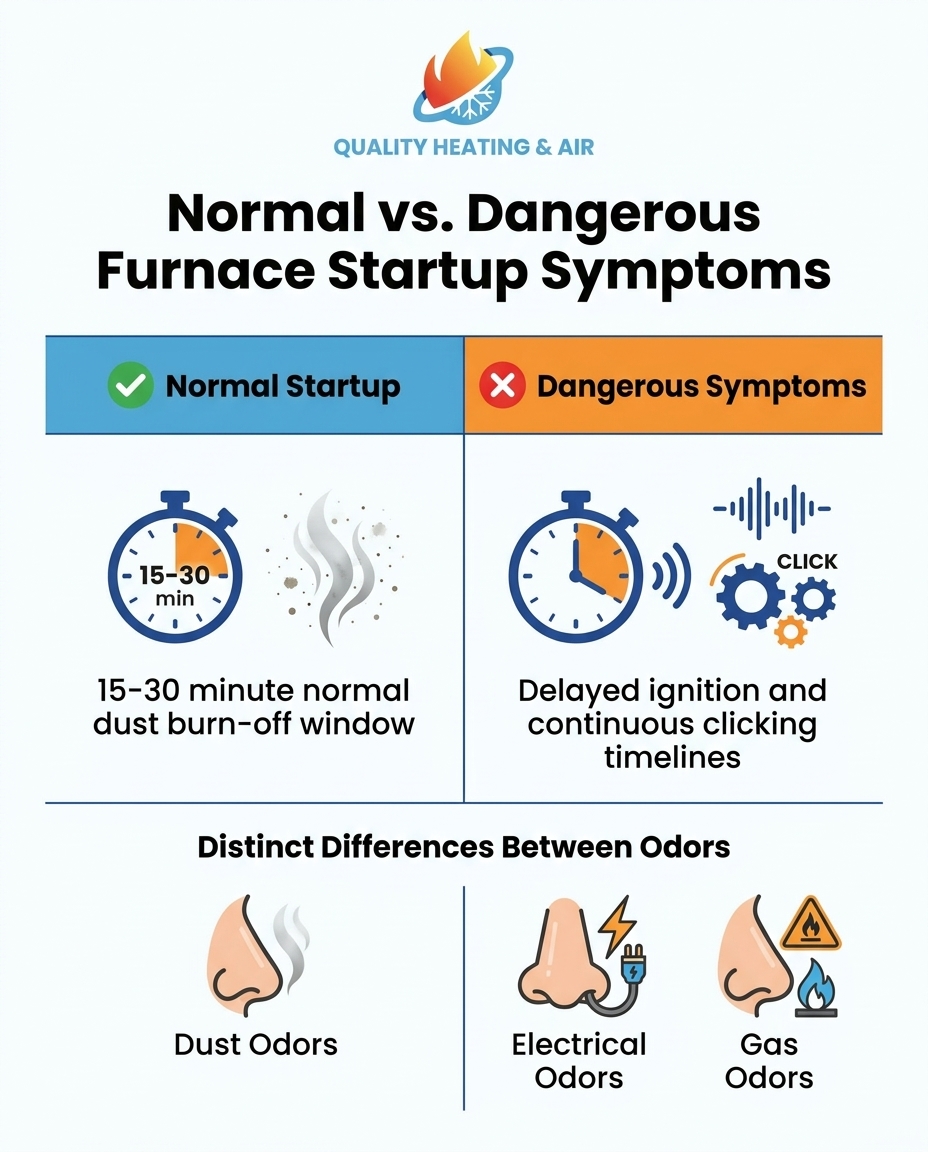
The key to diagnosing this smell is observing how long it lasts. The normal dust burn-off duration (15-30 minutes) is a strict timeline. During the first 15 minutes, the smell will be highly noticeable, often resembling the scent of a hot clothes iron or toasted dust. Opening a few windows to create cross-ventilation during this window is a highly effective way to manage the odor and maintain indoor air quality.
As the system approaches the 30-minute mark, the smell should noticeably dissipate. The heat exchanger has burned away the summer's accumulation, and the fresh air circulating through the home should clear the remaining odor. If the burning dust smell persists strongly beyond this 30-minute window, it indicates that the system is either overheating or pulling in new debris from a compromised filter or ductwork breach.
When Smells Mean Danger: Electrical and Gas Odors
While the normal dust burn-off duration (15-30 minutes) is expected, other odors are definitive red flags. Recognizing the difference between incinerated dust and a hazardous mechanical failure is the most important diagnostic skill a homeowner can develop during the fall season.
Identifying Electrical Component Failure
If the odor coming from your vents smells like melting plastic, hot metal, or ozone, you are likely dealing with an electrical failure. Over the summer, pests can infiltrate dormant HVAC cabinets and chew through wire insulation. When the system powers up, these exposed wires can arc, melting the surrounding plastic and creating a highly toxic smell. Additionally, a blower motor that is seizing up due to dried-out bearings will draw excessive electrical current, causing its internal wiring to overheat. An electrical burning smell will not dissipate after 30 minutes; it will grow stronger and more acrid the longer the system runs.
Gas Odors and Combustion Risks
The most dangerous odor you can encounter is the scent of rotten eggs. Natural gas is naturally odorless, but utility companies add a chemical called mercaptan to give it this distinct, foul smell. A rotten egg odor is never part of a normal startup. It indicates that gas is entering the combustion chamber but failing to ignite, or that there is a leak in the supply line itself. If you detect this odor, shut the system down at the thermostat immediately, open windows, leave the home, and contact a professional.
• Toasted / Burning Dust — Likely Cause: Incineration of summer debris on the heat exchanger. — Required Action: Monitor. Should fade within the normal dust burn-off duration (15-30 minutes).
• Melting Plastic / Ozone — Likely Cause: Overheating blower motor, frayed wiring, or failing capacitor. — Required Action: Shut down system immediately. Call for professional electrical diagnostics.
• Rotten Eggs (Mercaptan) — Likely Cause: Raw natural gas leak or complete ignition failure. — Required Action: Evacuate the area, avoid open flames, and call emergency services or a professional.
Mechanical Delays: Why Your Furnace Struggles to Ignite
Aside from unusual odors, the most common issue during the October heating startup is a system that simply refuses to light. You might hear a continuous clicking sound, or the system might spin up for a minute and then shut down completely. Understanding the mechanics behind delayed ignition helps explain why the system is struggling without encouraging dangerous DIY interventions.
The Ignition Sequence Explained
Modern furnaces operate on a strict, sequential safety protocol. When the thermostat calls for heat, the first component to activate is the draft inducer motor, which clears residual gases out of the heat exchanger. Next, a pressure switch verifies that the inducer is moving enough air. Once confirmed, the system sends power to the igniter (either a spark igniter or a hot surface igniter). Only after the igniter is glowing or sparking does the gas valve open to release fuel. Finally, a flame sensor must detect a successful fire within seconds, or it will immediately shut the gas valve down.
If your furnace sits dormant all summer, moisture and oxidation can build up on the delicate flame sensor. When the gas valve opens and the burners light, a dirty sensor fails to register the flame. The control board assumes the gas is pouring into the house unlit, and it slams the valve shut. This results in the system turning on, lighting briefly, and shutting down repeatedly.
Safety Lockouts and System Protection
If the ignition sequence fails three times in a row, the furnace control board will enter a "safety lockout" mode. This is a hard shutdown designed to prevent raw gas from pooling inside the combustion chamber and creating an explosive hazard. Continuous clicking usually means the spark igniter is firing, but the gas valve is refusing to open, or the board is locked out.
Mechanical delays aren't unique to heating systems; for example, one recent project involving an old house upgrade required installing a start assist for the air conditioner to overcome similar mechanical hesitation. Just as older cooling equipment can struggle to turn over after periods of inactivity, an aging furnace might experience delayed ignition during that critical fall startup. Repeatedly resetting the breaker to bypass a safety lockout is incredibly dangerous. If the system locks out, it is doing so to protect your home from a combustion hazard.
How Colorado's Climate and Altitude Impact Combustion
Environmental factors play a massive role in how a heating system operates, and local geography directly influences the severity of startup symptoms. Colorado's exceptionally dry climate creates a unique set of challenges for HVAC equipment. Throughout the summer, the lack of humidity allows particulate matter to remain airborne longer, leading to heavier dust accumulation inside the dormant furnace cabinet. Consequently, the normal dust burn-off duration (15-30 minutes) can produce a much more intense odor here than it might in a more humid coastal climate.
Beyond the dry air, altitude fundamentally changes the physics of combustion. In areas like Northglenn, sitting at approximately 5,300 feet above sea level, the air is significantly thinner. Because there is less oxygen per cubic foot of air, a furnace cannot burn the same volume of natural gas that it would at sea level. If a system is not properly calibrated—a process known as derating—the fuel-to-air mixture becomes too rich.
A rich fuel mixture causes the burners to produce excess soot, which coats the heat exchanger and reduces efficiency. More importantly, improper combustion at high altitude drastically increases the production of carbon monoxide. When a system sits unused all summer, minor misalignments in the burner assembly or partial blockages in the flue can exacerbate these altitude-related combustion issues. Ensuring your equipment is properly derated and calibrated is a central component of any reliable maintenance strategy.
Objective Safety Criteria: When to Call a Professional
The line between observing normal seasonal behaviors and requiring professional intervention must be clear. A successful October heating startup should involve a brief, manageable dust odor, a smooth ignition sequence, and steady, quiet airflow. When the system deviates from this baseline, professional diagnostics are required.
Here are the definitive red flags that mean you should shut off the system at the thermostat and call for help:
• Persistent Odors: Any burning smell that lasts longer than 30 minutes, or any smell resembling plastic, electrical wiring, or rotten eggs.
• Continuous Clicking: An igniter that clicks rapidly for more than a few seconds without a resulting flame indicates a failed component or gas delivery issue.
• Short Cycling: If the furnace runs for two or three minutes and shuts down before the house is warm, the system is overheating or failing a safety check.
• Loud Banging or Booming: A loud "boom" upon ignition means gas is pooling in the chamber before lighting, which can physically crack the heat exchanger over time.
Attempting DIY repairs on gas appliances or high-voltage electrical components is never recommended. The value of a professional evaluation lies in transparent diagnostics—educating you on exactly what has failed and why, rather than just pushing for a fast sale. Sometimes, a comprehensive diagnostic reveals that the most practical path forward is a full system replacement. In one recent case, a homeowner needed both their air conditioning and furnace replaced, and a transparent, family-owned approach to the evaluation ensured the new systems were successfully installed to meet their exact needs without unnecessary corporate upselling. Whether the solution is a simple sensor cleaning or upgrading to modern Ductless Mini Split Systems, objective data should always drive the decision.
FAQ
Why does my heater smell like burning when I turn it on for the first time?
The burning smell is caused by dust and debris that settled on the heat exchanger during the summer. When the furnace ignites for the first time in the fall, those components heat up rapidly and incinerate the accumulated particulate matter. This process pushes a toasted, burning dust odor through your ductwork and into your living spaces.
How long does the burning smell last when you turn on the heater?
A normal dust burn-off smell should dissipate within 15 to 30 minutes of continuous operation. During this time, opening a few windows can help ventilate the home and clear the odor faster. If the smell persists beyond 30 minutes or grows stronger, shut the system down, as it may indicate an overheating component or a dirty air filter.
When should I worry about my furnace making noise?
You should be concerned if you hear loud banging, continuous clicking, or high-pitched squealing. A loud boom upon startup indicates delayed ignition, where gas pools before lighting, which can damage the equipment. Continuous clicking usually means the igniter is failing to light the gas, while squealing points to a failing blower motor bearing.
Is it normal for a furnace to smell when first turned on?
Yes, a brief burning dust smell is a perfectly normal part of the initial seasonal startup. However, smells resembling melting plastic, electrical ozone, or rotten eggs are never normal. If you detect any of those hazardous odors, turn the system off immediately and seek professional diagnostics.
What should be on a fall home maintenance checklist?
A thorough fall checklist should prioritize the safe transition of your HVAC system from cooling to heating. This includes changing the air filter, clearing debris away from the indoor unit, and monitoring the first furnace cycle for unusual smells or delayed ignition. It is also the ideal time to test all carbon monoxide detectors in the home.
How does high altitude affect my furnace's performance?
High altitude environments have thinner air with less oxygen per cubic foot, which directly alters the combustion process. Furnaces installed at high elevations must be specifically calibrated, or derated, to reduce the gas input. Without this adjustment, the fuel-to-air mixture becomes too rich, leading to soot buildup and an increased risk of carbon monoxide production.
Ensuring a Safe Start to the Heating Season
Navigating the first heating cycle of the year doesn't have to be a source of stress. By understanding the normal dust burn-off duration and recognizing the signs of mechanical delays, you can confidently evaluate your system's performance. A clear, technical understanding of what is normal versus what requires immediate attention ensures your home stays safe and warm all winter long.

Testimonials
Neighbors trust Quality Heating & Air for honest work and fair pricing.
Service Areas