AC Repair Near Me & Heating Prep: A Northglenn Guide to October HVAC Startups
Navigating the Fall Climate Shift: From Cooling to Heating in Northglenn
Your air conditioner is finally resting after a long summer, but as you prepare for the October pre-winter heating startup, relying on proper home maintenance tips and troubleshooting is the best way to handle the strange burning smells or unsettling mechanical noises that often accompany a dormant furnace turning on for the first time. The transition from cooling to heating in Colorado brings a unique set of challenges to your home comfort system. You want your living space warm, but you also need to know if those lingering air conditioning quirks require immediate attention before the snow flies.
At Quality Heating & Air, our team frequently sees homeowners face a common dilemma during this brief seasonal window: they notice their cooling system was struggling during the final hot days of September, but they immediately shift their focus to the anxiety of turning on the furnace. Resolving any lingering air conditioning issues now is just as critical as ensuring your heating system is safe to operate. Ignoring a stressed AC component before winter means returning to a broken system the following spring.
Common fall transition anxieties include:
• Unfamiliar odors: Distinguishing between harmless settling dust and dangerous electrical burning.
• Unusual noises: Deciphering whether a click or a hum is a normal startup sequence or a failing component.
• Performance gaps: Wondering why a system that cooled perfectly in June suddenly struggles to heat in October.
Setting a strict safety-first boundary is essential during this shift. While observing a temporary quirk is part of homeownership, knowing when to call for professional HVAC services and AC repair and service is the safest way to ensure your entire system is ready for extreme weather. A licensed technician has the diagnostic tools to look beyond the surface symptoms and confirm that both your cooling and heating equipment are operating within safe, efficient parameters.
End-of-Season AC Care: Addressing Lingering Cooling Wear
In our years of serving Northglenn, CO, we've seen firsthand how the intense summer heatwaves put immense mechanical and electrical strain on your cooling components. When the ambient temperature climbs, your air conditioner works overtime to extract heat from your home, pushing capacitors, fan motors, and compressors to their operational limits. By the time fall arrives, these components are often heavily worn, even if the system is still technically producing cold air.
Ignoring minor cooling issues in the fall sets the stage for catastrophic failures or expensive emergency calls the following spring. When a stressed component is left to sit idle for six months, the degradation does not pause. Professional evaluation by our team before the system is shut down for winter ensures that small, manageable wear patterns are addressed immediately.
Key cooling components requiring fall evaluation:
• Dual run capacitors: These store the electrical charge needed to start your compressor and fan motors. Heat degrades their ability to hold a charge, and a weakened capacitor will eventually cause the compressor to stall.
• Refrigerant levels: A system that ran low on refrigerant during the summer will continue to leak over the winter, potentially causing the compressor to burn out when you start it next year.
• Condenser coils: Summer storms and high winds pack the outdoor fins with dirt, cottonwood, and debris, which restricts airflow and forces the system to work harder than necessary.
Taking a comprehensive approach to your home comfort means prioritizing routine AC maintenance and service even when the cooling season is ending. This proactive strategy ensures long-term reliability for your entire HVAC infrastructure.
The Risks of Dormant Equipment
When unresolved electrical or mechanical stress is ignored, it worsens during months of inactivity. Moisture can accumulate in compromised electrical connections, leading to corrosion. Bearings in a failing blower motor can seize entirely after sitting stationary. Furthermore, clearing debris from outdoor condenser units before winter snow arrives is critical; trapped organic matter holds moisture against the metal casing, accelerating rust and restricting the vital airflow the system will need on the first hot day of the new year.
The Burning Dust Phenomenon: Normal Startup or Safety Hazard?
One of the most frequent calls we field at Quality Heating & Air during the October pre-winter heating startup is about the sudden, alarming smell of burning that floods the house the moment the thermostat clicks to "heat." Understanding the science behind this phenomenon is the first step in protecting your home and identifying true hazards.
The Problem: You turn on your furnace for the first time in months, and within minutes, the air smells like something is actively on fire inside your ductwork.
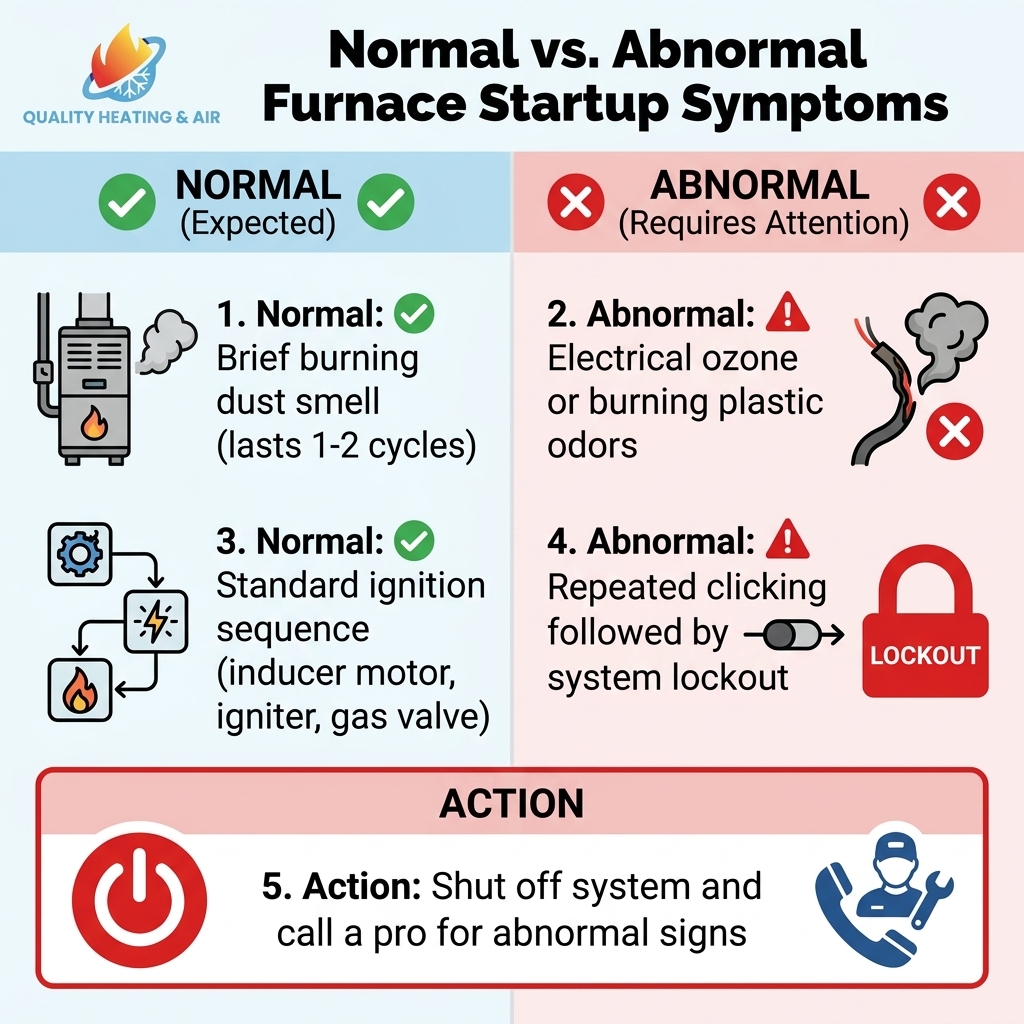
The Cause: Throughout the summer, your furnace sits idle. Northglenn's notoriously dry summer climate significantly exacerbates dust accumulation in your ductwork and directly on the furnace heat exchanger. When the burners ignite for the first time, the metal heat exchanger reaches extremely high temperatures. The accumulated layer of household dust, pet dander, and microscopic debris instantly carbonizes and burns off, sending that distinct odor through your vents.
The Solution: Establish a strict time boundary. The normal burning dust smell should dissipate entirely within the first one to two heating cycles (typically 30 to 60 minutes of operation). If you open a few windows to ventilate the space, the odor should fade quickly and not return.
However, you must be able to contrast normal dust burn-off with hazardous odors that require immediate system shutdown. The National Fire Protection Association (NFPA) cites heating equipment as a leading cause of home fires, underlining the absolute importance of taking unusual odors seriously.
• Normal Dust Burn-Off — Odor Profile: Dry, dusty, similar to a hot clothes iron — Required Action: Monitor for 1-2 cycles; ventilate home
• Electrical Failure — Odor Profile: Sharp ozone, melting plastic, fishy smell — Required Action: Shut down immediately at thermostat and breaker; call a pro
• Combustion Issue — Odor Profile: Rotten eggs (sulfur), heavy exhaust fumes — Required Action: Evacuate home, call gas utility, contact HVAC technician
High-Altitude Heating: Combustion Challenges in Colorado
Heating a home in Northglenn requires localized, authoritative knowledge because the environment directly impacts how mechanical systems operate. The physics of high-altitude combustion play a major role in furnace performance. At elevations of 5,000 feet and above, the air is significantly thinner, meaning there is less oxygen per cubic foot than at sea level.
Modern gas furnaces rely on a highly specific gas-to-air ratio to achieve safe, efficient combustion. When a furnace is manufactured, its factory settings are typically calibrated for sea-level operation. If a furnace is installed in Colorado without precise, professional calibration, the lack of oxygen creates a "rich" fuel mixture. This imbalance leads to delayed ignition, excessive soot buildup inside the heat exchanger, and significantly reduced energy efficiency.
The dangers of improper combustion go far beyond a poorly performing heater. When gas does not burn cleanly, it produces higher levels of carbon monoxide. If the heat exchanger becomes compromised by soot and stress, this deadly, odorless gas can enter your living space. Our professional technicians at Quality Heating & Air adjust the gas manifold pressure and verify the burner orifices to match the specific altitude of your home, ensuring the flame burns crisp and blue rather than lazy and yellow.
Furnace Ignition Lockouts: When Clicking Means Danger
Another common symptom we encounter during the October pre-winter heating startup is hearing the furnace turn on, followed by a series of rapid clicking noises, only for the system to fall silent without producing any heat. This is a classic sign of an ignition failure.
Modern gas furnaces are equipped with a sophisticated safety lockout feature. This is not a glitch; it is a critical protective measure designed to prevent hazardous gas buildup. The furnace follows a strict sequence of operations: the inducer draft motor clears the heat exchanger, the pressure switch verifies proper venting, the igniter glows or sparks, and finally, the gas valve opens. A flame sensor then has just seconds to detect a fire. If it does not sense a flame, the system shuts the gas valve immediately. After three to five consecutive failed attempts, the furnace goes into a hard lockout and shuts down entirely.
Common culprits for this sequence failure include dirty flame sensors covered in carbon buildup, faulty silicon carbide igniters that have cracked over time, or failing gas valves that refuse to open. Because these components handle raw natural gas and high-voltage electricity, we issue a strict warning against DIY troubleshooting. Bypassing a safety switch or attempting to clean delicate sensors without proper training puts your home at severe risk.
Why Resetting Isn't a Solution
When a furnace goes into lockout, many homeowners try to bypass the issue by constantly flipping the breaker to reset the system. This is a dangerous practice. The mechanical reasons for the lockout have not been resolved, meaning you are repeatedly dumping unburned gas into the combustion chamber or forcing a failing electrical component to surge. Constantly resetting a locked-out furnace can damage the control board and exacerbate the underlying issue. When the system locks you out, that is the definitive signal to stop troubleshooting and call a licensed professional.
Evaluating Local HVAC Expertise: Transparency Over Tactics
Whether you are dealing with a struggling air conditioner or a furnace that refuses to ignite, choosing a reliable contractor in Northglenn, CO, requires knowing what a proper diagnostic visit looks like. You should expect a thorough inspection, clear explanations of the mechanical failures, and absolutely no high-pressure tactics.
Large corporate entities often rely on aggressive sales strategies, pushing for immediate, full-system replacements without fully explaining the root cause of the failure. In contrast, working with our team at Quality Heating & Air—driven by family-owned values and transparent diagnostics—ensures you receive an honest evaluation. A knowledgeable technician will clearly explain the compatibility and condition of both your heating and cooling systems, showing you exactly what the diagnostic tools are reading.
For example, we recently helped a local homeowner who needed an AC installation after receiving multiple quotes. After reviewing our competitive bid, where our team clearly explained the technical differences from other offers, the system was installed on time with transparent communication throughout the entire process. This level of honesty provides the peace of mind that comes from partnering with a locally owned company that prioritizes long-term community relationships over quick sales.
Proactive Protection: The Value of Dual-System Evaluations
The fall transition is the ideal time to evaluate your entire home comfort infrastructure. Having both the AC and furnace evaluated simultaneously during the October pre-winter heating startup provides a complete picture of your home's mechanical health. This proactive approach allows our technicians to identify overlapping issues, such as a failing blower motor that struggles to push both warm and cool air through your ductwork.
Proactive upgrades can optimize your home comfort and extend the lifespan of your equipment. A pattern we see often is older systems struggling as the weather shifts. Recently, our team helped a homeowner in an older house who faced simultaneous AC and furnace issues during the fall transition. One of our technicians quickly responded, installing a start assist for the aging AC unit to ease the electrical load on the compressor, while also fitting a new furnace. Addressing both systems at once established long-term operational stability and trust.
Enrolling in a structured HVAC maintenance plan offers significant financial and operational benefits, ensuring that your equipment receives consistent, professional oversight year after year. Additionally, taking advantage of current HVAC promotions—and exploring whether generic utility incentives or federal tax credits may apply to qualifying high-efficiency installations—makes comprehensive, dual-system care more accessible. Ultimately, a clear, definitive explanation of normal versus abnormal startup behaviors, combined with professional maintenance, is the best way to keep your home safe and comfortable all winter long.
Frequently Asked Questions
Why does my heater smell like burning when I turn it on for the first time?
This odor is typically caused by the combustion of dust and debris that has settled on your furnace's heat exchanger during the summer months. When the metal heats up for the first time in autumn, this layer of dust carbonizes and burns off. It is a normal seasonal occurrence that our technicians see in almost every home. However, if the smell resembles melting plastic or electrical ozone, shut the system down immediately.
How long should a furnace smell like burning dust?
The standard burning dust smell should dissipate within the first one to two heating cycles, which usually takes about 30 to 60 minutes of operation. Opening a few windows to ventilate the house can help clear the odor faster. If the smell persists beyond a few hours or returns on subsequent days, it is time to call a professional technician to investigate.
Why is my furnace clicking but not igniting?
A clicking noise usually indicates that the furnace is trying to ignite the gas, but a component in the sequence has failed. This is often caused by a dirty flame sensor, a cracked igniter, or a gas valve that is not opening properly. When the system fails to detect a safe flame, it automatically shuts down the ignition process to prevent hazardous gas from accumulating in your home.
When should I call a professional for furnace troubleshooting?
You should call a professional immediately if your furnace enters a safety lockout, produces unusual smells like sulfur or melting plastic, or makes loud grinding noises. Additionally, if you have repeatedly tried to reset the system without success, stop immediately. DIY repairs on gas and high-voltage electrical components are dangerous and require a licensed expert.
Does my air conditioner need maintenance before winter?
Yes, evaluating your air conditioner before winter ensures that minor wear and tear from the summer heat does not turn into a major failure while the system sits dormant. A professional will check the refrigerant levels, test the dual run capacitors, and ensure the condenser coils are clear of debris. Addressing these issues in the fall guarantees your AC will be ready to perform reliably next spring.
How does Colorado's altitude affect my gas furnace?
At high altitudes, the thinner air contains less oxygen, which directly impacts the gas-to-air combustion ratio required for your furnace to burn fuel safely and efficiently. Factory settings are typically calibrated for sea level, meaning a furnace installed in Colorado requires professional adjustment. Proper calibration prevents delayed ignition, soot buildup, and the dangerous production of carbon monoxide.

Testimonials
Neighbors trust Quality Heating & Air for honest work and fair pricing.
Service Areas